
[論文レビュー] A Survey of Optimization-based Task and Motion Planning: From Classical To Learning Approaches
本調査は、古典的ハイブリッド最適化手法と現代の学習ベースのアプローチを統合する最適化に基づくタスク・アーム・プランニング(TAMP)の包括的レビューを提示する。複雑で接触を伴う歩行および操作タスクを解消するための階層的および分散型のアルゴリズム的構造を強調しつつ、大規模言語モデル(LLM)と軌道最適化の協調的連携により、長時間スパンで動的かつダイナミックなロボット行動を実現する。
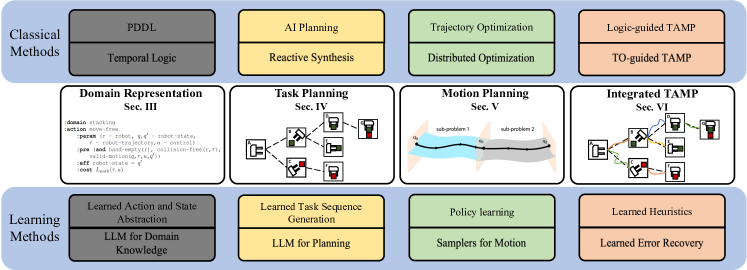
Task and Motion Planning (TAMP) integrates high-level task planning and low-level motion planning to equip robots with the autonomy to effectively reason over long-horizon, dynamic tasks. Optimization-based TAMP focuses on hybrid optimization approaches that define goal conditions via objective functions and are capable of handling open-ended goals, robotic dynamics, and physical interaction between the robot and the environment. Therefore, optimization-based TAMP is particularly suited to solve highly complex, contact-rich locomotion and manipulation problems. This survey provides a comprehensive review on optimization-based TAMP, covering (i) planning domain representations, including action description languages and temporal logic, (ii) individual solution strategies for components of TAMP, including AI planning and trajectory optimization (TO), and (iii) the dynamic interplay between logic-based task planning and model-based TO. A particular focus of this survey is to highlight the algorithm structures to efficiently solve TAMP, especially hierarchical and distributed approaches. Additionally, the survey emphasizes the synergy between the classical methods and contemporary learning-based innovations such as large language models. Furthermore, the future research directions for TAMP is discussed in this survey, highlighting both algorithmic and application-specific challenges.
研究の動機と目的
- 記号的タスクプランニングと連続的軌道最適化を統合する最適化ベースTAMPフレームワークの体系的レビューを提供すること。
- 複雑で動的なロボットタスクを扱う際の論理的タスクプランニングとモデルベース軌道最適化の相互作用を分析すること。
- 特に階層的および分散型の手法を含むアルゴリズム的進歩が、長時間スパンの計画におけるスケーラビリティと効率性を向上させる仕組みを同定すること。
- 学習ベースの手法(大規模言語モデルや強化学習を含む)と古典的最適化ベースTAMPの統合を検討すること。
- 実世界への展開に向けたTAMPの未解決課題と今後の研究方向性を特定すること、特に歩行、操作、人間-ロボット協働の分野において。
提案手法
- 離散的記号的プランニングと連続的軌道最適化を組み合わせたハイブリッド最適化問題としてTAMPを定式化し、目的関数を用いて計画の質を表現する。
- アクション記述言語と時相論理を用いて高水準のタスク表現を実現し、複雑な目的や制約の形式的定式化を可能にする。
- モデルベースの軌道最適化(TO)を統合し、ロボットの動的特性を表現することで、接触を伴う環境でも自然で効率的かつダイナミックな運動を実現する。
- 階層的および分散型最適化戦略を適用し、タスクレベルの組み合わせ的複雑性と運動レベルの数値的複雑性を分離する。
- 大規模言語モデル(LLM)とビジョン・言語モデル(VLM)をTAMPと統合し、タスク理解と指示の接地性を向上させる。
- 強化学習に基づくポリシー学習を用いてエンドツーエンドのスキル習得を実現し、一般化を促進する観察および行動表現の設計に重点を置く。
実験結果
リサーチクエスチョン
- RQ1最適化ベースTAMPは、長時間スパンで動的かつ複雑なタスクにおいて、計算効率と計画の包括性の両立をどのように達成できるか?
- RQ2スケーラブルかつ効率的なTAMPを実現するための主要なアルゴリズム的構造(例えば階層的・分散型アプローチ)は何か?
- RQ3大規模言語モデルはTAMPにおけるタスクプランニングと指示の接地性をどのように向上させることができるか。また、空間的・時間的推論における現在の限界は何か?
- RQ4強化学習を最適化ベースTAMPとどのように統合することで、ポリシーの一般化性と現実世界への転送性を向上させられるか?
- RQ5特に器用な手を備えたヒューマノイドロボットや動的接触を伴う状況において、歩行と操作の計画統合に直面する課題は何か?
主な発見
- 接触を伴う操作や動的歩行において、特に開けた目的や複雑な目的関数を扱う際、最適化ベースTAMPは制約ベースやサンプリングベースの手法を上回る性能を示す。
- 階層的および分散型最適化フレームワークは、タスク計画と運動計画の分離により計算複雑性を顕著に低減し、長時間スパンのタスクに対してスケーラブルな解決策を可能にする。
- 大規模言語モデルの統合により高水準のタスク理解と指示の解析が向上するが、空間的推論能力と短期記憶の限界が、順次的で多段階のタスクにおけるロバストネスを損なう要因となっている。
- 観察および行動表現を注意深く設計した強化学習はポリシーの一般化性を向上させるが、サンプル非効率性とシミュレーションから現実への転送性が依然として主な課題である。
- ロボット中心の歩行計画とオブジェクト中心の操作計画における接触頻度や表現の違いにより、歩行・操作統合TAMPは依然として困難な課題のままである。
- 人間-ロボット協働におけるTAMPは、意図予測、運動モデリング、マルチモーダルコミュニケーション(例:言語と物理的相互作用)を通じて進展しているが、効率的かつロバストな統合は未解決の問題のままである。
この論文を読む
Nubintのビューアで原文を開き、読みながら気になる箇所をすぐに質問できます。
Nubintでこの論文を読むこのレビューはAIが論文の原文をもとに作成しました。引用する前に原文をご確認ください。