
[論文レビュー] A tutorial on networks in social systems: A mathematical modeling perspective
このチュートリアルは、社会的ネットワークをモデル化するための基礎的な数学的枠組みを提供し、グラフ表現、ネットワーク特性(例:クラスタリング、次数分布)、生成モデル(例:Erdős–Rényi、優先接続、Watts–Strogatz)といった重要な概念を紹介する。これらのモデルが現実の社会的ネットワークに見られる一般的な構造的パターン(例:スモールワールド特性、コミュニティ構造)をどのように説明するかを示している。
This article serves as an introduction to the study of networks of social systems. First, we introduce the reader to key mathematical tools to study social networks, including mathematical representations of networks and essential terminology. We describe several network properties of interest and techniques for measuring these properties. We also discuss some popular generative models of networks and see how the study of these models provides insight into the mechanisms for the emergence of structural patterns. Throughout, we will highlight the patterns that commonly emerge in social networks. The goal is to provide an accessible, broad, and solid foundation for a reader who is new to the field so that they may confidently engage more deeply with the mathematical study of social networks.
研究の動機と目的
- 社会的ネットワーク解析に初めて取り組む研究者に、ネットワーク表現および用語の数学的根拠に基づく基礎を提供すること。
- 社会的システムに頻繁に現れるコアなネットワーク特性(例:次数分布、クラスタリング、経路長)を説明すること。
- 生成ネットワークモデル(例:G(n,p)、優先接続、ストークスティックブロックモデル)が、観察された構造的パターンの出現をどのように説明するかを示すこと。
- 数学的アプローチによる社会的ネットワークの研究を深めるために、主要なツール、リソース、および未解決の問題を示唆すること。
提案手法
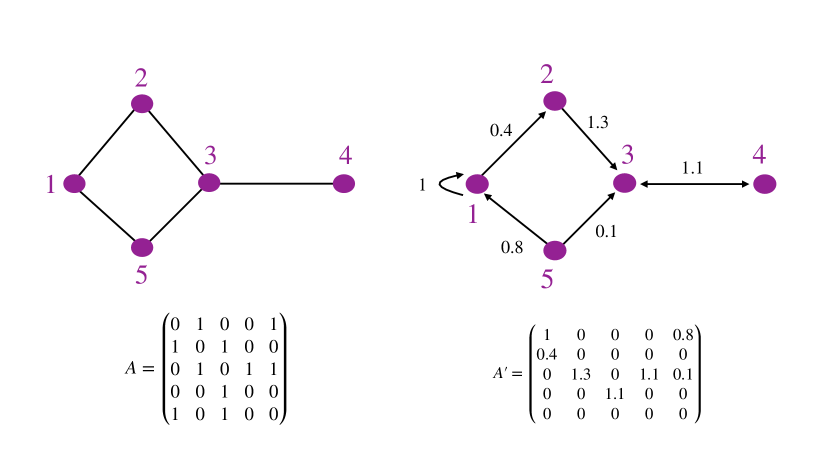
- 社会的ネットワークを、ノードの集合 V とエッジの集合 E からなる無向または有向グラフ G = (V, E) として表現する。
- 隣接行列を用いてネットワーク構造を符号化し、重みなしグラフではバイナリ値、重み付きエッジでは重み付き値を用いる。
- 数学的ツールを用いてネットワーク特性を測定する:次数分布、クラスタリング係数、最短経路長、モジュラリティ。
- ランダムネットワークのための生成モデル(G(n,p) および G(n,m))と、スケールフリーネットワークを生成するための優先接続モデルを用いる。
- Watts–Strogatz モデルを用いて、高いクラスタリングと短い平均経路長を持つネットワークを生成し、スモールワールド現象を模倣する。
- ノードグループ間の接続確率を異なる値に設定することで、コミュニティ構造を持つネットワークを生成するための確率的ブロックモデルを用いる。
実験結果
リサーチクエスチョン
- RQ1社会的ネットワークをモデリングおよび分析するためには、どのような数学的ツールが不可欠か?
- RQ2現実の社会的ネットワークに頻繁に観察される構造的特性(例:クラスタリング、次数分布、スモールワールド特性)は何か?
- RQ3生成ネットワークモデルが、べき則次数分布やコミュニティ構造といった観察された構造的パターンの出現をどのように説明するか?
- RQ4社会的システムにおける高いクラスタリングと短い経路長といったネットワーク特徴の背後にあるメカニズムは何か?
- RQ5ネットワークの数学的モデリングが、情報の拡散や意思決定といった動的プロセスの研究にどのように寄与できるか?
主な発見
- 現実の社会的ネットワークは、しばしば高いクラスタリングと短い平均経路長を示し、この組み合わせはスモールワールド特性として知られている。
- 多くの社会的ネットワークはべき則次数分布を示すが、これは生成モデルにおける優先接続メカニズムによって説明可能である。
- Watts–Strogatz モデルは、エッジを低い確率で再接続することで、高いクラスタリングと短い平均経路長を持つネットワークを効果的に生成する。
- 確率的ブロックモデルは、ノードグループ間の接続確率を異なる値に設定することで、コミュニティ構造を効果的に再現できる。
- 構成モデルを用いることで、指定された次数列を持つネットワークを生成でき、実データと比較することが可能になる。
- 優先接続や構成モデルといった生成モデルは、社会的ネットワークにおける構造的パターンを駆動するメカニズムについての理論的洞察を提供する。
この論文を読む
Nubintのビューアで原文を開き、読みながら気になる箇所をすぐに質問できます。
Nubintでこの論文を読むこのレビューはAIが論文の原文をもとに作成しました。引用する前に原文をご確認ください。