
[論文レビュー] Category-Level Multi-Part Multi-Joint 3D Shape Assembly
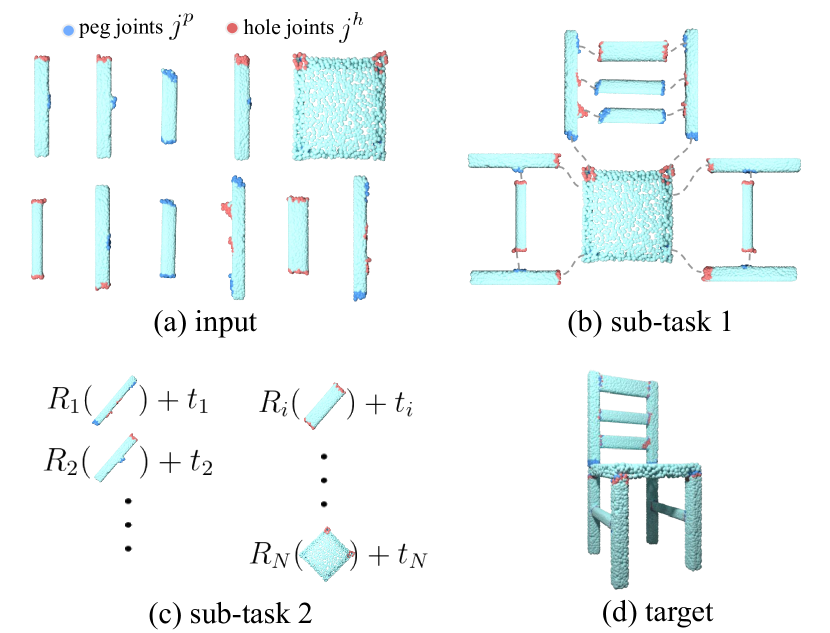
本論文は、形状構造とジョイントアライメントを共同最適化する階層的グラフ学習フレームワークを提案し、カテゴリーレベルのマルチパーツ・マルチジョイント3D形状アセンブリを実現する。2段階のグラフネットワーク(パーツレベルで構造的推論、ジョイントレベルでマッチング)と反復的な粗〜細かいリファインメントを組み合わせることで、形状構造の忠実度およびジョイントアライメント精度の両面で最先端の性能を達成し、72.81%のパーツ正確度および57.18%のジョイント正確度を含むベンチマーク指標において、先行手法を上回る結果を得た。
Shape assembly composes complex shapes geometries by arranging simple part geometries and has wide applications in autonomous robotic assembly and CAD modeling. Existing works focus on geometry reasoning and neglect the actual physical assembly process of matching and fitting joints, which are the contact surfaces connecting different parts. In this paper, we consider contacting joints for the task of multi-part assembly. A successful joint-optimized assembly needs to satisfy the bilateral objectives of shape structure and joint alignment. We propose a hierarchical graph learning approach composed of two levels of graph representation learning. The part graph takes part geometries as input to build the desired shape structure. The joint-level graph uses part joints information and focuses on matching and aligning joints. The two kinds of information are combined to achieve the bilateral objectives. Extensive experiments demonstrate that our method outperforms previous methods, achieving better shape structure and higher joint alignment accuracy.
研究の動機と目的
- 既存の形状アセンブリ手法が物理的ジョイントマッチングを無視し、対称性に起因するポーズ誤差を抱えるという限界を是正すること。
- マルチパーツ・マルチジョイント3Dアセンブリタスクを、形状構造とジョイントアライメントのバランスを取る最適化問題として定式化すること。
- 離散的ジョイントマッチングと連続的ポーズ最適化を分離・統合する、新規のエンドツーエンドのグラフベースフレームワークを構築すること。
- 反復的アセンブリにおける誤差の蓄積を軽減するため、粗〜細かい段階的で複数反復のグラフ学習スキームを採用すること。
- カテゴリーレベルのマルチパーツ3D形状アセンブリを対象とした、ジョイントアノテーション付きデータセットと評価指標を確立すること。
提案手法
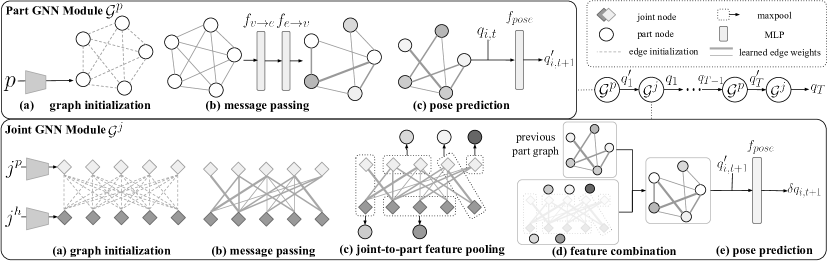
- 本手法は、2つの異なるグラフレベルを持つ階層的グラフネットワークを採用する:パーツグラフは包括的な形状構造学習を、ジョイントグラフはピッグ・ホールジョイントのマッチングとアライメントを担当する。
- ジョイント特徴をパーツごとに埋め込み・集約し、ジョイント中心のパーツ特徴を形成した後、それらをパーツグラフ特徴と統合してポーズ予測をガイドする。
- 粗〜細かい反復的リファインメントプロセスにより、パーツグラフとジョイントグラフの畳み込みを交互に実行し、ポーズ予測の順次是正とジョイントマッチングの向上を図る。
- 損失関数内でハンガリアンマッチングアルゴリズムを用いることで、順列不変性を維持し、幾何的アライメントとジョイントアライメントの目的関数を同期化する。
- ジョイント埋め込みを明示的に学習させることで、ポーズ編集に強い明示的信号を提供し、アライメント正確度を向上させる。
- 形状のカームファーディスタンス、パーツ正確度、ジョイントカームファーディスタンスを組み合わせたマルチ目的損失を用いて、エンドツーエンドでモデルを訓練する。
実験結果
リサーチクエスチョン
- RQ1ジョイント最適化を施した3D形状アセンブリ手法は、マルチパーツ・マルチジョイント環境下で、高い構造的忠実度と正確なジョイントアライメントを同時に達成できるか?
- RQ2分離されたパーツおよびジョイント表現を有する階層的グラフ学習は、統合された幾何学的特徴のみを用いるアプローチと比較して、どの程度性能向上をもたらすか?
- RQ3粗〜細かい反復的リファインメントスキームは、マルチパーツアセンブリにおける誤差蓄積をどの程度軽減できるか?
- RQ4ジョイント埋め込みとマッチングに配慮した損失関数は、ジョイントアライメント正確度にどの程度寄与するか?
- RQ5最初のパーツグラフイテレーションから得られる形状構造ヒューリスティックは、ジョイントマッチング性能にどのような影響を及えるか?
主な発見
- 提案手法は、チェアカテゴリにおいて72.81%のパーツ正確度および57.18%のジョイント正確度を達成し、先行手法を顕著に上回った。
- アブレーションスタディの結果、最初のパーツグラフイテレーションを削除するとパーツ正確度が23.71%に低下し、形状構造ヒューリスティックとしての役割が裏付けられた。
- ジョイント埋め込みを排除すると、パーツ正確度は33.36%に低下し、ジョイント正確度は21.4%低下し、ポーズ最適化におけるその重要性が明確になった。
- 損失関数内でのハンガリアンマッチングアルゴリズムの削除により、性能が急激に低下し、ジョイント正確度は37.50%にまで低下した。これは損失目的関数の不整合が原因である。
- 粗〜細かい反復的スキームは誤差伝搬を効果的に軽減し、中間段階で構造的忠実度およびジョイントアライメント両方の改善が段階的に観察された。
- 完全なモデルは、形状カームファーディスタンス(SCD)0.006およびジョイントカームファーディスタンス(JCD)0.352を達成し、高い構造的およびジョイント忠実度を示した。
この論文を読む
Nubintのビューアで原文を開き、読みながら気になる箇所をすぐに質問できます。
Nubintでこの論文を読むこのレビューはAIが論文の原文をもとに作成しました。引用する前に原文をご確認ください。