
[論文レビュー] Chirality-Induced Magnetization of Magnetite by an RNA Precursor
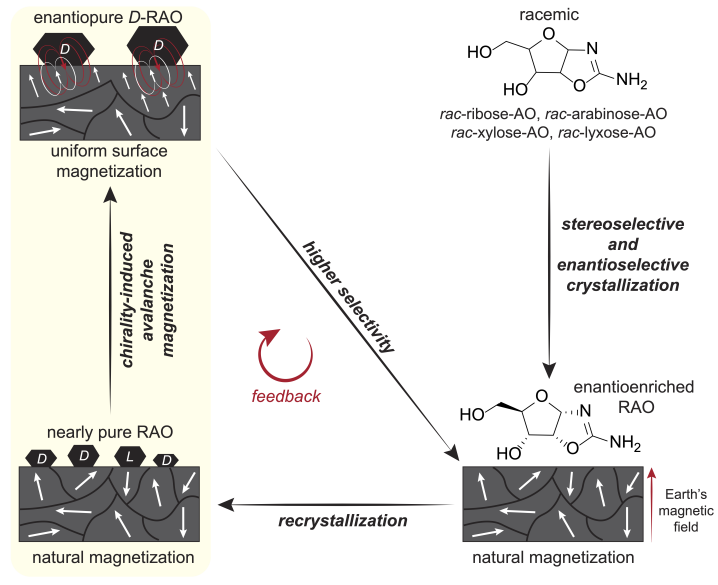
本論文は、RNA前駆体であるキラルなリボースアミノオキサゾリン(RAO)が、キラル誘起スピン選択性(CISS)効果を介してマグネトイト(Fe₃O₄)表面にアvalanche的磁化を誘発することを提案している。キラル分子は局所的に磁化スピンを整列させ、協同的で長距離にわたる磁化カスケードを引き起こし、弱い自然残留磁化を増幅することで、磁性鉱物上での持続的でスピン選択的化学反応を前生物的に妥当なメカニズムとして提供する。
Life is homochiral and homochirality is a fundamental feature of living systems on Earth. While the exact mechanism that led to homochirality is still not fully understood, any realistic scenario on the origins of life needs to address the emergence of homochirality. In order to impose and maintain chirality in a prebiotic network, an environmental factor functioning as a chiral agent is demanded. Magnetized surfaces are prebiotically plausible chiral agents, shown to be effective in enantioseparation of ribose-aminooxazoline (RAO), a ribonucleic acid (RNA) precursor, due to the chiral-induced spin selectivity (CISS) effect. As such, mechanisms for breaking the magnetic symmetry of magnetic minerals are of the utmost importance. Here we report the avalanche magnetization of magnetite $(Fe_{3}O_{4})$ by the crystallization of enantiopure RAO. The observed breaking of the magnetic symmetry is induced by the chiral molecules due to the CISS effect and spreads out across the magnetic surface like an avalanche, providing a way to uniformly magnetize a magnetic surface without fully covering it. Considered together with our previous results on enantioseparation by crystallization on a magnetic surface, chirality-induced avalanche magnetization paves the way for a cooperative feedback between chiral molecules and magnetic surfaces. With this feedback, a weak natural bias in the net magnetization can be amplified and spin-selective processes can be accommodated on magnetic minerals on a persistent basis.
研究の動機と目的
- キラル分子が前生物的磁性鉱物(例:マグネトイト)の磁気的対称性をどのように破るかを調査すること。
- リボースアミノオキサゾリン(RAO)などのキラル分子が、マグネトイト表面に磁化を誘発・増幅できるかどうかを検討すること。
- キラル分子と磁性表面の間で、ヘモキラリティに不可欠なスピン選択的プロセスを維持するフィードバック機構を確立すること。
- CISS効果が、完全な表面被覆がなくても、磁性表面全体にわたる協同的・長距離磁化拡散を駆動できることを示すこと。
- 弱い自然磁化バイアスを、持続的かつ方向性のある磁化に増幅する前生物的に妥当な経路を提供すること。
提案手法
- 前生物的条件下でエナンチオマー純度の高いリボースアミノオキサゾリン(RAO)を合成し、マグネトイト(Fe₃O₄)表面に結晶化させた。
- 表面磁化の変化を検出・マップするために、磁気光学カー効果(MOKE)測定を実施した。
- 試料の網状磁化および磁化履歴を定量するために、超伝導量子干渉計(SQUID)磁化計測を実施した。
- 表面のトポグラフィーを画像化し、分子結晶化と局所的磁化ドメイン構造を相関させるために、磁気力顕微鏡(mc-AFM)を用いた。
- RAOのエナンチオマー純度とそのキラル表面相互作用を確認するために、円二色性(CD)分光法を用いた。
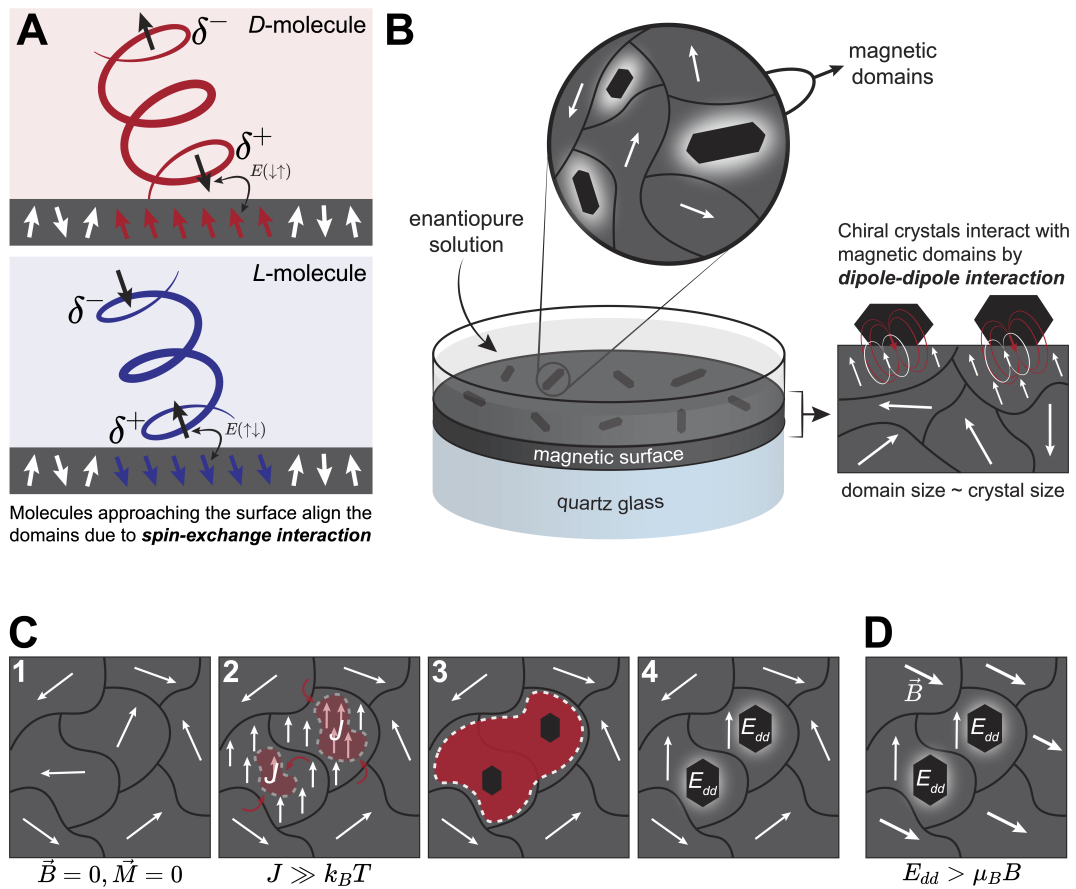
- キラル分子-スピン交換相互作用($J_c$)を組み込んだ2次元イジング型ハミルトニアンを用いてモデル化し、キラル分子が有効磁場を生成することで集団的スピン整列およびアバランチ的磁化を駆動することを示した。
実験結果
リサーチクエスチョン
- RQ1RAOのようなキラル分子がCISS効果を介して、マグネトイト表面に長距離的・協同的磁化を誘発できるか?
- RQ2キラルなRAO結晶の存在が、表面被覆が完全でない場合でも、測定可能な方向性を持つ網状磁化を引き起こすか?
- RQ3自生的マグネトイトの弱い自然残留磁化が、キラル分子誘起スピン整列によって増幅可能か?
- RQ4CISS効果が、キラル分子と磁性表面の間の相互作用を媒介し、集団的磁気的秩序を駆動する役割を果たすか?
- RQ5温度が、磁性ドメイン内でのキラル誘起磁化拡散の効率および範囲にどのように影響するか?
主な発見
- エナンチオマー純度の高いRAOがマグネトイト表面に結晶化することで、表面に散在している場合でさえも、測定可能な方向性を持つ網状磁化が誘発された。
- 磁化はアバランチ的に表面に広がり、キラル分子-表面相互作用によって駆動される協同的・長距離スピン整列プロセスを示している。
- MOKEおよびSQUID測定により、誘発された磁化が持続的であり、履歴を示すことが確認され、安定な磁化ドメイン形成が示された。
- スピン交換相互作用($J_c$)を介してキラル分子が生成する有効磁場は強く、短距離的(約0.01–1 eV)であり、表面全体にわたる集団的スピン再配列を誘発するのに十分であった。
- 2次元イジングモデル近似において、系は2次相転移に類似した挙動を示し、低温でスピン相関が強化されることにより、磁化の広がりが著しく増幅された。
- 観察された磁化の方向はRAOの分子ヘリシティに従って決定されており、磁気的秩序に対するキラル制御機構の存在を確認した。
この論文を読む
Nubintのビューアで原文を開き、読みながら気になる箇所をすぐに質問できます。
Nubintでこの論文を読むこのレビューはAIが論文の原文をもとに作成しました。引用する前に原文をご確認ください。