
[論文レビュー] Defining eccentricity for gravitational wave astronomy
本論文は、重力波信号から直接導出されたゲージ不変で波形に基づく離心率($e_{\text{gw}}$)および平均近点角($l_{\text{gw}}$)の定義を提案し、多様なモデルやシミュレーション間での一貫性のある比較を可能にする。この手法は、オープンソースのPythonパッケージ *gw_eccentricity* に実装されており、後ニュートン近似、有効1体理論、極端質量比、数値相対論的波形において、$10^{-5}$ から 0.999 の離心率範囲で正確な離心率測定を達成し、その頑健性が確認されている。
Eccentric compact binary mergers are significant scientific targets for current and future gravitational wave observatories. To detect and analyze eccentric signals, there is an increasing effort to develop waveform models, numerical relativity simulations, and parameter estimation frameworks for eccentric binaries. Unfortunately, current models and simulations use different internal parameterisations of eccentricity in the absence of a unique natural definition of eccentricity in general relativity, which can result in incompatible eccentricity measurements. In this paper, we adopt a standardized definition of eccentricity and mean anomaly based solely on waveform quantities, and make our implementation publicly available through an easy-to-use Python package, gw_eccentricity. This definition is free of gauge ambiguities, has the correct Newtonian limit, and can be applied as a postprocessing step when comparing eccentricity measurements from different models. This standardization puts all models and simulations on the same footing and enables direct comparisons between eccentricity estimates from gravitational wave observations and astrophysical predictions. We demonstrate the applicability of this definition and the robustness of our implementation for waveforms of different origins, including post-Newtonian theory, effective one body, extreme mass ratio inspirals, and numerical relativity simulations. We focus on binaries without spin-precession in this work, but possible generalizations to spin-precessing binaries are discussed.
研究の動機と目的
- 重力波モデルやシミュレーション間で異なる内部パrameterizationに起因する離心率測定の不一致を解消すること。
- 軌道要素に依存せず、観測可能な波形量のみを用いて離心率および平均近点角を定義すること。
- 離心率測定の標準化により、重力波観測と天体物理学的予測との直接比較を可能にすること。
- 多様な理論的・数値的波形源からの適用が可能な、頑健で後処理に適した手法を提供すること。
- スピンの進動を伴う離心率を持つ二重星系への将来的な拡張の基盤を築くこと。
提案手法
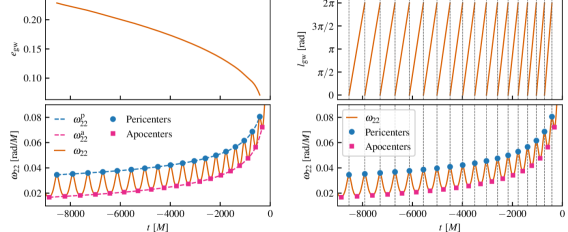
- 時間領域の重力波ひずみにのみ依存する形で、近点および遠点通過時刻を用いて離心率 $e_{\text{gw}}$ および平均近点角 $l_{\text{gw}}$ を定義する。
- 振幅の周期的変動、残差振幅解析、またはフィッティング手法を用いて、時間系列内での近点および遠点通過を特定する。
- 連続する近点および遠点通過間の時間間隔を用いて、波形に基づくゲージ不変な形式で $e_{\text{gw}}$ および $l_{\text{gw}}$ を計算する。
- 弱場領域ではニュートン極限に正しく還元され、全離心率範囲における束縛軌道に対しても有効であることを保証する。
- パラメータ推定や後処理に使用可能な、公開のPythonパッケージ *gw_eccentricity* にこの手法を実装する。
- 後ニュートン理論、有効1体理論、極端質量比インスパイラル、数値相対論的シミュレーションの波形に対して、この手法の妥当性を検証する。
実験結果
リサーチクエスチョン
- RQ1軌道要素に依存せず、重力波信号から直接得られる一貫性がありゲージ不変な離心率定義をどのように導出できるか。
- RQ2異なる離心率領域において、信頼性の高い波形ベース手法で近点および遠点通過をどのように特定できるか。
- RQ3提案された $e_{\text{gw}}$ 定義は、既存の波形モデルやシミュレーションで用いられる内部離心率測定とどのように比較できるか。
- RQ4本手法は、高離心率系($e \gtrsim 0.9$)および低離心率系($e \sim 10^{-5}$)においても、頑健に離心率を測定できるか。
- RQ5新しい基準に従う重力波データ解析における基準周波数および開始周波数を、離心率を持つ二重星系に一般化するにはどうすればよいか。
主な発見
- 提案された $e_{\text{gw}}$ 定義はゲージの曖昧さがなく、弱場領域では正しくニュートン極限に還元される。
- 後ニュートン近似、有効1体理論、極端質量比、数値相対論的モデルの波形において、一貫した結果を得て離心率を正確に測定できた。
- 初期時刻 $t_0 = -5 \times 10^6 M$ で $e_{\text{eob}} = 0.999$ の系について、$\widehat{t}_0 \approx -2 \times 10^6 M$ での測定離心率 $e_{\text{gw}} \approx 0.99$ が得られ、高離心率領域でも滑らかな時間的変化を示した。
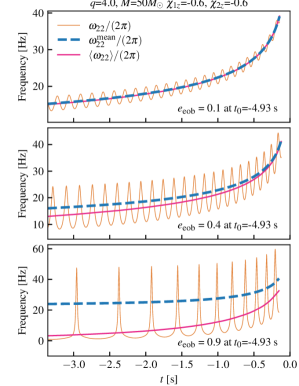
- 振幅法(Amplitude)、残差振幅法(ResidualAmplitude)、振幅フィッティング法(AmplitudeFits)はいずれも信頼性の高い離心率推定を可能にし、振幅法は $e_{\text{gw}} \gtrsim 10^{-3}$ に対して有効で、他の2つは低離心率領域に適している。
- 滑らかさテストにより、一部の波形モデルにノイズの多い特徴が確認され、本手法がモデルのアーチファクトを特定する有用性を示した。
- 少なくとも4〜5周期分の波形が得られる場合には実装が頑健であるが、高離心率の数値相対論的シミュレーションでは、軌道カバー範囲が限られるため課題が残っている。
この論文を読む
Nubintのビューアで原文を開き、読みながら気になる箇所をすぐに質問できます。
Nubintでこの論文を読むこのレビューはAIが論文の原文をもとに作成しました。引用する前に原文をご確認ください。