
[論文レビュー] Evaluating tree-based imputation methods as an alternative to MICE PMM for drawing inference in empirical studies
本論文は、現実的なNEPSベースのシミュレーションにおいて、木ベースの補完法(MICE RF、missRanger、MIXGBoost)をMICE PMMと比較し、RFベースの補完が係数推定、第一種の誤り、検出力においてしばしば最良のパフォーマンスを示すことを示す。ただし欠損が多い場合には留意点がある。
Dealing with missing data is an important problem in statistical analysis that is often addressed with imputation procedures. The performance and validity of such methods are of great importance for their application in empirical studies. While the prevailing method of Multiple Imputation by Chained Equations (MICE) with Predictive Mean Matching (PMM) is considered standard in the social science literature, the increase in complex datasets may require more advanced approaches based on machine learning. In particular, tree-based imputation methods have emerged as very competitive approaches. However, the performance and validity are not completely understood, particularly compared to the standard MICE PMM. This is especially true for inference in linear models. In this study, we investigate the impact of various imputation methods on coefficient estimation, Type I error, and power, to gain insights that can help empirical researchers deal with missingness more effectively. We explore MICE PMM alongside different tree-based methods, such as MICE with Random Forest (RF), Chained Random Forests with and without PMM (missRanger), and Extreme Gradient Boosting (MIXGBoost), conducting a realistic simulation study using the German National Educational Panel Study (NEPS) as the original data source. Our results reveal that Random Forest-based imputations, especially MICE RF and missRanger with PMM, consistently perform better in most scenarios. Standard MICE PMM shows partially increased bias and overly conservative test decisions, particularly with non-true zero coefficients. Our results thus underscore the potential advantages of tree-based imputation methods, albeit with a caveat that all methods perform worse with an increased missingness, particularly missRanger.
研究の動機と目的
- 欠損データを含む線形モデルにおける係数推定に対する、異なる補完法の影響を評価する。
- MICE PMM、MICE RF、missRanger、MIXGBoostの各法でのバイアス、第一種の誤り、検出力を比較する。
- 欠損率を変化させた現実的なNEPSベースのシミュレーションデータセットでの性能を評価する。
提案手法
- 収入をアウトカムとする5時点にわたるNEPSベースの縦断データを、完結データとして12,410件作成してシミュレーションする。
- 欠損データをMICE PMM、MICE RF、missRanger(PMMあり・なし)、およびMIXGBoostを用いて補完する。
- 補完がOLS回帰係数、第一種の誤り、検出力に与える影響を評価する。
- 混在データ型(数値・カテゴリ)を要約するためにIPM(Imputation Performance Metric)を用いる。
- シミュレーションを1200回複製し、成功した1000回の複製を分析する。
- 欠損レベルとデータパターン間の性能差を強調する。
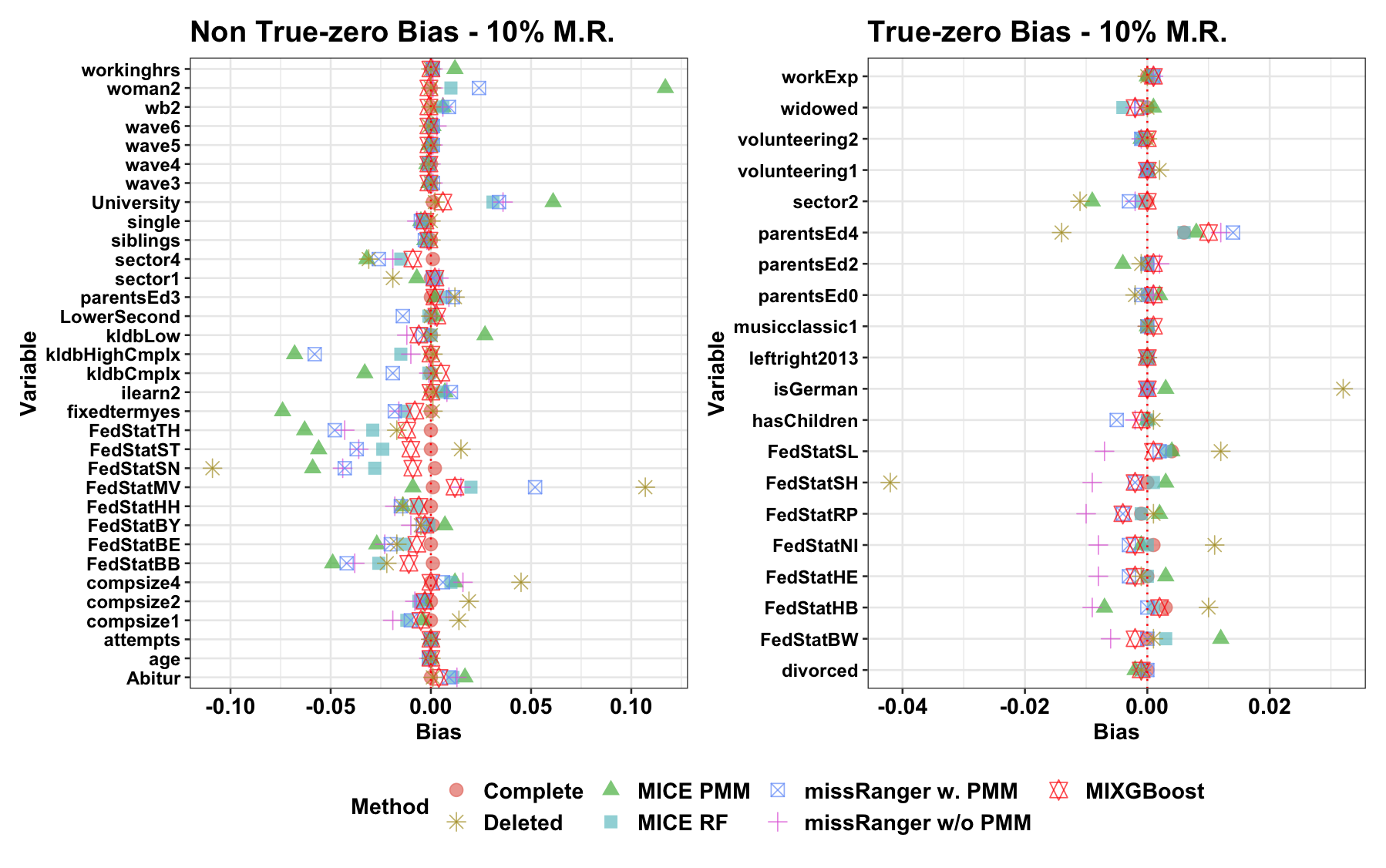
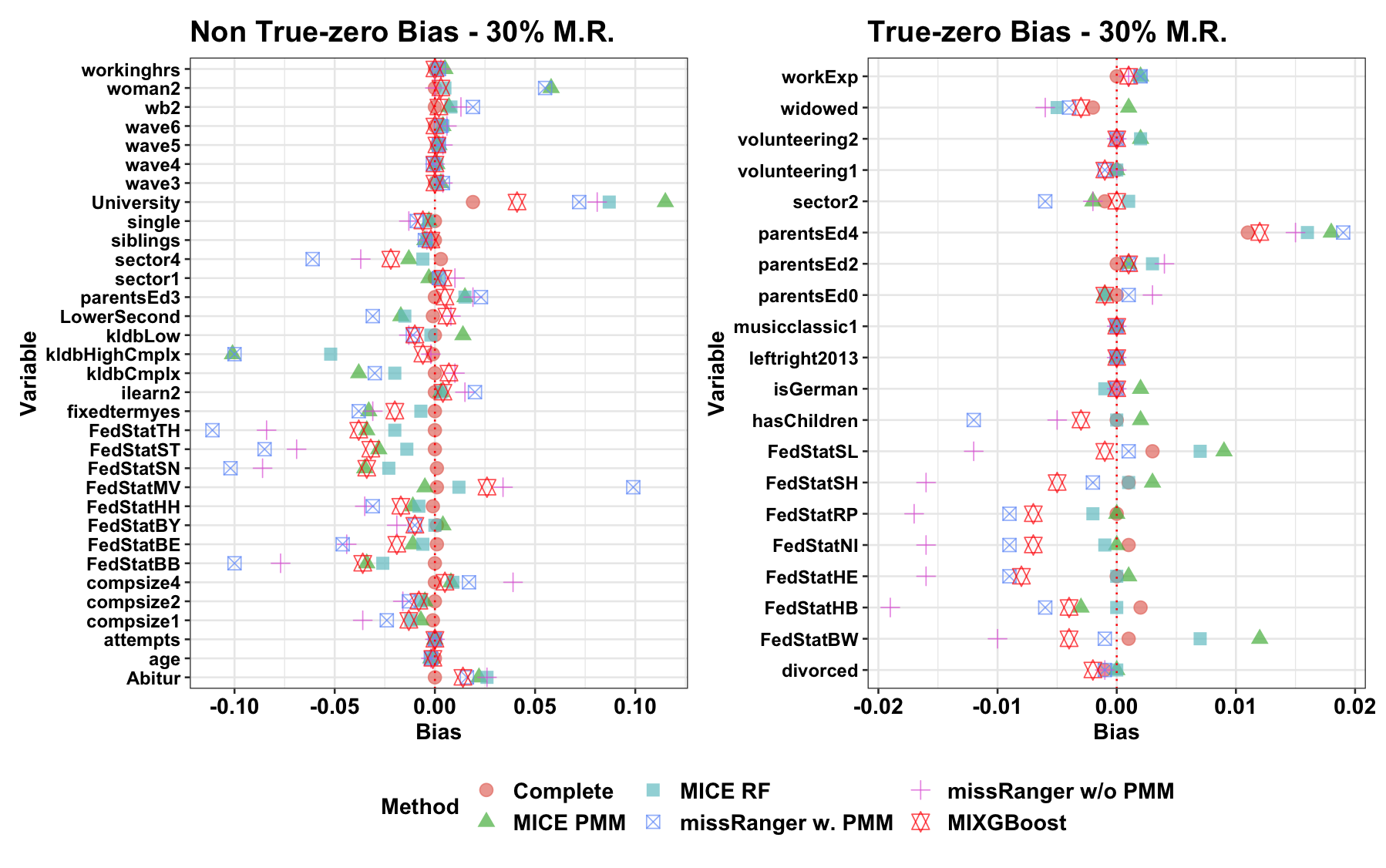
実験結果
リサーチクエスチョン
- RQ1木ベースの補完法は、線形モデルの係数バイアスの観点でMICE PMMとどう比較されるか?
- RQ2シナリオ全体で補完法が第一種の誤りと統計的検出力に及ぼす影響はどうか?
- RQ3MAR欠測 under MAR 欠測条件で、RFベースの木補完法(MICE RF、missRanger)は一貫してMICE PMMより優れているか?
- RQ4欠損の増加が各補完法の性能に与える影響は何か?
主な発見
- Random Forestベースの補完、特にMICE RFおよびPMM付きのmissRangerは、ほとんどのシナリオで一貫してより良い性能を示す。
- 標準的なMICE PMMは、偏りの一部増加と検定決定の保守的過ぎる傾向を示し、特に真のゼロでない係数の場合に顕著。
- MissRangerの性能は欠損が高くなると低下する。
- 欠損が増えると全ての方法の性能が低下し、特にmissRangerが最も影響を受ける。
- 木ベースの方法は、混在データ型や複雑な相互作用を多くの設定でMICE PMMよりも適切に扱える。
この論文を読む
Nubintのビューアで原文を開き、読みながら気になる箇所をすぐに質問できます。
Nubintでこの論文を読むこのレビューはAIが論文の原文をもとに作成しました。引用する前に原文をご確認ください。