
[論文レビュー] Exploring Precision and Recall to assess the quality and diversity of LLMs
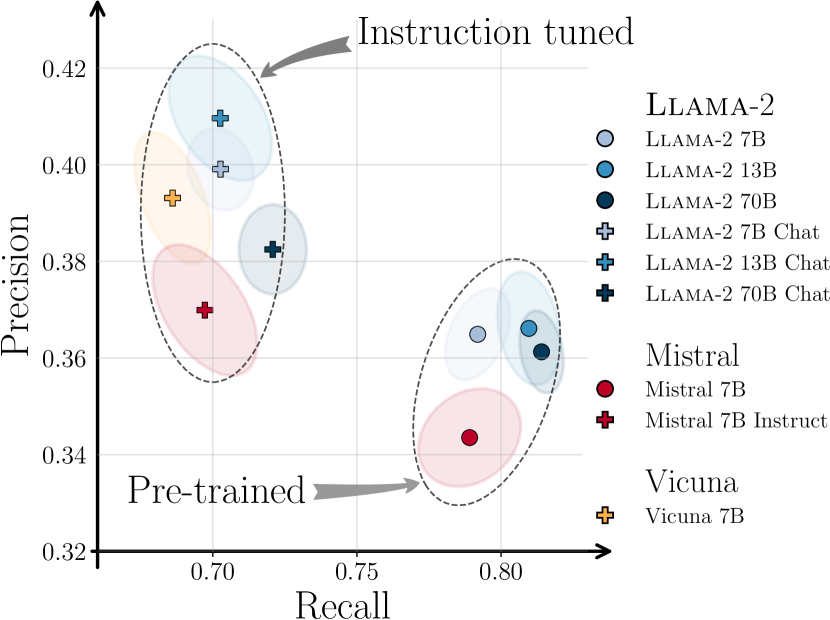
この論文は、画像生成のために開発されたPrecisionとRecallの指標を、大規模言語モデル(LLMs)であるLlama-2 や Mistral が生成するテキストの品質と多様性を評価するために適応している。人間による対応付のリファレンスを必要とせず、モデルの出力分布とリファレンス分布を比較することで、ファインチューニングに人間のフィードバックを用いることで生成品質(高いPrecision)は向上するが、出力の多様性(低いRecall)は低下するという重要なトレードオフが明らかになる。
We introduce a novel evaluation framework for Large Language Models (LLMs) such as extsc{Llama-2} and extsc{Mistral}, focusing on importing Precision and Recall metrics from image generation to text generation. This approach allows for a nuanced assessment of the quality and diversity of generated text without the need for aligned corpora. By conducting a comprehensive evaluation of state-of-the-art language models, the study reveals new insights into their performance on open-ended generation tasks, which are not adequately captured by traditional benchmarks. The findings highlight a trade-off between the quality and diversity of generated samples, particularly when models are fine-tuned on instruction dataset or with human feedback. This work extends the toolkit for distribution-based NLP evaluation, offering insights into the practical capabilities and challenges that current LLMs face in generating diverse and high-quality text. We release our code and data.
研究の動機と目的
- オープンエンドなLLM生成における従来のリファレンス依存評価手法の限界を克服すること。
- 人間がアノテートしたリファレンスコーパスに依存しない、分布ベースの評価フレームワークを構築すること。
- テキスト生成における品質(Precision)と多様性(Recall)の両面からLLMsを洗練された評価を行うこと。
- 人間のフィードバックを用いたファインチューニングが、LLM出力における品質と多様性のバランスに与える影響を調査すること。
- MAUVEなどの分布ベースの指標を拡張し、より解釈可能で実行可能なインサイトを提供するPrecisionとRecallを導入すること。
提案手法
- LLMの出力を分布Qとしてモデル化し、リファレンスデータセット(例:WebText)を分布Pとしてモデル化する。
- Precisionを、QのサンプルのうちPに近いものの割合として計算し、生成テキストの関連性や品質を測定する。
- Recallを、PのサンプルのうちQによってカバーされているものの割合として計算し、モデル出力の多様性を測定する。
- 両指標の「近さ」を定義するために、埋め込みベースの類似度(例:sentence-BERT)を用いる。
- ゼロショットおよびインstructファインチューニングされたLLM(例:Llama-2, Mistral)を、オープンエンドな伝記生成タスクに対して適用する。
- 統計的不確実性を示すエラーレイアウトを報告することで、モデル間の比較を可能にする。
実験結果
リサーチクエスチョン
- RQ1PrecisionとRecallを画像生成からテキスト生成へのLLMsに意味的に適応する方法は何か?
- RQ2SOTAのLLMs(例:Llama-2, Mistral)は、オープンエンドな生成タスクにおいて、どの程度の品質と多様性を達成しているか?
- RQ3人間のフィードバックを用いたファインチューニングは、生成品質と多様性のトレードオフにどのような影響を及ぼすか?
- RQ4PrecisionとRecallは、MAUVEなどの既存の分布ベースの指標と比較して、モデルの挙動をどの程度的確に捉えられるか?
- RQ5PrecisionとRecallは、繰り返しや低品質な幻覚といった特定の失敗モードを検出できるか?
主な発見
- 人間のフィードバックを用いたファインチューニングにより、Precisionが顕著に向上し、出力の品質と関連性が高まっていることが示された。
- しかし、この向上はRecallの低下という代償を伴い、出力の多様性が著しく低下していることが明らかになった。
- Mistral Instruct v0.2 は伝記生成タスクにおいて極めて低いRecall(ほぼゼロ)を示し、リファレンスセットに多様性があるにもかかわらず、繰り返し同じ伝記を生成していた。
- Llama-2-7b は高いRecallを示したが、Precisionは低く、多様な出力が生成される一方で、事実的・文脈的に不正確な内容が多かった。
- PrecisionとRecallのトレードオフは、実証的に測定され、可視化され、モデル間で明確なパフォーマンスフロンティアが明らかになった。
- 提案されたフレームワークは、繰り返し(低Recall)や低品質な生成(低Precision)といったモデル固有の失敗モードを効果的に同定できており、従来のベンチマークでは捉えきれない問題を特定できた。

この論文を読む
Nubintのビューアで原文を開き、読みながら気になる箇所をすぐに質問できます。
Nubintでこの論文を読むこのレビューはAIが論文の原文をもとに作成しました。引用する前に原文をご確認ください。