
[論文レビュー] Fed and Trump -- The Dirty Game
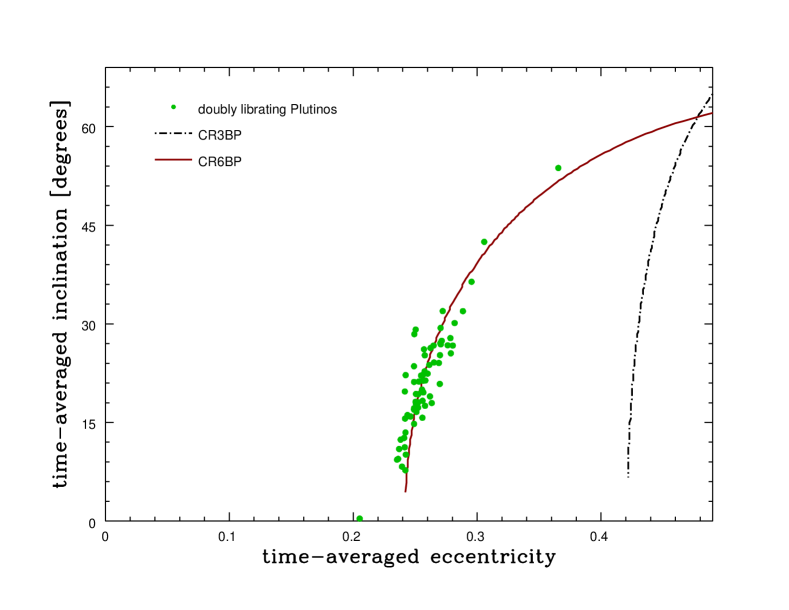
論文は二重リブラトするプルートinosを分析し、離心率–傾斜角空間にgリブラトが clustering されることを特定し、それを第三種の周期軌道に結び付けている。プルートinosの約16%がgリブラトであると推定する。
Named for orbital kinship with Pluto, the Plutinos are a prominent group of Kuiper Belt objects whose orbital periods are in libration about the 3/2 ratio with Neptune's. We investigate the long term orbital dynamics of known Plutinos, with attention to the additional libration (or lack thereof) of their argument of perihelion, $g$, a well-known characteristic of Pluto's orbit. We show that the $g$ librators amongst the Plutinos cluster around an arc in the eccentricity--inclination parameter plane. This previously unreported dynamical structure is owed to a family of periodic orbits of the third kind in the restricted problem of three bodies, identified by Poincaré at the end of the 19th century. Approximately sixteen percent of the currently known Plutinos exhibit $g$ librations, a far greater fraction than the ratios of the associated libration frequencies. These results may offer new constraints for theoretical models of the dynamical history of the Plutinos and of the orbital migration history of the giant planets.
研究の動機と目的
- 既知のプルートinos の長期動力学を g リブラションを強調して評価する。
- どのプルートinos が持続的な g リブラションを示し、それらの分布を特徴づける。
- g リブラションのクラスタリングを古典的三体問題における第三種の周期軌道の族と関連づける。
- プルートinos の g リブラータの割合の最新見積もりを提供し、海王星–惑星の移動モデルへの影響を議論する。
提案手法
- Volk & Van Laerhoven (2024) のプルートinos リストを作成し、JPL Horizons から軌道データを取得する。
- SWIFT_RMVS3 を用いて100 Myr の軌道を伝搬し、プルートinos を試行粒子として扱う。
- 100 Myr にわたり sigma の最大値と最小値の差が 358 度未満となる基準で長期安定なプルートinos を同定する。
- g リブラション中心(0°, 90°, 180°, 270°)を、g の範囲が 179°未満となる範囲で探索する。
- 時間平均離心率と傾斜を計算し、時間平均の e–i 平面でのクラスタリングを解析する。
- CR6BP および CR3BP の第三種の周期軌道と比較して、プルートinos の軌道平均摂動関数の极小値を算出し、観測された構造を解釈する。

実験結果
リサーチクエスチョン
- RQ1ネプチューンの外側3:2 共鳴内で持続的な g リブラション(g リブラト)を示すプルートinos の割合はどれくらいか。
- RQ2g リブラトゥーラは時間平均の離心率–傾斜平面にどのように分布しており、この分布を説明する力学的構造は何か。
- RQ3観測された g リブラーションの局所は、還元三体問題における第三種の周期軌道の族とどのように関連しているのか。
- RQ4CR3BP と CR6BP のモデルを比較したとき、内側巨大惑星の影響は g リブラーションの locus にどのような影響を与えるか。
主な発見
- 長期安定なプルートinos 441個のうち 69 個が g リブラションを示し、約 16% である。
- g リブラトは時間平均の離心率–傾斜平面に沿ってほぼ双曲的な弧としてクラスタリングする。
- 軌道平均摂動関数の局所最小値は g = ±90° の最小値と一致し、第三種の周期軌道の族と一致することを示唆する;内側の巨惑星はこの locus を純粋な CR3BP の場合より低い離心率へ移動させる。
- クラスタリングは g リブラション中心が 0° または 180° の場合には観察されず、g リブラトは概ね 90° と 270° の中心でほぼ等しく分布している。
- 例外的な天体(2015 VR164)は主クラスタを外れ、非常に低い e と i を示すが、共鳴力学ではなく運動学的効果によると考えられる。
- 観察される g-リブレーター割合は、単純な位相空間体積推定を超えており、惑星移動中の力学的安定性と捕獲履歴による過密化が原因である可能性がある。
この論文を読む
Nubintのビューアで原文を開き、読みながら気になる箇所をすぐに質問できます。
Nubintでこの論文を読むこのレビューはAIが論文の原文をもとに作成しました。引用する前に原文をご確認ください。