
[論文レビュー] Learning Causally Disentangled Representations via the Principle of Independent Causal Mechanisms
本稿では、流れに基づく微分同相写像と因果的分離事前分布を用いて独立因果メカニズム(ICM)を強制することで、因果的に分離された表現を学習する変分オートエンコーダー枠組みであるICM-VAEを提案する。本手法は、置換および要素ごとの再パラメータ化までに同定可能であり、弱教師あり設定下で高い分離性、干渉に対するロバスト性、一貫性のある反事実的生成を示す。
Learning disentangled causal representations is a challenging problem that has gained significant attention recently due to its implications for extracting meaningful information for downstream tasks. In this work, we define a new notion of causal disentanglement from the perspective of independent causal mechanisms. We propose ICM-VAE, a framework for learning causally disentangled representations supervised by causally related observed labels. We model causal mechanisms using nonlinear learnable flow-based diffeomorphic functions to map noise variables to latent causal variables. Further, to promote the disentanglement of causal factors, we propose a causal disentanglement prior learned from auxiliary labels and the latent causal structure. We theoretically show the identifiability of causal factors and mechanisms up to permutation and elementwise reparameterization. We empirically demonstrate that our framework induces highly disentangled causal factors, improves interventional robustness, and is compatible with counterfactual generation.
研究の動機と目的
- 既存の分離表現学習手法が独立要因を仮定しているという限界に対処すること。これは、因果的依存関係を示す現実世界のデータではしばしば現実的ではない。
- 独立因果メカニズム(ICM)の原則に基づく、因果的分離の新しい定式化を提示すること。
- 流れに基づく微分同相関数と因果的分離事前分布を用いて、因果的に因子化された潜在表現を学習するフレームワークを開発すること。
- 弱い条件下でも、置換および要素ごとの再パラメータ化までに、因果的要因とメカニズムの理論的同定可能性を確立すること。
- 弱教師あり設定下での、改善された分離性、干渉へのロバスト性、反事実的生成の実証的検証を行うこと。
提案手法
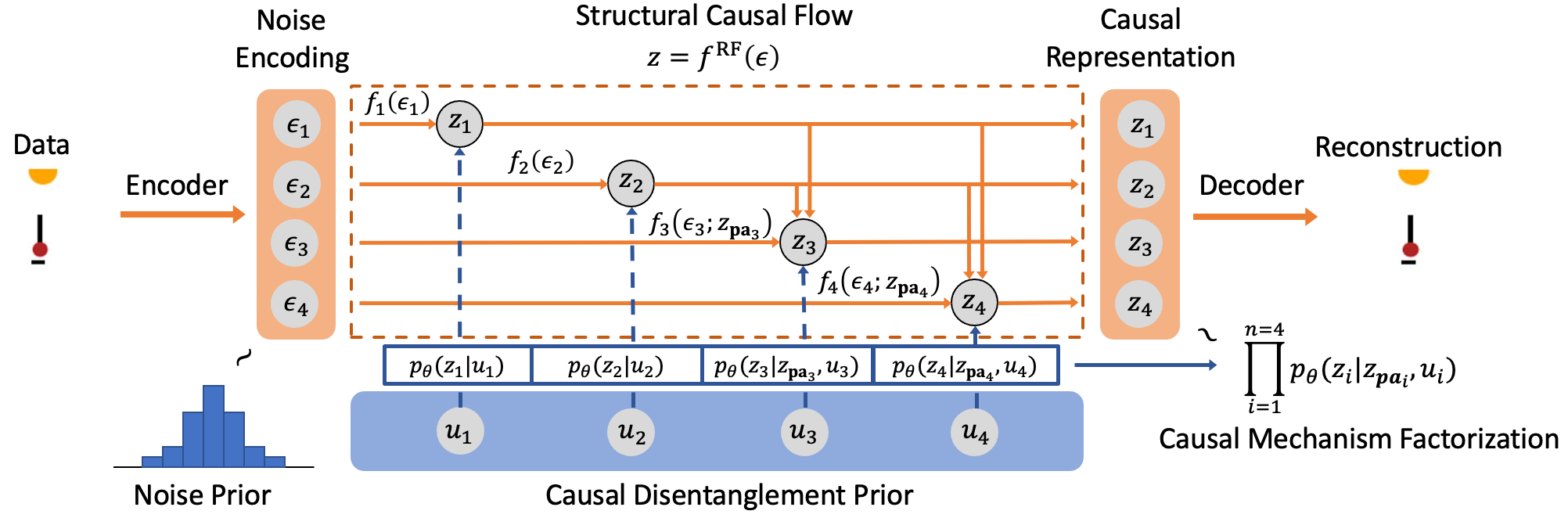
- ノイズ変数を潜在因果変数へ写像する学習可能な流れに基づく微分同相関数を用いて因果メカニズムをモデル化する、変分オートエンコーダーであるICM-VAEを提案する。
- 既知の因果構造を活用して、潜在空間における因果的に因子化された分布を促進する因果的分離事前分布を導入する。
- 補助ラベルに基づく条件付き事前分布を用いて同定可能性を強制し、iVAEフレームワークを因果的設定に拡張する。
- 可逆なフローを用いてノイズ変数と潜在変数間の双射写像を保証し、正確な推論と反事実的生成を可能にする。
- 一つのメカニズムの変更が他のメカニズムに影響を与えないことを保証するため、独立因果メカニズム(ICM)の原則を適用する。
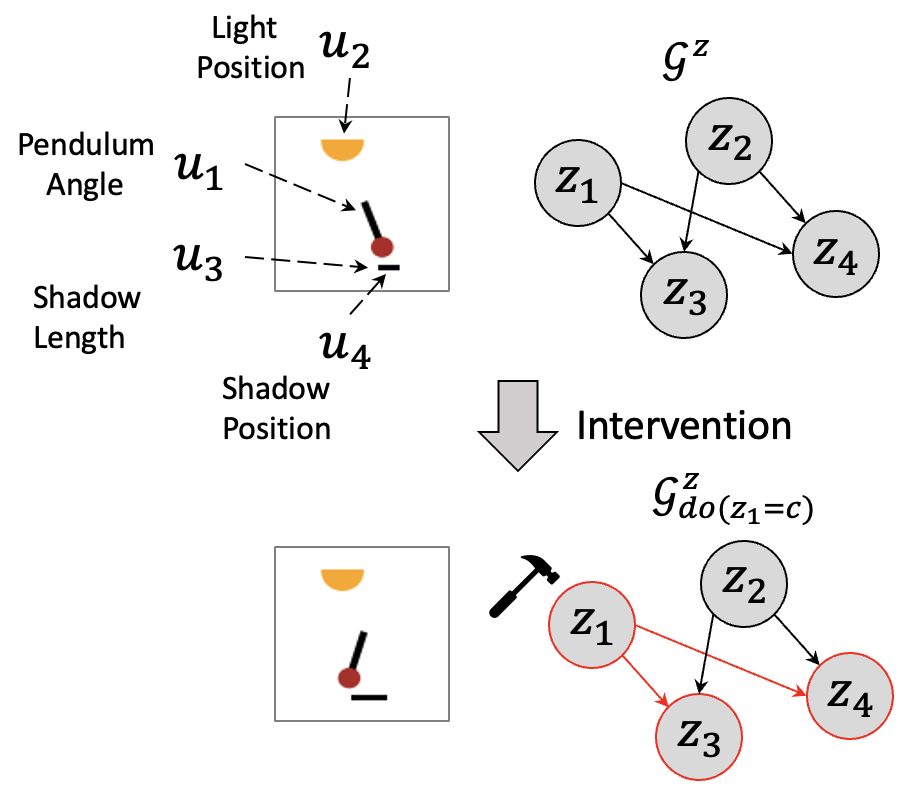
- 反事実的生成のための2段階推論プロセスを採用する:帰納(観測から潜在ノイズを推定)、操作(潜在要因を干渉)、予測(変更された潜在変数からデータを再構築)
実験結果
リサーチクエスチョン
- RQ1弱教師あり設定下で、独立因果メカニズム(ICM)の原則を用いて因果的分離を形式化し、達成可能か?
- RQ2潜在空間における因子化され、同定可能である因果的表現を促進するため、因果的分離事前分布をどのように設計できるか?
- RQ3弱い仮定のもとで、提案フレームワークがどの程度まで因果的要因とメカニズムの同定可能性を達成できるか?
- RQ4先行手法と比較して、本モデルは干渉へのロバスト性を向上させ、一貫性のある反事実的生成を可能にするか?
- RQ5要因が独立ではなく因果関係にある場合でも、本フレームワークは高い分離性を維持できるか?
主な発見
- 提案されたICM-VAEフレームワークは、複数のランダムシードで中央値DCIスコアが0.98に達するなど、因果的要因のほぼ完全な分離性を達成した。
- モデルは干渉に対する強いロバスト性を示し、生成要因への干渉に対しても潜在表現の高い一貫性を保った。
- 反事実的生成は一貫的かつ意味的に明確であり、振り子の角度などの因果変数に干渉した後、妥当な反事実的画像を効果的に生成できた。
- 理論的分析により、弱い条件下でも、置換および要素ごとの再パラメータ化までに因果的要因とメカニズムの同定可能性が示された。
- β-VAE や iVAE といったベースライン手法と比較して、特にデータ内に因果的依存関係が存在する場合に、分離性とロバスト性の両面で優れた性能を示した。
- 本フレームワークは連続的および離散的潜在変数の両方と互換性があるが、現在の結果は連続的真値変数に限定されている。
この論文を読む
Nubintのビューアで原文を開き、読みながら気になる箇所をすぐに質問できます。
Nubintでこの論文を読むこのレビューはAIが論文の原文をもとに作成しました。引用する前に原文をご確認ください。