
[論文レビュー] Learning to Model and Plan for Wheeled Mobility on Vertically Challenging Terrain
本論文では、SE(3)における3次元車両-地形前向きダイナミクスを学習することで、垂直に挑戦的な地形における車輪付きロボットの運動をモデル化・計画する学習ベースのアプローチを提案する。3次元計画における新規のコスト関数を用いることで、2台の車輪付きロボットが複雑なオフロード環境を走破する際、ナビゲーション成功率が最大60%向上し、不安定なシャシーのロール・ピッチが46%低減された。
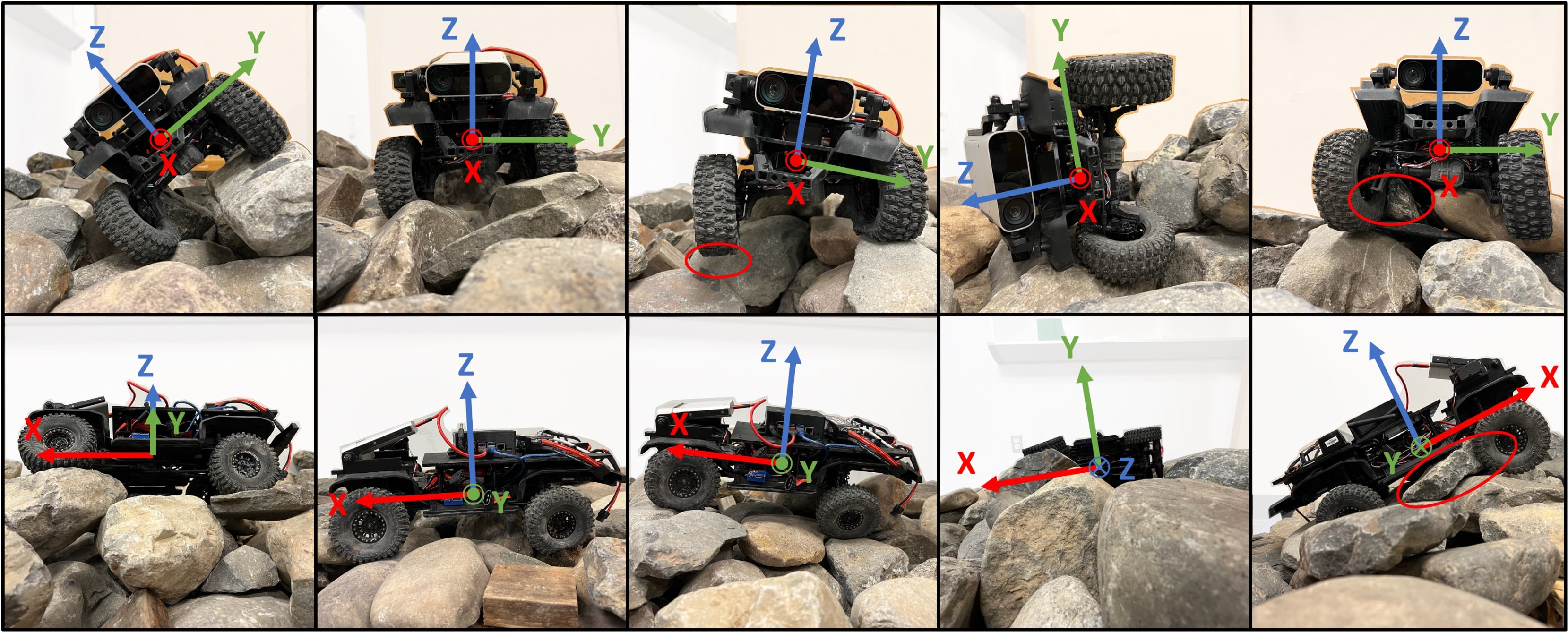
Most autonomous navigation systems assume wheeled robots are rigid bodies and their 2D planar workspaces can be divided into free spaces and obstacles. However, recent wheeled mobility research, showing that wheeled platforms have the potential of moving over vertically challenging terrain (e.g., rocky outcroppings, rugged boulders, and fallen tree trunks), invalidate both assumptions. Navigating off-road vehicle chassis with long suspension travel and low tire pressure in places where the boundary between obstacles and free spaces is blurry requires precise 3D modeling of the interaction between the chassis and the terrain, which is complicated by suspension and tire deformation, varying tire-terrain friction, vehicle weight distribution and momentum, etc. In this paper, we present a learning approach to model wheeled mobility, i.e., in terms of vehicle-terrain forward dynamics, and plan feasible, stable, and efficient motion to drive over vertically challenging terrain without rolling over or getting stuck. We present physical experiments on two wheeled robots and show that planning using our learned model can achieve up to 60% improvement in navigation success rate and 46% reduction in unstable chassis roll and pitch angles.
研究の動機と目的
- 障害物と自由空間の区別が明確でない垂直に挑戦的な地形において、従来の2次元剛体運動計画の限界を解消すること。
- サスペンションの変形、タイヤ-地形の摩擦、動的重量分布を含む、車輪付きロボットと3次元地形との複雑で非剛体な相互作用をモデル化すること。
- 岩や倒れた木などのこれまで到達不可能とされた障害物を安定的かつ効率的に通過できるように、衝突を回避するナビゲーションを保証する計画フレームワークを開発すること。
- 学習データとは異なる地形特徴を示す未観測の屋外環境への一般化を可能にすること。
提案手法
- 現在の車両状態、制御入力、地形標高マップに基づき、SE(3)における6自由度(6-DoF)車両状態軌道を予測するデータ駆動型前向きダイナミクスモデルを学習する。
- wm-vctプランナは、学習済みダイナミクスモデルを用いた、サンプリングベースのリcede-horizonアプローチを採用し、軌道のロールアウトを実行する。
- 高いロール・ピッチ角や停止の可能性をペナルティ化する新しい3次元コスト関数を設計し、計画段階での安定性を促進する。
- 学習済みダイナミクスをRRT*-ベースの運動計画法に統合し、実行可能で安定的かつ効率的な軌道を生成する。
- 本手法は、2台の車輪付きロボットプラットフォーム(V6WおよびV4W)を用いて、制御されたテストベッドおよび実際の屋外環境で評価された。
- 微調整なしに未観測の屋外地形へ一般化可能であり、分布外の地形特徴に対しても頑健であることが示された。
実験結果
リサーチクエスチョン
- RQ1SE(3)における学習済み前向きダイナミクスモデルは、サスペンションおよびタイヤの変形を伴う複雑な3次元地形において、車輪付きロボットの運動を正確に予測できるか?
- RQ23次元ダイナミクスを計画コスト関数に組み込むことで、2次元剛体仮定と比較して、垂直に挑戦的な地形における安定性と成功率がどのように向上するか?
- RQ3学習済みモデルは、学習データに存在しなかった大きな不規則な障害物を有する未観測の屋外環境へどの程度一般化できるか?
- RQ4実世界のオフロード環境において、行動クラッシングや他の最先端のプランナと比較して、wm-vctプランナの性能と安定性はどの程度か?
主な発見
- wm-vctプランナは、3段階の難易度を持つテストベッド環境において、V6WおよびV4Wロボットの両方で、最良のベースライン(行動クラッシング)と比較して最大60%高いナビゲーション成功率を達成した。
- 行動クラッシングと比較して、wm-vctプランナは不安定なシャシーのロール・ピッチ角を最大46%低減した。特に中程度および困難な環境で顕著であった。
- 困難なテストベッド環境では、行動クラッシングは5回中4回が転倒または停止により失敗したが、wm-vctは5回中4回で成功した。
- 機械的性能が低い4輪のV4Wプラットフォームにおいても、wm-vctは成功率および安定性指標の両面で行動クラッシングを上回った。
- 大きな不規則な岩を有する未観測の屋外地形においても、プランナは正常に一般化し、行動クラッシングは過剰なロール角により転倒したため失敗した。
- 屋外デモンストレーションでは、wm-vctが従来到達不可能とされた障害物を安定して通過できることを確認したのに対し、行動クラッシングは攻撃的で不安定な軌道により失敗した。
より良い研究を、今すぐ始めましょう
論文の読解から最終レビューまで、研究時間を劇的に削減しましょう。
クレジットカード登録不要
このレビューはAIが作成し、人間の編集者が確認しました。