
[論文レビュー] Light-Matter Hybridization and Entanglement from the First-Principles
本稿では、強い結合光物質系における非調和量子揺らぎを捉えるために、量子電磁力学ハートリー・フォック(QEDHF)フレームワーク内に変分的圧縮変換を提案する。圧縮パラメータの最適化により、光場揺らぎの正確な記述と光物質もつれの定量的評価が可能となり、従来の平均場近似を超えて強い結合領域における予測精度が著しく向上する。
The hybridization between light and matter is fundamental for achieving cavity-induced control over quantum materials, necessitating accurate ab initio methods for their analysis. Among these, the quantum electrodynamics Hartree-Fock framework stands out as an essential mean field approximation for electron-electron and electron-photon interactions, forming the basis for advanced post-Hartree-Fock methods like quantum electrodynamics coupled cluster and auxiliary field quantum Monte Carlo. However, trivial quantum electrodynamics Hartere-Fock (QEDHF) methods assume a product state ansätze and thus cannot describe the light-matter Entanglement. Furthermore, our previous work on variational ansätze approaches lacked the capability to capture anharmonic or nonlinear fluctuations, limiting their applicability to strongly coupled systems. To overcome these limitations, we propose an extended QEDHF formalism by introducing a variational Squeeze transformation capable of describing anharmonic quantum fluctuations in photon fields. By optimizing the squeezing parameters, our framework provides a more nuanced and accurate characterization of photon field quantum fluctuations, significantly enhancing the predictive power of QEDHF in strong coupling regimes. Moreover, this formalism enhances the description of light-matter Entanglement, providing a first-principles framework for understanding light-matter hybridization and paving the way for deeper insights into cavity-modified quantum phenomena.
研究の動機と目的
- 標準的QEDHFが強い結合光物質系における非調和的・非線形的量子揺らぎを記述する点で抱える限界を克服すること。
- 変分的シフトQEDHFフレームワークを拡張し、光子場相関のより良い取り扱いを実現するため、変分的圧縮変換を組み込むこと。
- 強い結合領域において第一原理から光物質もつれの定量的特徴付けを可能にすること。
- 量子電磁力学における後ハートリー・フォック法(QED-CC や QMC など)のより良い平均場基準を提供すること。
- 平均場近似と量子材料における強い相関光子効果の間のギャップを埋めること。
提案手法
- QEDHF形式に変分的圧縮(VSQ)変換を導入し、圧縮パラメータを変分変数として扱い、エネルギーを最小化する。
- 圧縮変換を光子場ハミルトニアンに適用し、非調和揺らぎを反映するよう光子エネルギー項と結合項を修正する。
- 圧縮コherent状態(SCS)表現における有効ハミルトニアンを導出する。これにより、線形および二次光子項が再正規化される。
- coherent squeeze状態(CSS)表現を用いて有効ハミルトニアンと密度行列を計算し、もつれの定量的評価を可能にする。
- 電子自由度について部分トレースを実行し、光子の縮約密度行列を計算することで、von Neumann エントロピーによるもつれの測定が可能になる。
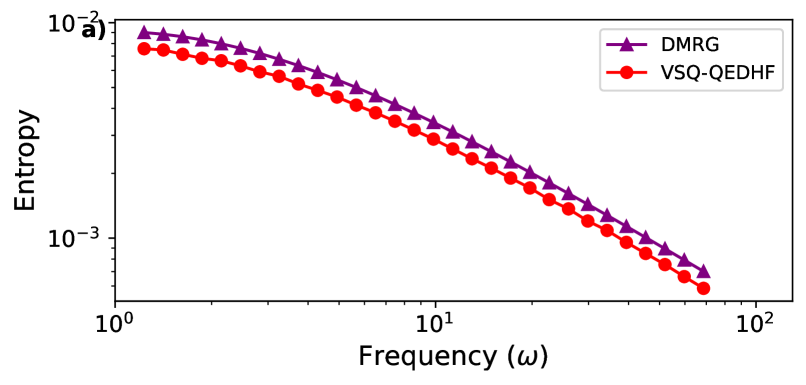
- DMRGベンチマークと比較して手法の妥当性を検証し、もつれとエネルギー予測における精度向上を示す。
実験結果
リサーチクエスチョン
- RQ1QEDHFにおける変分的圧縮変換は、強い結合光物質系における非調和量子揺らぎを正確に記述できるか?
- RQ2標準的QEDHFと比較して、圧縮の導入が光物質もつれの記述をどの程度改善するか?
- RQ3VSQ-QEDHFフレームワークは、強い結合領域における平均場理論の予測精度をどの程度向上させるか?
- RQ4このフレームワークは、DMRG計算でベンチマークされたもつれ指標を定量的に再現できるか?
- RQ5光子の非調和性は、キャビティ修飾量子材料における基底状態エネルギーと電子構造にどのような影響を与えるか?
主な発見
- 変分的圧縮変換は、光子場における非調和揺らぎを効果的に捉え、調和近似を超えた強い結合系の記述を改善した。
- 本手法により、von Neumann エントロピーを用いた光物質もつれの定量的計算が可能となり、DMRGベンチマークと整合性を示した。
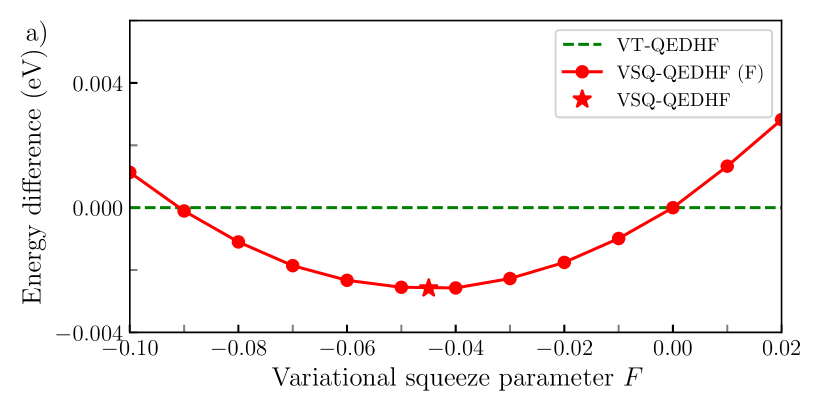
- 圧縮パラメータは変分的に最適化され、変分エネルギーが低くなり、強い結合領域における精度が向上した。
- coherent squeeze状態(CSS)表現における有効ハミルトニアンは、線形結合項および光子ハミルトニアン項の両方を再正規化し、非自明な光子相関を反映している。
- 多数光子基底関数セットの極限において、圧縮操作は基底状態エネルギーに顕著な影響を及ぼし、非摂動的役割を確認した。
- 本フレームワークは、量子電磁力学におけるQED-CC や QMC などの後ハートリー・フォック法の堅牢な第一原理的基準を提供する。
この論文を読む
Nubintのビューアで原文を開き、読みながら気になる箇所をすぐに質問できます。
Nubintでこの論文を読むこのレビューはAIが論文の原文をもとに作成しました。引用する前に原文をご確認ください。