
[論文レビュー] Observational Parameters of Blue Large-amplitude Pulsators
本研究では、青色大振幅脈動星(BLAPs)の包括的な photometric および spectroscopic 分析を実施し、その周期–重力および周期–等価光度関係を特定し、二峰性のヘリウム含有量分布を同定するとともに、数十年にわたる安定性を確認した。主な貢献は、Zバンプ脈動星における周期–等価光度関係の初回導出であり、これにより将来的な距離測定および星団内メンバーの特定が可能になる。
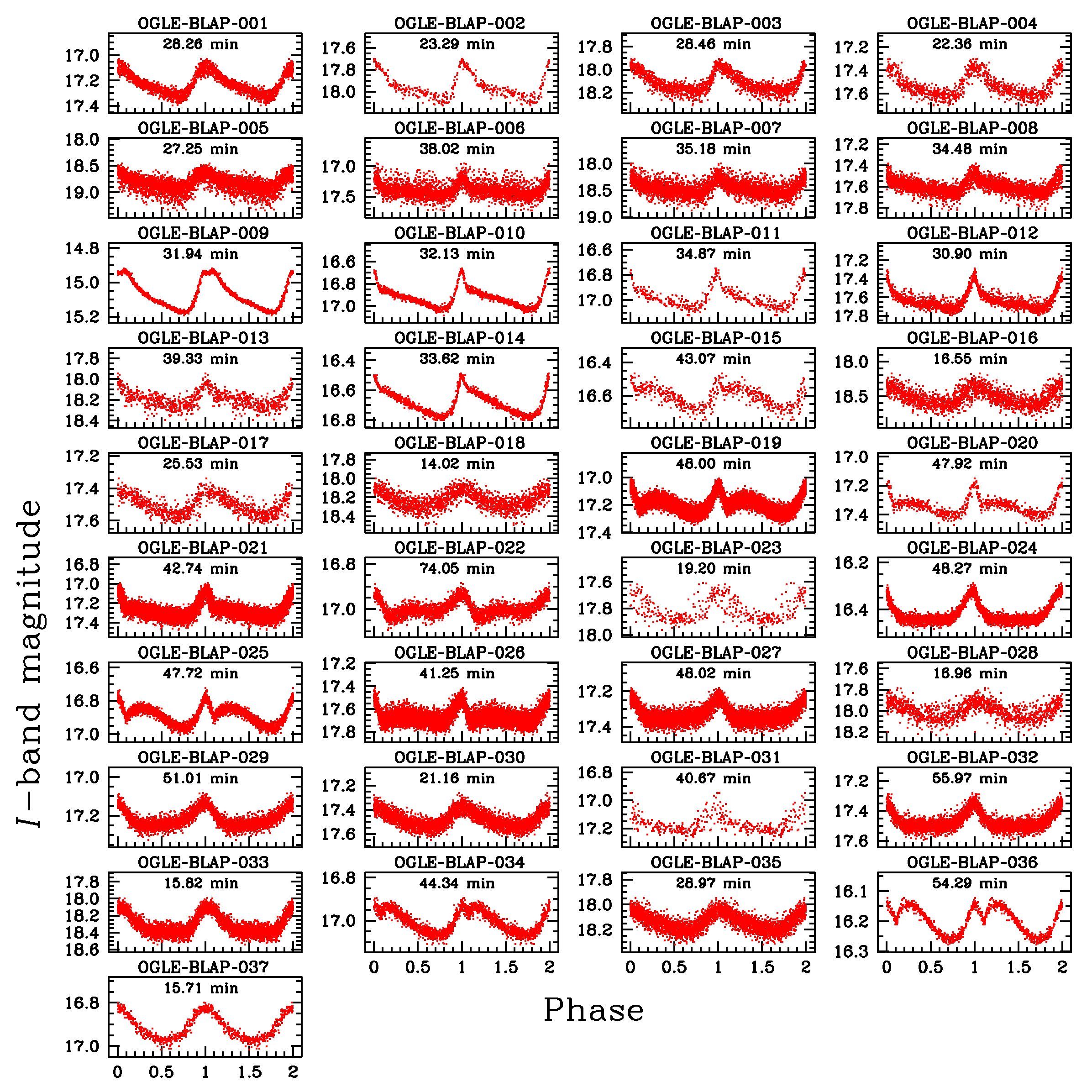
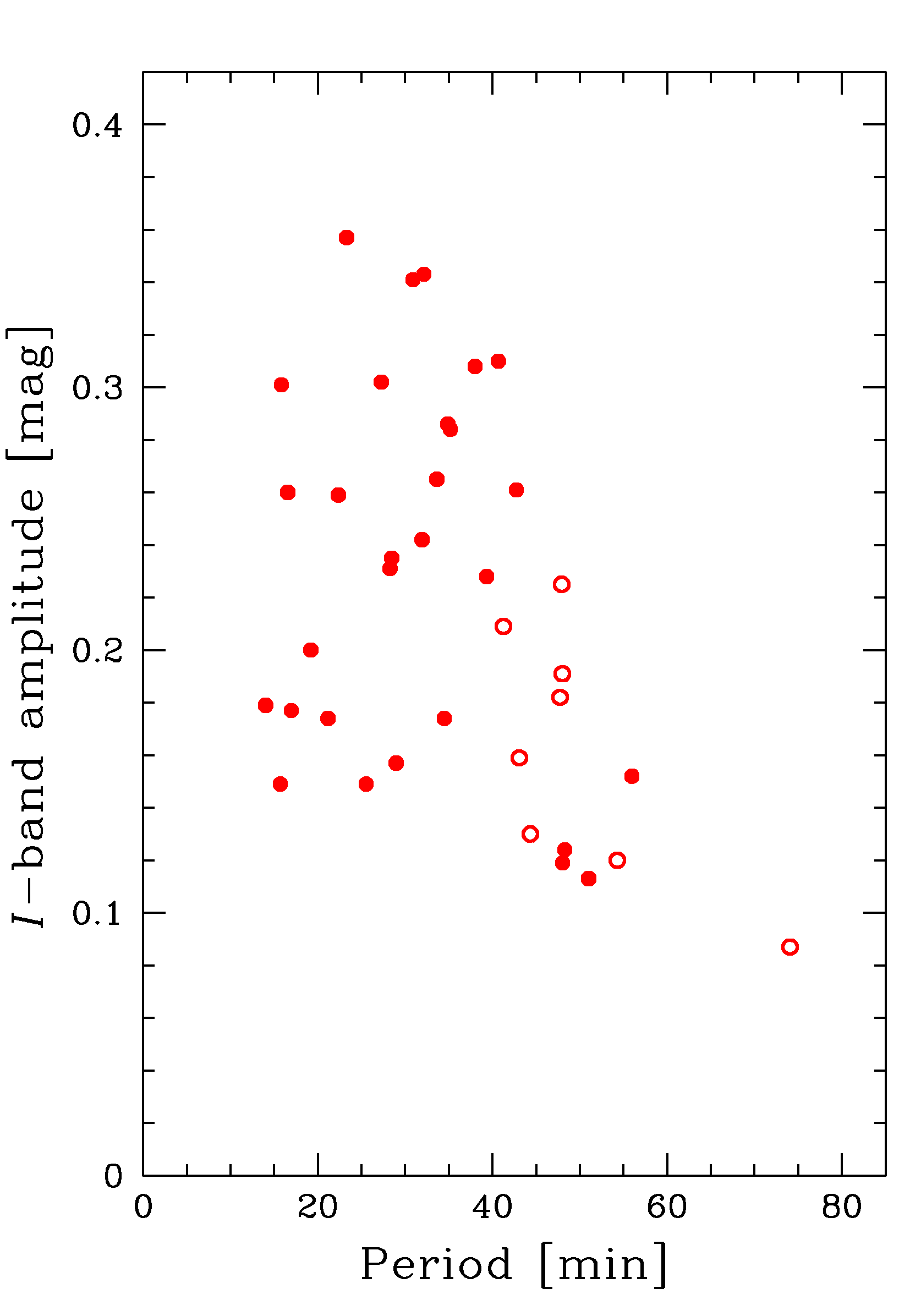
Blue large-amplitude pulsators (BLAPs) are a recently discovered class of short-period pulsating variable stars. In this work, we present new information on these stars based on photometric and spectroscopic data obtained for known and new objects detected by the Optical Gravitational Lensing Experiment (OGLE) survey. BLAPs are evolved objects with pulsation periods in the range of 3-75 minutes, stretching between subdwarf B-type stars and upper main-sequence stars in the Hertzsprung-Russell diagram. In general, BLAPs are single-mode stars pulsating in the fundamental radial mode. Their phase-folded light curves are typically sawtooth-shaped, but many longer-period objects exhibit an additional bump. The long-term OGLE observations show that the period change rates of BLAPs are usually of the order of $10^{-7}$ yr$^{-1}$ and in a quarter of the sample are negative. The spectroscopic data indicate that the BLAPs form a homogeneous group in the period, surface gravity, and effective temperature spaces. However, we observe a split into two groups in terms of helium-to-hydrogen content. The atmospheres of the He-enriched BLAPs are more abundant in metals (about 5 times) than the atmosphere of the Sun. We discover that BLAPs obey a period--gravity relationship and we use the distance to OGLE-BLAP-009 to derive a period--luminosity relation. Most of the stars observed in the OGLE Galactic bulge fields seem to reside in the bulge, while the remaining objects likely are in the foreground Galactic disk.
研究の動機と目的
- 長期間にわたる photometric および spectroscopic データを用いて、青色大振幅脈動星(BLAPs)の観測的パラメータを特徴づけること。
- 異なる周期における脈動モード、周期変化率、光曲線の形状の特徴を特定すること。
- 特にヘリウム対水素比の大気組成を調査し、脈動特性との相関関係を検討すること。
- BLAPs における周期–等価光度関係を確立すること。これは、距離推定および星団内メンバー特定のための重要なツールである。
- BLAPs の天の川銀河内での空間的分布を明確にし、核球と円盤の集団を区別すること。
提案手法
- 1.3-m ワルシャワ望遠鏡(OGLE調査)の長期間 photometric データを用い、数十年にわたる脈動周期、振幅、周期変化率を測定した。
- 6.5-m マグニチュード・ベイド望遠鏡を用いたスペクトロスコピック解析により、効果的温度、表面重力、大気組成(ヘリウム/水素比を含む)を決定した。
- 位相を合わせた光曲線を構築し、周期に応じて歯型、対称型、バンプ変形型の形状を分類した。
- サンプル全体の脈動周期を表面重力値にフィットさせることで、周期–重力関係を導出した。
- OGLE-BLAP-009 の距離(2.2 ± 0.2 kpc)を用いて、BLAPs における初の周期–等価光度関係を校正した。
- ヘリウム含有量に基づき2つのグループに分類:ヘリウム豊富(log(N_He/N_H) ≈ -0.5 dex)およびヘリウム貧困(log(N_He/N_H) < -2 dex)、周期依存の傾向を示した。
実験結果
リサーチクエスチョン
- RQ1BLAPs は周期–重力関係に従うか? また、質量や半径といった物理的パラメータの推定に利用可能か?
- RQ2BLAPs に周期–等価光度関係が存在するか? また、既知の距離を用いて校正可能か?
- RQ3BLAP 大気中のヘリウム対水素含有量の分布は何か? また、周期および温度とどのように相関するか?
- RQ4BLAPs の長期的周期変化率は何か? これにより進化状態にどのような示唆が得られるか?
- RQ5BLAPs は主に銀河の核球に存在するのか、それとも円盤に存在するのか? これにより起源および進化に関する知見が得られるか?
主な発見
- BLAPs は直線的周期–重力関係を示し、一様な構造的パラメータを持つ単一モード径方向脈動星としての地位を裏付けた。
- OGLE-BLAP-009(2.2 ± 0.2 kpc)の距離を用いて、Zバンプ脈動星における初の周期–等価光度関係が導出された。これにより将来的な距離推定が可能になった。
- 周期変化率は通常 ~10⁻⁷ yr⁻¹ であり、サンプルの25%が負の変化率を示した。OGLE-BLAP-030 は三重モード脈動のため、異常に高い +4.6 × 10⁻⁶ yr⁻¹ の変化率を示した。
- BLAPs は大気組成の観点から2つのグループに分類された:ヘリウム豊富(log(N_He/N_H) ≈ -0.5 dex、約5倍太陽金属量)、ヘリウム貧困(log(N_He/N_H) < -2 dex)。後者は主に短周期(P ≤ 15 min)および高温(T_eff > 31,000 K)に存在した。
- 光曲線は数十年にわたって安定しており、37個の星においては食を検出しなかった。これにより、二重星の割合が顕著に低いことが示された。
- OGLE 銀河核球領域の大多数の BLAPs は銀河の核球に位置しており、少数は前方の円盤に存在する。OGLE-BLAP-009 は 2.2 ± 0.2 kpc、既知で最も近い BLAP(HD 133729)は 463 ± 7 pc に位置する。
この論文を読む
Nubintのビューアで原文を開き、読みながら気になる箇所をすぐに質問できます。
Nubintでこの論文を読むこのレビューはAIが論文の原文をもとに作成しました。引用する前に原文をご確認ください。