
[論文レビュー] Observations of a PT-like phase transition and limit cycle oscillations in non-reciprocally coupled optomechanical oscillators levitated in vacuum
本研究では、反対方向のレーザー光ビームを用いて真空中に浮上させた非相互的結合されたオプトメカニカルオシレーターのペアにおいて、PTに類似した相転移および極限サイクル振動を示した。ビームの相対的パワー、位相、偏光を調整することで、非エルミート的ダイナミクスが実現され、散逸を低下させるとホフプ・分岐を経て集団的振動が発生し、特異的点センシングやトポロジカルオプトメカニクスのためのプラットフォームが得られた。
Nanoparticles levitated in an optical trap provide a versatile platform to study mechanical oscillators in a controlled environment with tuneable parameters. Recently, it has become possible to couple two of these optomechanical oscillators. Here, we demonstrate the collective non-Hermitian dynamics of such a pair of non-conservatively coupled oscillators. We take advantage of the tunability of the optical interactions between the particles in our system and set the optical interaction between the particles to be purely non-reciprocal. By continuously varying the relative power of the trapping beams, we take the system through a transition, similar to a parity-time phase transition. A Hopf bifurcation at a critical point results in the formation of collective limit cycle oscillations, resembling those observed in phonon lasers. These coupled levitated oscillators provide a platform for exceptional point optomechanical sensing and can be extended to multi-particle systems, paving the way for the development of topological optomechanical media.
研究の動機と目的
- 非相互的結合を有する2つの光学的浮上ナノ粒子系における非エルミート的集団的ダイナミクスの調査。
- 真のPT対称性を持たない古典的開放系において、PTに類似した挙動の出現を調査すること。
- レーザー出力周波数のずれを連続的に調整することで、パリティ・タイム(PT)相転移に類似した遷移を実証すること。
- 散逸を低減した条件下でホフプ分岐を経て集団的極限サイクル振動の形成を観測すること。
- 特異的点オプトメカニカルセンシングおよびトポロジカルメディアのための可変的で多粒子型プラットフォームを確立すること。
提案手法
- 2組の反対方向のレーザー光ビームを用いた真空中におけるシリカナノ粒子の光学的浮上。
- 捕獲ビームの相対的位相、偏光、間隔を調整することで非相互的結合を誘導。
- 系の非エルミート的性質を調整するため、2つのビーム間のパワー周波数ずれ(η)を連続的に変化。
- デジタルマイクロミラー素子(DMD)を用いてビームパターンを形状化・動的制御し、高精度な捕獲を実現。
- 四分音フォトダイオード(QPD)と高スルーレートCMOSイメージング(400 kHzサンプリング)を併用して粒子位置を同時検出。
- 高スルーレート動画追跡との比較によるQPD信号のキャリブレーションにより、位置測定の高精度を確保。
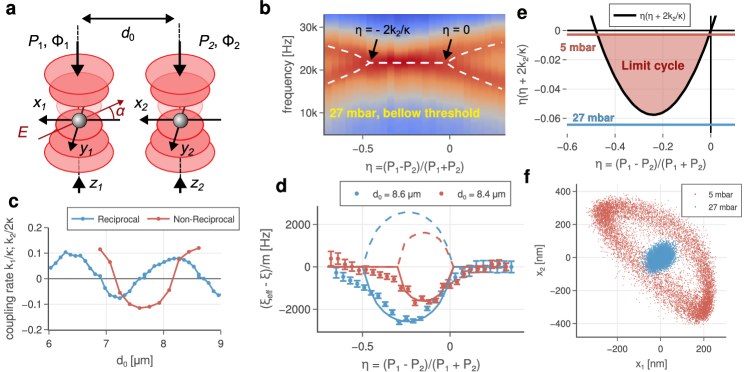
実験結果
リサーチクエスチョン
- RQ1真空中に浮上した非相互的結合されたオプトメカニカル系が、PT相転移に類似したダイナミクスを示すことができるか?
- RQ2非相互的光学的力が2粒子系において集団的極限サイクル振動を誘導する役割を果たすか?
- RQ3相対的レーザー出力周波数ずれ(η)を調整することで、結合系の安定性およびスペクトル的性質にどのような影響を与えるか?
- RQ4観測されたダイナミクスは、フォノンレーザーまたは他の非エルミート系とどの程度類似しているか?
- RQ5この系が特異的点センシングおよびトポロジカルオプトメカニカル現象のための可変的プラットフォームとして機能できるか?
主な発見
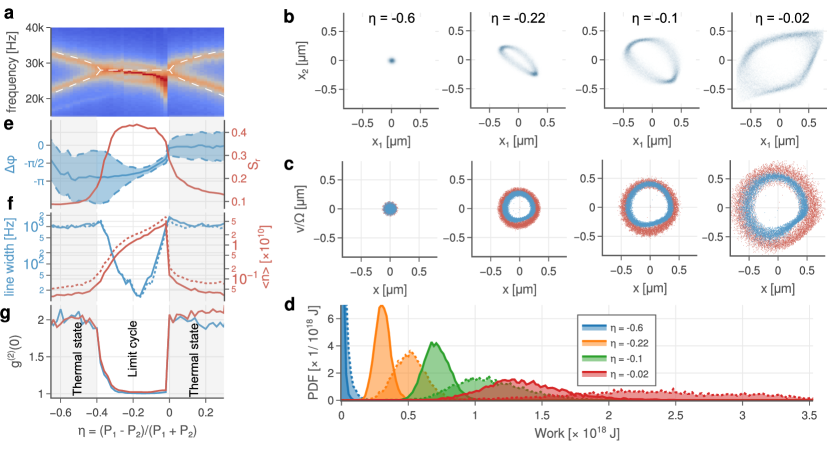
- パワー周波数ずれηを連続的に調整することで、安定平衡状態から複素固有値を有する非平衡状態へのPTに類似した相転移が観測された。
- 散逸を低減するとホフプ分岐が発生し、結合ナノ粒子系に集団的極限サイクル振動が出現した。
- 光学的結合相互作用の強さは、クーロン相互作用のおよそ10^4倍に達しており、光学的力が支配的であることを確認した。
- 測定された結合率b/Ω₀ < 10⁻⁴は、クーロン相互作用が光学的結合に比べて無視できるほど小さいことを示し、設計された非相互的光学的力の優位性を裏付けた。
- d字型エッジミラーの分離により粒子信号間のクロストークが最小限に抑えられ、安定した長時間の軌道(最大100,000フレーム)が達成された。
- 真のPT対称性が存在しないにもかかわらず、観測されたダイナミクスは非エルミート物理学、特に特異的点に類似した挙動と整合的であった。
より良い研究を、今すぐ始めましょう
論文の読解から最終レビューまで、研究時間を劇的に削減しましょう。
クレジットカード登録不要
このレビューはAIが作成し、人間の編集者が確認しました。