
[論文レビュー] On the archetypal `flavours', indices and teleconnections of ENSO revealed by global sea surface temperatures
本稿では、1982–2022年の全球表層水温(SST)および海面高異常(SLA)データから、伝統的なEP/CP分類を超える多様な『タイプ』のENSOを特定するため、原型的分析(AA)を導入する。この手法は、SSTのみで判別が難しい状況においても、ENSOフェーズの検出およびトランスミッションマッピングを改善し、微細なイベントダイナミクスと非定常性を捉えることで、準季節的から季節的予測システムを強化する。
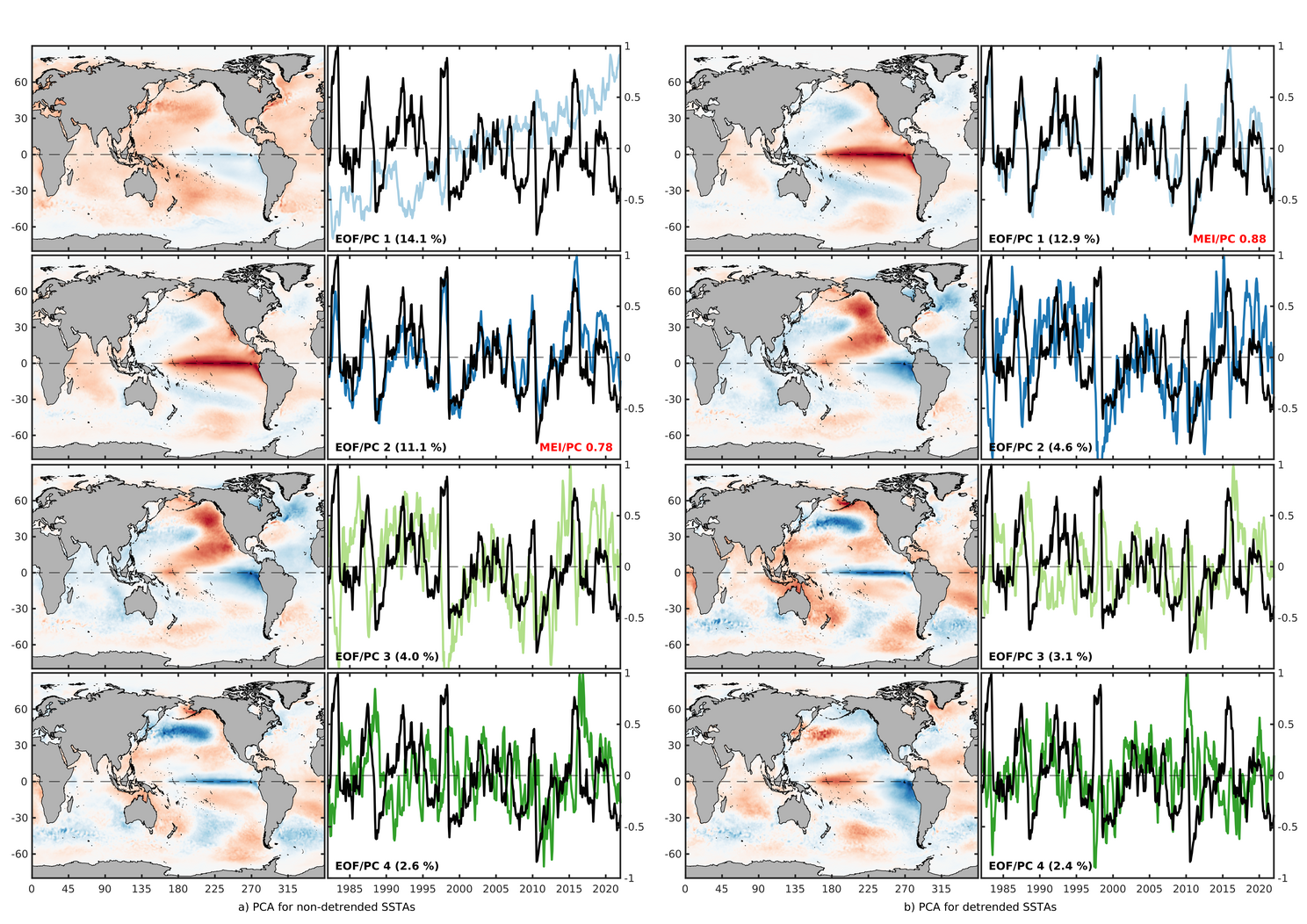
El Niño-Southern Oscillation global (ENSO) imprint on sea surface temperature comes in many guises. To identify its tropical fingerprints and impacts on the rest of the climate system, we propose a global approach based on archetypal analysis (AA), a pattern recognition method based on the identification of extreme configurations in the dataset under investigation. Relying on detrended sea surface temperature monthly anomalies over the 1982 to 2022 period, the technique recovers central and eastern Pacific ENSO types identified by more traditional methods and allows one to hierarchically add extra flavours and nuances to both persistent and transient phases of the phenomenon. Archetypal patterns found compare favorably to phase identification from K-means, fuzzy C-means and recently published network-based machine-learning algorithms. The AA implementation is modified for the identification of ENSO phases in sub-seasonal-to-seasonal prediction systems and complements current alert systems in characterising the diversity of ENSO and its teleconnections. Tropical and extra-tropical teleconnection composites from various oceanic and atmospheric fields derived from the analysis are shown to be robust and physically relevant. Extending AA to sub-surface ocean fields improves the discrimination between phases when the characterisation of ENSO based on sea surface temperature is uncertain. We show that AA on detrended sea-level monthly anomalies provides a clearer expression of ENSO types.
研究の動機と目的
- 単一インデックスに依存する伝統的なENSO分類手法の限界を是正すること。これらはENSOイベントの全般的な多様性を捉えられていない。
- 1982–2022年の期間にわたり、熱帯SST異常において複数の明確に異なるENSOの原型(タイプ)を特定可能な、データ駆動型で教師なしの手法を開発すること。
- SSTに基づく分類が識別不能である場合に生じる曖昧性を解消するために、海面高異常(SLA)を統合することで、ENSOフェーズの検出およびトランスミッション分析を向上させること。
- ENSOの発生、持続、減衰フェーズの特徴づけに関して、AAの堅牢性とスケーラビリティを評価し、他の気候モードへの応用を拡張すること。
提案手法
- 1982–2022年の期間にわたり、線形トレンドを除去した月次表層水温(SST)異常に対して、原型的分析(AA)を適用し、ENSOの極端で代表的なパターン(原型)を同定する。
- SSTパターンが曖昧または重複する場合のENSOフェーズの区別を向上させるために、線形トレンドを除去した海面高異常(dSLA)をAAに統合する。
- AAから得られる所属確率行列を、ENSOタイプの表現度を示す確率的指標として用い、大気および海洋場におけるトランスミッションの条件付き期待値分析を可能にする。
- AAで同定された原型が、K-means、ファジーセントロイド法、ネットワークベースの機械学習アルゴリズムといった既存手法と比較して一貫性と性能に優れているかを検証する。
- 原型への所属に基づく条件付き期待値を用いて、大気および海洋場における影響を熱帯および亜寒帯地域にわたってマッピングするためのトランスミッション合成図を作成する。
- 本手法の堅牢性を異なる期間および地理的領域で評価し、後続の統計的および機械学習モデルにおける次元削減ツールとしての有効性を検証する。
実験結果
リサーチクエスチョン
- RQ1原型的分析は、東太平洋(EP)および中央太平洋(CP)イベントといった既知のENSOタイプを、全球SST異常からどれほどよく回復できるか?
- RQ2SSTに基づく分類が不確かまたは曖昧な場合、海面高異常(SLA)を組み込むことで、ENSOフェーズの区別にどのような改善がもたらされるか?
- RQ3原型的分析は、ENSOサイクルの発生段階、主要段階、減衰段階において、微細なENSOフェーズを検出し、特徴づけることができるか?
- RQ4AAから得られるトランスミッションパターンは、従来の合成分析から得られるものと比べて、物理的妥当性および堅牢性において優れているか?
- RQ5AAの確率的性質により、1982–2022年の期間にわたりENSOイベント系列における非定常性の検出がどの程度可能になるか?
主な発見
- 原型的分析は、EPおよびCPイベントといった既存のENSOタイプを良好に回復しており、K-means、ファジーセントロイド法、ネットワークベースの機械学習手法と同等の結果を示している。
- 線形トレンドを除去した海面高異常(dSLA)を組み込むことで、ENSOタイプの明確さと区別能が顕著に向上し、特にSSTパターンが不明瞭または重複する場合に顕著である。
- 本手法により、1982–2022年の期間にわたり、2つのENSOイベント系列がまったく同一ではないことが明らかになった。これは、線形トレンドを除去してもENSO行動に非定常性が存在することを示している。
- AAから得られるトランスミッション合成図は物理的に整合性があり、明確な大気および海洋応答を示しており、それらは明確に分離されたENSO原型に関連している。
- AAの所属確率行列は、平均および分散におけるトランスミッションのより洗練された理解を可能にする確率的フレームワークを提供している。
- 表層水温に加えて、下層海洋場(例:dSLA)にAAを適用することで、ENSOフェーズの特徴づけが向上し、表面のみの指標がイベントタイプを区別できない場合の代替手段として有効である。
![Figure 2: AA results for cardinality 4 based only on dSSTAs first 2 PCs multiplied by their respective eigenvalues, $\textbf{X}_{2\times t}=[\lambda_{1}PC_{1},\lambda_{2}PC_{2}]$ . The 2D convex hull is the black polygon. Points in the pointset are represented by coloured dots if they lay within the](https://ar5iv.labs.arxiv.org/html/2406.08694/assets/fig2.png)
より良い研究を、今すぐ始めましょう
論文の読解から最終レビューまで、研究時間を劇的に削減しましょう。
クレジットカード登録不要
このレビューはAIが作成し、人間の編集者が確認しました。