
[論文レビュー] On the Skew-Symmetric Binary Sequences and the Merit Factor Problem
本稿では、反対称二値列の最適化において、フラップ操作の数学的性質を活用することで、メモリ複雑性を O(n²) から O(n) に低減する軽量な確率的アルゴリズムを提案する。長さ 10⁵+1 までに、5 を超えるマーリット要因を達成し、実行時間は列長に対して2次関数的に増加する。
The merit factor problem is of practical importance to manifold domains, such as digital communications engineering, radars, system modulation, system testing, information theory, physics, chemistry. However, the merit factor problem is referenced as one of the most difficult optimization problems and it was further conjectured that stochastic search procedures will not yield merit factors higher than 5 for long binary sequences (sequences with lengths greater than 200). Some useful mathematical properties related to the flip operation of the skew-symmetric binary sequences are presented in this work. By exploiting those properties, the memory complexity of state-of-the-art stochastic merit factor optimization algorithms could be reduced from $O(n^2)$ to $O(n)$. As a proof of concept, a lightweight stochastic algorithm was constructed, which can optimize pseudo-randomly generated skew-symmetric binary sequences with long lengths (up to ${10}^5+1$) to skew-symmetric binary sequences with a merit factor greater than 5. An approximation of the required time is also provided. The numerical experiments suggest that the algorithm is universal and could be applied to skew-symmetric binary sequences with arbitrary lengths.
研究の動機と目的
- 反対称二値列の最適化における高メモリ消費の確率的アルゴリズムの計算不能性に対処する。
- 反対称構造の数学的洞察を用いて、フラップ操作のメモリ複雑性を O(n²) から O(n) に低減する。
- 長大な長さ(最大 10⁵+1)において、マーリット要因 >5 を達成できる軽量な確率的アルゴリズムを開発する。
- さまざまな列長における高マーリット要因を達成するのに要する時間の、経験的および解析的近似を提供する。
提案手法
- 反対称二値列の数学的性質を活用し、マーリット要因計算に用いられる従来のタウテーブル(τ(S))の代わりに、O(n) の代替を導出する。
- 局所的(L)およびグローバル(G)な改善ヒューリスティクスを用いて探索ステップを誘導する確率的最適化アルゴリズムを設計する。
- 局所的最小値から脱出するため、列内の Q 個のランダムビットを反転する「Quake」関数を実装し、Q を列長に応じて動的にスケーリングする。
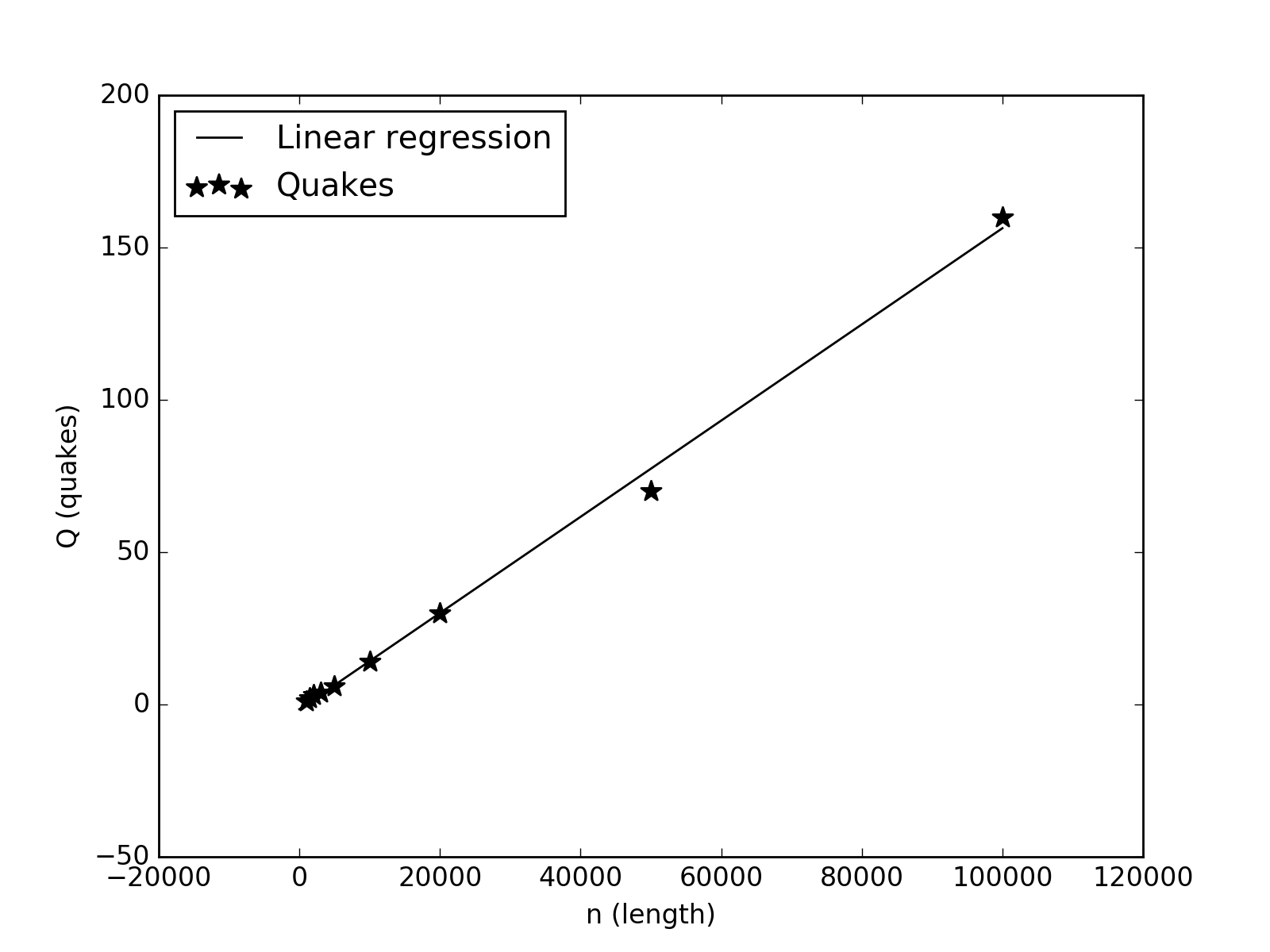
- 実験的 (n, Q) 組み合わせを用いて線形回帰を実行し、必要なクエイク数を Q ≈ 0.001578787n − 1.546093 でモデル化する。
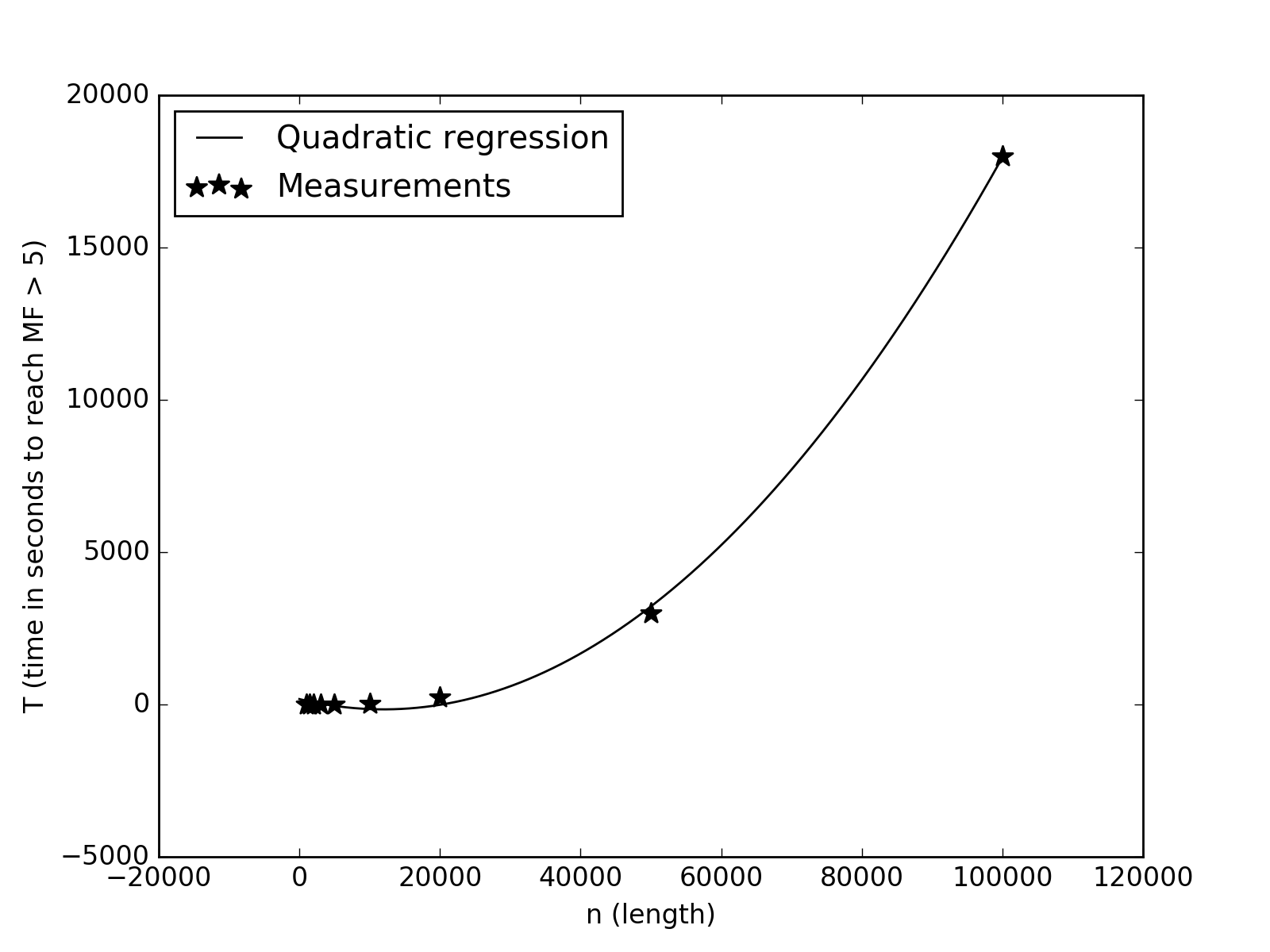
- (n, T) 測定値に2次回帰を適用し、実行時間 T ≈ 177.2867 − 0.0562043n + 0.000002340029n² 秒を推定する。
- C++ を用い、12スレッドシステムで、999 から 100,001 の列長にわたりアルゴリズムを検証し、実行結果に一貫性があることを確認した。
実験結果
リサーチクエスチョン
- RQ1反対称二値列の確率的マーリット要因最適化において、構造的性質を用いてメモリ複雑性を O(n²) から O(n) に低減できるか?
- RQ2長大な反対称列において、マーリット要因 >5 を達成するために必要な最小のランダムビット反転数(Q)は何か?
- RQ3マーリット要因 >5 を達成するのに要する実行時間は、列長 n の増加に伴いどのように変化するか?
- RQ4任意の奇数長(最大 10⁵+1)において、普遍的で軽量な確率的アルゴリズムが一貫して高マーリット要因の反対称列を生成できるか?
- RQ5列長と、高マーリット要因に到達するまでに必要なクエイク操作回数の間に、予測可能な関係があるか?
主な発見
- 提案されたアルゴリズムは、タウテーブルの代わりに数学的に導出された O(n) の代替を用いることで、フラップ操作のメモリ複雑性を O(n²) から O(n) に低減した。
- 長さ 10,001 の列では、Q = 14 のクエイクを用いて約 1 分でマーリット要因 >5 を達成した。
- 長さ 20,001 の列では、約 4 分でマーリット要因 >5 を達成した。このとき Q = 30 であった。
- 長さ 50,001 の列では、実行時間が約 40 分で、Q = 70 のクエイクを用いた。
- 長さ 100,001 の列では、約 5 時間でマーリット要因 >5 を達成した。このとき Q = 160 のクエイクを用いた。
- 必要なクエイク数 Q は n に対して線形に増加し、フィットしたモデルは Q ≈ 0.001578787n − 1.546093 であった。
より良い研究を、今すぐ始めましょう
論文の読解から最終レビューまで、研究時間を劇的に削減しましょう。
クレジットカード登録不要
このレビューはAIが作成し、人間の編集者が確認しました。