
[論文レビュー] Pupil-Adaptive 3D Holography Beyond Coherent Depth-of-Field
本稿では、リアルタイムの目差孔サイズに基づいてホログラフィック再構成における被写界深度を動的に調整する、瞳孔に適応するニューラルフレームワークを提案する。これにより、現実世界の非コherent光と区別できない写実的なぼかし効果が実現される。受容fieldの瞳孔依存性を学習することで、コherentホログラフィー固有の制限を克服し、先行手法と比較して最大5 dB高いPSNRを達成するとともに、物理的プロトタイプで自然なフォーカスキューを示した。
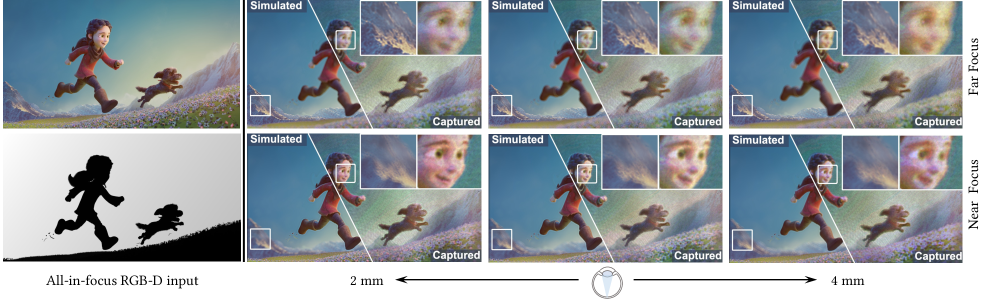
Recent holographic display approaches propelled by deep learning have shown remarkable success in enabling high-fidelity holographic projections. However, these displays have still not been able to demonstrate realistic focus cues, and a major gap still remains between the defocus effects possible with a coherent light-based holographic display and those exhibited by incoherent light in the real world. Moreover, existing methods have not considered the effects of the observer's eye pupil size variations on the perceived quality of 3D projections, especially on the defocus blur due to varying depth-of-field of the eye. In this work, we propose a framework that bridges the gap between the coherent depth-of-field of holographic displays and what is seen in the real world due to incoherent light. To this end, we investigate the effect of varying shape and motion of the eye pupil on the quality of holographic projections, and devise a method that changes the depth-of-the-field of holographic projections dynamically in a pupil-adaptive manner. Specifically, we introduce a learning framework that adjusts the receptive fields on-the-go based on the current state of the observer's eye pupil to produce image effects that otherwise are not possible in current computer-generated holography approaches. We validate the proposed method both in simulations and on an experimental prototype holographic display, and demonstrate significant improvements in the depiction of depth-of-field effects, outperforming existing approaches both qualitatively and quantitatively by at least 5 dB in peak signal-to-noise ratio.
研究の動機と目的
- コherentホログラフィックディスプレイと自然な非コherent光イメージングのギャップを埋めるために、瞳孔依存のぼかし効果をモデル化すること。
- 特にコherent光によって引き起こされる不自然なぼかし効果に起因する、現在のコンピュータ生成ホログラフィーにおける現実的なフォーカスキューの欠如に取り組むこと。
- リアルタイムの観測者瞳孔サイズの変動に基づいて、ホログラフィックディスプレイにおける被写界深度の動的適応を可能にすること。
- 非コherent光輸送効果を模倣することで、ホログラフィックプロジェクションの画像忠実度と写実性を向上させること。
- 単一のRGB画像を含む多様な入力モodalitiesをサポートする汎用的なフレームワークを構築すること。
提案手法
- 眼追跡データに基づいてリアルタイムに調整される瞳孔に適応する受容fieldを学習する統合的ニューラルフレームワークを設計した。
- 変動する瞳孔サイズがホログラフィック再構成における被写界深度の認識に与える影響をシミュレートするために、微分可能な波動伝搬モデルを用いた。
- 異なる瞳孔条件下での写実的再構成を生成するレンダリングパイプラインを組み込み、SLM位相パターンを非コherent光効果を模倣するように調整した。
- 高い画像忠実度と正確なぼかし効果を強制する損失関数を採用し、リバーブやスペックルなどのアーティファクトを最小限に抑えた。
- RGB-Dや単一のRGB画像を含む複数の入力モダリティをサポートし、広範な適用可能性を実現した。
- リアルタイムの眼追跡を備えた物理的プロトタイプディスプレイ上でシステムを検証し、瞳孔変化に応じた動的適応を実証した。
実験結果
リサーチクエスチョン
- RQ1コherent光に基づく波面変調の制約のもとで、非コherent光によって引き起こされるリアルなぼかし効果をホログラフィックディスプレイがどのように再現できるか。
- RQ2ニューラルフレームワークがリアルタイムの瞳孔サイズ測定に基づいて、ホログラフィック再構成の被写界深度をどれほど動的に適応できるか。
- RQ3瞳孔に適応するホログラフィーは、現在のコherentホログラフィー手法を上回る画像品質と受動的リアリズムを向上させられるか。
- RQ4単一のRGB画像やRGB-Dデータなどの異なる入力モダリティに、提案手法がどれほど一般化できるか。
- RQ5瞳孔依存のぼかしが、近眼型ホログラフィックディスプレイにおける被知覚的奥行きと視覚的快適性に与える影響は何か。
主な発見
- 提案手法は、最先端の手法と比較して最大5 dB高いピーク信号対雑音比(PSNR)を達成し、優れた画像忠実度を示した。
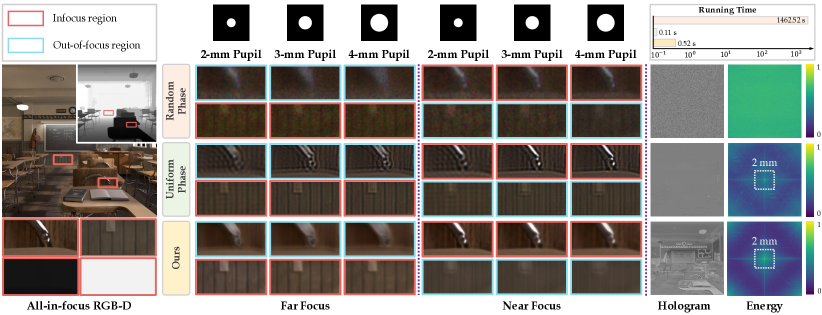
- フレームワークを用いて合成されたホログラムは、現実世界の非コherentイメージングと密接に一致する自然なぼかし効果を示し、コherentディスプレイで一般的な不自然なシャープネスやアーティファクトを解消した。
- 実験結果では、特にエッジ付近に顕著に現れるリングアーティファクトが、本手法により効果的に抑制された。これは、TensorHolo V1/V2などの先行手法に共通する問題であった。
- 物理的プロトタイプディスプレイを用いた実験により、瞳孔に適応するホログラフィーが、瞳孔状態の変化に応じて受動的にリアルな被写界深度効果を生成することが確認された。
- フレームワークは単一のRGB画像入力に対しても良好に一般化され、深度マップを必要とせずに妥当でリアルなぼかし効果を生成した。
- 主観的評価は今後の作業として計画されているが、結果から受動的リアリズムと視覚的快適性の顕著な向上が示唆される。
この論文を読む
Nubintのビューアで原文を開き、読みながら気になる箇所をすぐに質問できます。
Nubintでこの論文を読むこのレビューはAIが論文の原文をもとに作成しました。引用する前に原文をご確認ください。