
[論文レビュー] Second Euler number in four dimensional synthetic matter
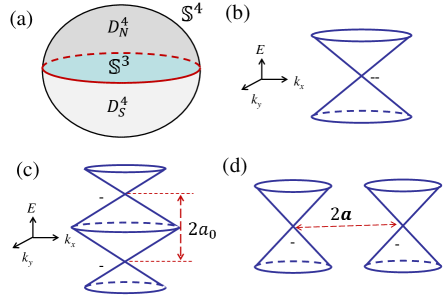
本稿は、4次元の合成物質におけるトポロジカル不変量として第二のオイラー数を導入し、ギャップなし境界状態を強く保証する2つの新しいタイトバインディング模型を提案する。主な結果は、4バンド部分空間内に存在する連結されたノード面の三重組みが、4次元のバルクノード構造を形成することの同定であり、最小ブロッホハミルトニアンのグラスマンニアン構成を介して、超冷却原子系で実現可能である。
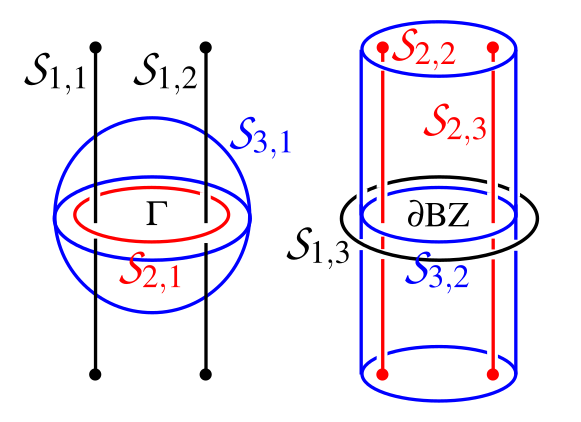
Two-dimensional Euler insulators are novel kind of systems that host multi-gap topological phases, quantified by a quantised first Euler number in their bulk. Recently, these phases have been experimentally realised in suitable two-dimensional synthetic matter setups. Here we introduce the second Euler invariant, a familiar invariant in both differential topology (Chern-Gauss-Bonnet theorem) and in four-dimensional Euclidean gravity, whose existence has not been explored in condensed matter systems. Specifically, we firstly define two specific novel models in four dimensions that support a non-zero second Euler number in the bulk together with peculiar gapless boundary states. Secondly, we discuss its robustness in general spacetime-inversion invariant phases and its role in the classification of topological degenerate real bands through real Grassmannians. In particular, we derive from homotopy arguments the minimal Bloch Hamiltonian form from which the tight-binding models of any second Euler phase can be generated. Considering more concretely the gapped Euler phase associated with the tangent bundle of the four-sphere, we show that the bulk band structure of the nontrivial 4D Euler phase necessarily exhibits triplets of linked nodal surfaces (where the three types of nodal surfaces are formed by the crossing of the three successive pairs of bands within one four-band subspace). Finally, we show how to engineer these new topological phases in a four-dimensional ultracold atom setup. Our results naturally generalize the second Chern and spin Chern numbers to the case of four-dimensional phases that are characterised by real Hamiltonians and open doors for implementing such unexplored higher-dimensional phases in artificial engineered systems, ranging from ultracold atoms to photonics and electric circuits.
研究の動機と目的
- 4次元系における第二のオイラー数を強固な不変量として導入することで、高次元におけるトポロジカル相の分類を拡張すること。
- 非ゼロの第二のオイラー数を支持し、特異なギャップなし境界モードを示す4次元の明示的タイトバインディング模型を構築すること。
- 実グラスマンニアンとホモトピー論を用いた、トポロジカルに退inglyな実バンドの分類の一般枠組みを確立すること。
- すべての第二のオイラー相を体系的に生成可能な最小ブロッホハミルトニアンの形を導出すること。
- 4次元の超冷却原子系におけるこのような相がどのように設計可能かを示すことにより、実験的実現可能性を示すこと。
提案手法
- 著者らは、ブリユアンゾーンから実4次元フレームのグラスマンニアン多様体への写像を介して、4次元球面の接 bundle を引き戻すことにより、4次元タイトバインディング模型を定義する。
- S⁴ 上の超球座標から得られるユニタリフレームを用いて、接 bundle の滑らかな断面を定義し、これにより有限の跳躍範囲を持つ実ハミルトニアンを構築する。
- ハミルトニアンの運動量空間形を、Hopf 型の余弦および正弦関数の有限フーリエ級数展開により近似することで、模型を実現する。
- 第二のオイラー数は、ブリユアンゾーン上のグラスマンニアン bundle の曲率と関連するチェーン=ガウス=ボンネの定理を用いて計算される。
- 実グラスマンニアンのホモトピー群の解析から、最小ブロッホハミルトニアンが導出され、連続的変形に対してトポロジカルに安定であることが保証される。
- 非自明な4次元オイラー相が、4バンド部分空間内での連続するバンドギャップの交差によって形成される三重の連結ノード面を有することを示すことで、構成の妥当性が検証される。
実験結果
リサーチクエスチョン
- RQ1微分トポロジーおよび4次元重力で知られている第二のオイラー数が、実ハミルトニアンを持つ物性系においてトポロジカル不変量として実現可能か。
- RQ24次元において非自明な第二のオイラー数を支持する最小のブロッホハミルトニアンの形は何か。
- RQ3このような相のバルクバンド構造は、特にノードトポロジーの観点からどのように現れるか。
- RQ4時空反転対称性が第二のオイラー不変量を安定化するために果たす役割は何か。
- RQ5このような4次元トポロジカル相が、超冷却原子などの合成量子系で設計可能か。
主な発見
- 非自明な4次元オイラー相は、単一の4バンド部分空間内での3つの連続するバンドペアの交差によって形成される、連結されたノード面の三重組みを必然的に示すバルクバンド構造によって特徴づけられる。
- 第二のオイラー数は、時空反転対称性を有する相においても安定であり、このような対称性下でのトポロジカル保護を示している。
- 任意の第二のオイラー相の最小ブロッホハミルトニアンは、実グラスマンニアン多様体のホモトピー不変量から導出され、普遍的な構築フレームワークを提供する。
- 逆格子空間におけるハミルトニアンの近似として、有限フーリエ級数展開を用いることで、有限跳躍範囲のタイトバインディングハミルトニアンが実現される。
- 第二のオイラー不変量によって保護される特異なギャップなし境界状態が、低次元トポロジカル絶縁体のエッジモードに類似した性質を示す。
- グラスマンニアンに基づく構成を用いることで、適切な跳躍振幅とバンド構造を設計することにより、4次元の超冷却原子系でこの相を実験的に実現可能である。
この論文を読む
Nubintのビューアで原文を開き、読みながら気になる箇所をすぐに質問できます。
Nubintでこの論文を読むこのレビューはAIが論文の原文をもとに作成しました。引用する前に原文をご確認ください。