
[論文レビュー] Spectroscopy of edge and bulk collective modes in fractional Chern insulators
本稿では、超低温原子で実現された分数チェーンインソレーターにおけるキラルなエッジモードおよびバルク磁気ロトンモードをプローブするため、干渉するラゲール・ガウスビームを用いた分光法プロトコルを提案する。制御された角運動量とエネルギーを転送することで、局所密度測定を用いてエッジおよびバルク励起状態を検出する手法であり、現実的な実験パラメータのもとでも、2ボソン系であってもこれらのシグナルが検出可能であることを示している。
The exploration of atomic fractional quantum Hall (FQH) states is now within reach in optical-lattice experiments. While ground-state signatures have been observed in a system realizing the Hofstadter-Bose-Hubbard model in a box [Leonard et al., Nature 2023], how to access hallmark low-energy collective modes remains a central open question in this context. We introduce a spectroscopic scheme based on two interfering Laguerre-Gaussian beams, which transfer a controlled angular momentum and energy to the system. The edge and bulk responses to the probe are detected through local density measurements, by tracking the transfer of atoms between the bulk and the edge of the FQH droplet. This detection scheme is shown to simultaneously reveal two specific signatures of FQH states: their chiral edge branch and their bulk magneto-roton mode. We numerically benchmark our method by considering few bosons in the $ν=1/2$ Laughlin ground state of the Hofstadter-Bose-Hubbard model, and demonstrate that these signatures are already detectable in realistic systems of two bosons, provided that the box potential is larger than the droplet. Our work paves the way for the detection of fractional statistics in cold atoms through edge signatures.
研究の動機と目的
- 超低温原子の分数量子ホール状態における低エネルギー集団モード、特にキラルなエッジモードおよびバルク磁気ロトンモードを検出する分光法を開発すること。
- 現在の実験的可及的な少数体系、例えば2ボソンのFQHドロップレットにおいても、これらの普遍的シグナルを実験的に検出可能にする。
- 量子ガス顕微鏡を用いた局所密度測定により、実用的で実験的に実現可能なプロトコルを提供すること。
- エッジモードの数え上げとバルクモードの角運動量構造を用いて、トポロジカル相を区別すること。
- 角運動量分解された吸収スペクトルとエッジ状態の conformal field theory 予測との間の関係を確立すること。
提案手法
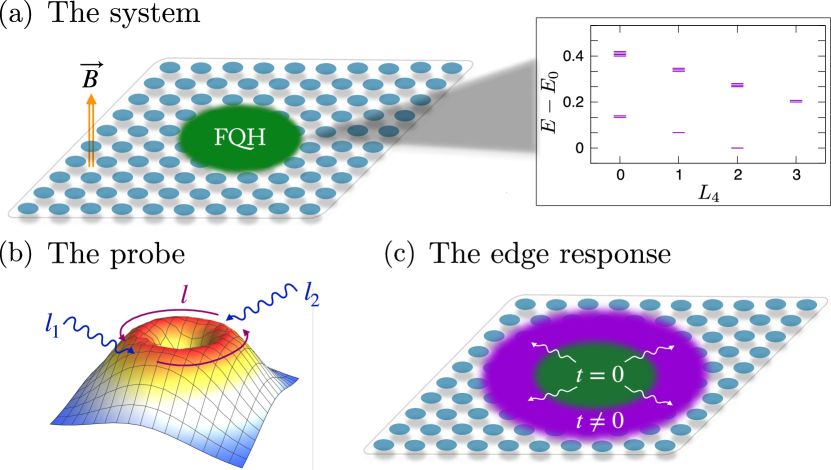
- プロトコルは、制御された角運動量 $ l = l_1 - l_2 $ とエネルギー $ \bar{\hbar}\omega $ を系に転送する2つの干渉するラゲール・ガウスレーザービームを用いる。
- プローブは、レーザー場の空間的分布と多体波動関数との行列要素を通じて系に結合し、エッジモードおよびバルクモードの選択的励起を可能にする。
- 反応は、時間発展に伴う局所密度の変化として測定される:エッジでの密度増加はエッジ状態の励起を示し、バルク密度の変化は磁気ロトンモードの励起を示す。
- 角運動量分解された吸収スペクトルは、プローブ周波数 $ \omega $ の関数としてバルク領域とエッジ領域間の密度転送を測定することで抽出される。
- 低エネルギー状態に現れる有効な回転対称性に起因する近似選択則を活用することで、混合されたエッジおよびバルクモードを解離可能にする。
- 数値シミュレーションでは、ボックス型閉じ込め下での $ \nu = 1/2 $ ラウフリン基底状態をもつホフスタッター・ボーズ・ハッブルモデルを用いる。
実験結果
リサーチクエスチョン
- RQ1少数体の超低温原子系において、分数チェーンインソレーターのキラルエッジモードを光学分光法でプローブ可能か?
- RQ22ボソン系においてもバルク磁気ロトンモードを実験的に解像可能か?
- RQ3プローブの角運動量およびエネルギーがエッジモードおよびバルクモードの検出にどのように影響するか?
- RQ4観測された分光的シグナルが、ラウフリンとムーア=リードのFQH状態のような異なるFQH状態をどの程度明確に区別できるか?
- RQ5プローブからのエッジモードの数え上げが、自由なキラルボソンの conformal field theory 予測と一致するか?
主な発見
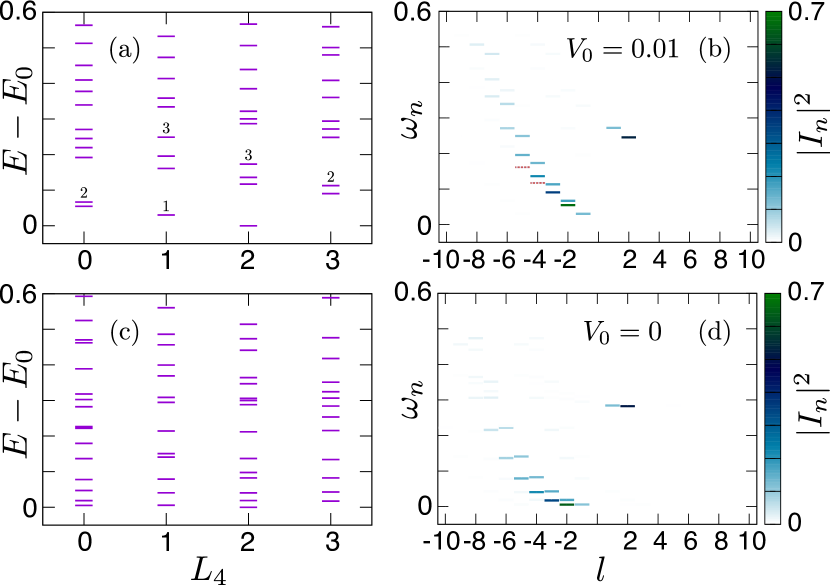
- 2ボソン系において、ドロップレットサイズより大きなボックスポテンシャルを用いた場合、角運動量分解された吸収スペクトルにおいてキラルエッジモードおよび磁気ロトンモードが明確に解像される。
- $ l = -1 $ に対して $ \omega \approx 0.03 \, \hbar/J $ の共鳴が観測され、エッジ状態の励起に対応し、$ t^* = 50 \, \hbar/J $ 経過後に $ \Delta\rho_{\text{edge}} \sim 0.1-1 $ の検出可能な密度転送が観測される。
- この手法によりエッジ励起とバルク励起が明確に区別できる:エッジ状態はドロップレットの端縁で密度増加を示し、MRAはバルク密度の調制を引き起こす。
- $ l = -3 $ までエッジモードの数え上げが自由なキラルボソンのCFT予測と一致し、エッジのトポロジカル性が確認される。
- より強い閉じ込めはエネルギー分裂を増大させ、同じ $ l $ における共鳴の解像を、より長い観測時間なしに可能にする。
- 3または4粒子系に対してもこのプロトコルは有効であり、2体極限を超えたロバスト性が示される。
この論文を読む
Nubintのビューアで原文を開き、読みながら気になる箇所をすぐに質問できます。
Nubintでこの論文を読むこのレビューはAIが論文の原文をもとに作成しました。引用する前に原文をご確認ください。