
[論文レビュー] Stringy Running Vacuum Model and current Tensions in Cosmology
本論文は、量子重力にインspiredされた宇宙論的枠組みとして、ストリング理論由来の重力異常と量子補正を組み込むことで、ΛCDMモデルにおけるハッブル定数と構造成長の両方の矛盾を動的に説明する『ストリング的ランニング真空中間モデル』(StRVM)を提案する。このモデルは、Hubbleパラメータに依存する真空中エネルギー項を対数的ランニングとともに導入し、現在の宇宙論的矛盾を顕著に緩和する一方で、観測データおよび量子場理論の原則に整合している。
We discuss the potential alleviation of both the Hubble and the growth of galactic structure data tensions observed in the current epoch of Cosmology in the context of the so-called Stringy Running Vacuum Model (RVM) of Cosmology. This is a gravitational field theory coupled to matter, which, at early eras, contains gravitational (Chern-Simons (CS) type) anomalies and torsion, arising from the fundamental degrees of freedom of the massless gravitational multiplet of an underlying microscopic string theory. The model leads to RVM type inflation without external inflatons, arising from the quartic powers of the Hubble parameter that characterise the vacuum energy density due to primordial-gravitational-wave-induced anomaly CS condensates, and dominate the inflationary era. In modern eras, of relevance to this work, the gravitational anomalies are cancelled by chiral matter, generated at the end of the RVM inflationary era, but cosmic radiation and other matter fields are still responsible for a RVM energy density with terms exhibiting a quadratic-power-of-Hubble-parameter dependence, but also products of the latter with logarithmic $H$-dependencies, arising from potential quantum-gravity and quantum-matter loop effects. In this work, such terms are examined phenomenologically from the point of view of the potential alleviation of the aforementioned current tensions in Cosmology. Using standard information criteria, we find that these tensions can be substantially alleviated in a way consistent not only with the data, but also with the underlying microscopic theory predictions, associated with the primordial dynamical breaking of supergravity that characterise a pre-RVM-inflationary phase of the model.
研究の動機と目的
- 現代宇宙論における持続的なハッブル定数および大規模構造の成長の矛盾を解決すること。
- 現象論的ΛCDMフレームワークを越えた、根本的な量子重力にインspiredされた宇宙論的モデルを構築すること。
- ストリング理論に由来する重力異常およびカイラル物質からの量子補正が、動的にランニングする真空中エネルギー密度を生成できるかどうかを検討すること。
- このモデルが、同時にCMB、SNIa、BAO、およびH₀データと整合し、現在の宇宙論的矛盾を緩和できるかどうかをテストすること。
- 有効場理論を通じて、初期の超対称性の破れと、晩期の真空中動態との間に接続を確立すること。
提案手法
- モデルは、曲がった時空における量子場理論から導出され、ストリング理論の質量なし重力多重項に由来するChern-Simons型の重力異常およびねじれを含む。
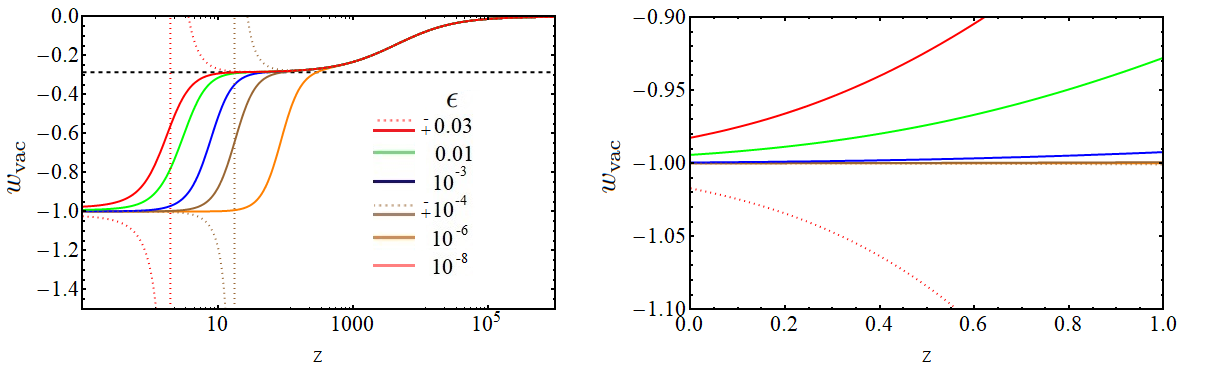
- モデルは、Hubbleパラメータの四次および二次の項に加え、量子重力および量子物質のループ効果に起因する対数的H依存性を持つ真空中エネルギー密度(VED)を導入する。
- モデルは、外部のインフレーション粒子を必要とせず、初期の重力波誘発異常凝集体によって駆動されるRVM型のインフレーションを自然に導く。
- 現代の宇宙論的時代において、重力異常はカイラル物質によってキャンセルされるが、H²およびH²lnH依存性を持つ残存するVED項が残存する。
- 標準的な情報基準(ΔAIC、ΔBIC)を用いて、Planck 2018、SNIa、BAO、および局所的H₀データ(高ℓ CMB、レンズ効果、np(偏光なし)データセットを含む)に対してモデルをテストする。
- 摂動論を用いて、FLRW背景におけるスカラー、ベクトル、テンソルモードの一次元メトリックおよび物質の揺らぎの式を導出する。
実験結果
リサーチクエスチョン
- RQ1ストリング理論に由来するランニング真空中間モデルは、便宜的な成分を導入せずに現在のハッブル定数の矛盾を緩和できるか?
- RQ2このモデルは、ΛCDMフレームワークにおける構造成長の矛盾をどの程度緩和できるか?
- RQ3量子重力および量子物質のループ効果は、晩期宇宙論における真空中エネルギー密度をどのように修正するか?
- RQ4StRVMは、初期(CMB)および晩期(SNIa、BAO、H₀)の観測と両立可能か?
- RQ5このモデルの現象論は、動的超対称性の破れを含む予インフレーション期の基本的プロセスから導出可能か?
主な発見
- StRVMは、組み合わせたデータセット(Planck18 + SNIa + BAO + CCH)に対して、ΛCDMと比較してχ²minが顕著に低く、全データセットでΔχ²min ≈ 20となり、適合度の向上を示している。
- モデル選択性能の観点から、BICおよびAICスコアがΛCDMを上回っており、より優れたモデル選択が可能であることを示している。
- 高ℓ CMB偏光(Planck18(np))およびレンズ効果(Planck18(lens))データを含めても、StRVMはΛCDMを上回り、主な設定でΔχ²min ≈ 10–15の優位性を示している。
- モデルの真空中エネルギー密度には、H²およびH²lnHに比例する項が含まれており、これは量子補正に起因するもので、矛盾の緩和に不可欠である。
- StRVMは、ビッグバン核合成(BBN)制約と整合しており、現在の現象論的フィットと同程度のオーダーのRVMパラメータを持つ。
- モデルの動的真空中性は、カイラル物質による重力異常のキャンセルから自然に生じ、初期宇宙の量子重力と晩期宇宙論の真空中動態を結びつける。
この論文を読む
Nubintのビューアで原文を開き、読みながら気になる箇所をすぐに質問できます。
Nubintでこの論文を読むこのレビューはAIが論文の原文をもとに作成しました。引用する前に原文をご確認ください。