
[論文レビュー] Structural Chirality and Electronic Chirality in Quantum Materials
本論文は、軌道角運動量ロックを介して、量子材料における構造的キラリティと電子的キラリティを統一的な枠組みで結びつけるものであり、原子スケールのヘンネスがスピン分極(CISS)、ダイオード様の輸送(EMCA)、および異常な円偏光光放出(ACPLE)を引き起こすことを示している。主な貢献は、これらのキラル現象の背後にある中心的メカニズムとして軌道角運動量ロックを特定したことである。本研究の示唆は、スピントロニクス、オプトエレクトロニクス、およびトポロジカル量子材料分野に及ぶ。
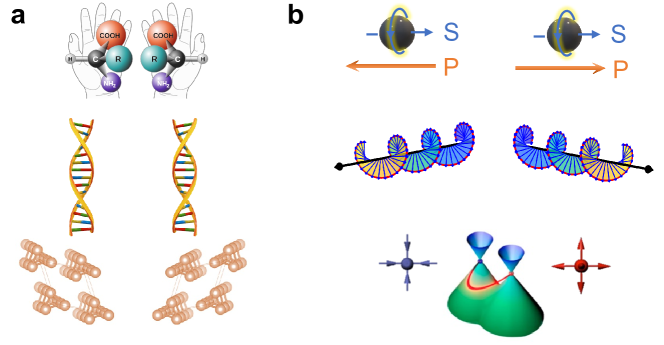
In chemistry and biochemistry, chirality represents the structural asymmetry characterized by non-superimposable mirror images for a material like DNA. In physics, however, chirality commonly refers to the spin-momentum locking of a particle or quasiparticle in the momentum space. While seemingly disconnected, structural chirality in molecules and crystals can drive electronic chirality through orbital-momentum locking, i.e. chirality can be transferred from the atomic geometry to electronic orbitals. Electronic chirality provides an insightful understanding of the chirality-induced spin selectivity (CISS), in which electrons exhibit salient spin polarization after going through a chiral material, and electric magnetochiral anisotropy (EMCA), which is characterized by the diode-like transport. It further gives rise to new phenomena, such as anomalous circularly polarized light emission (ACPLE), in which the light handedness relies on the emission direction. These chirality-driven effects will generate broad impacts in fundamental science and technology applications in spintronics, optoelectronics, and biochemistry.
研究の動機と目的
- 原子スケールの構造的キラリティと量子材料における顕在する電子的キラリティとの微視的関係を確立すること。
- 軌道角運動量ロックとスピン軌道結合を介して、キラル誘起スピン選択的透過(CISS)の起源を説明すること。
- EMCAとCISSを、同じ根本的メカニズムたる軌道角運動量ロックに結びつける統一的理解を提供すること。
- キラル有機半導体における異常な円偏光光放出(ACPLE)の物理的起源を、光学ベリー位相を用いて説明すること。
- ハイブリッドペロブスカイトやねじれ2次元ヘテロ構造を含む多様な材料におけるキラル量子現象の予測および設計のための一般理論枠組みを提案すること。
提案手法
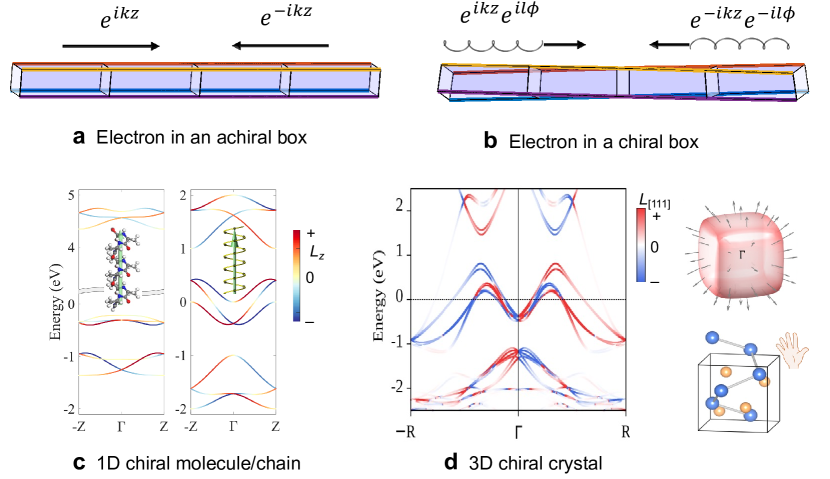
- ねじれた3次元ボックスの簡易モデルを用いて、キラルな幾何学的構造が電子波動関数に軌道角運動量(OAM)を誘発し、それによって軌道角運動量ロックが生じることを示す。
- 軌道角運動量ロックの概念を応用し、キラル分子における波動関数の構造を導出し、$k$ と $l$ が符号および大きさでロックされていることを示す。
- 金属接触におけるスピン軌道結合(SOC)の役割を導入し、軌道スピン極化をスピン極化に変換することでCISS効果を可能にする。
- オンサーガーの相反関係を適用してEMCAとCISSを結びつけ、両者の共通の起源がキラル電子構造に起因する時間反転対称性の破れにあることを示す。
- 光学ベリー位相を用いてACPLEを分析し、電流誘起の軌道極化が方向依存の円偏光光放出を引き起こすことを示す。
- 光学ベリー曲率ダイポールを用いてACPLEを固体へ一般化し、非中心対称材料における固有のバンド構造特性と関連付ける。
実験結果
リサーチクエスチョン
- RQ1材料内の構造的キラリティが、どのように軌道角運動量ロックを介して内在的な電子的キラリティを誘発するか?
- RQ2キラル分子におけるキラル誘起スピン選択的透過(CISS)効果の微視的メカニズムは何か?
- RQ3EMCAとCISSはどのように関連づけられ、両者を貫く共通の物理的起源は何か?
- RQ4キラル有機半導体における異常な円偏光光放出(ACPLE)を可能にする光学ベリー位相の役割は何か?
- RQ5非中心対称固体における光学ベリー曲率ダイポールは、新しい材料におけるACPLEの予測および設計に利用可能か?
主な発見
- キラル分子やキラル結晶における構造的キラリティは、電子の軌道角運動量(OAM)が運動量にロックされることで、電子的キラリティを誘発する。
- 軌道角運動量ロックメカニズムは、CISSで観測されるスピン分極を説明するものであり、金属接触におけるスピン軌道結合によってスピンフィルタリングが可能になる。
- EMCAとCISSは、キラル電子構造に起因する時間反転対称性の破れという同じ基本的物理現象の二つの顕現であることが示され、オンサーガーの相反関係によって結びつけられる。
- 異常な円偏光光放出(ACPLE)は、電流誘起の軌道極化に起因し、放射の方向が放出される円偏光光のヘンネスを決定づける。
- ACPLEは電子・正孔再結合における光学ベリー位相に起因し、キャリアから光子への角運動量の転送により、前向および逆方向発光で同じヘンネスが観測される。
- 光学ベリー曲率ダイポールは、有機半導体にとどまらずペロブスカイトや2次元ヘテロ構造を含む固体系キラル材料におけるACPLEを予測する一般枠組みを提供する。
より良い研究を、今すぐ始めましょう
論文の読解から最終レビューまで、研究時間を劇的に削減しましょう。
クレジットカード登録不要
このレビューはAIが作成し、人間の編集者が確認しました。