
[論文レビュー] The metallicity dependence of the stellar initial mass function
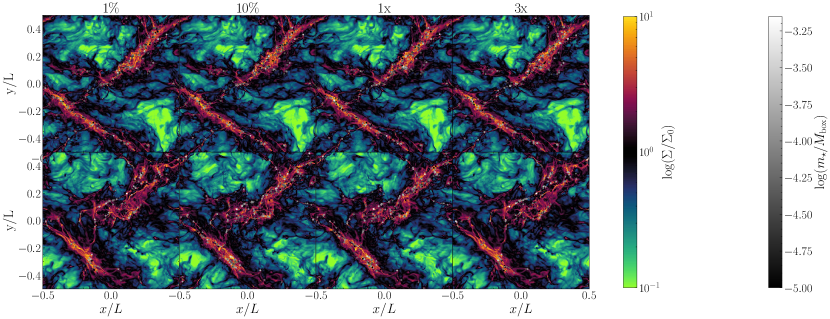
本研究では、放射磁気流体力学的シミュレーションを用いて、金属量が星の初期質量関数(IMF)に与える影響を調査した。金属量の変化により、わずかなIMFシフトが生じるが、金属量が低い環境では放射フィードバックが弱いため、やや底部が重いIMFが形成される。しかし、その変化は初期期銀河における観測されたIMFの変動を説明するには小さすぎる。表面密度が、金属量よりもIMF変動の主因である。表面密度が高い環境では、フィードバック効率が向上するため、より底部が重いIMFが形成される。
Dust is important for star formation because it is the crucial component that couples gas to stellar radiation fields, allowing radiation feedback to influence gas fragmentation and thus the stellar initial mass function (IMF). Variations in dust abundance therefore provide a potential avenue by which variation in galaxy metallicity might affect the IMF. In this paper we present a series of radiation-magnetohydrodynamic simulations in which we vary the metallicity and thus the dust abundance from 1% of Solar to 3$ imes$ Solar, spanning the range from the lowest metallicity dwarfs to the most metal-rich early-type galaxies found in the local Universe. We design the simulations to keep all dimensionless parameters constant so that the interaction between feedback and star-forming environments of varying surface density and metallicity is the only factor capable of breaking the symmetry between the simulations and modifying the IMF, allowing us to cleanly isolate and understand the effects of each environmental parameter. We find that at a fixed surface density more metal-rich clouds tend to form a slightly more bottom-heavy IMF than metal-poor ones, primarily because in metal-poor gas radiation feedback is able to propagate further, heating somewhat larger volumes of gas. However, shifts in IMF with metallicity at a fixed surface density are much smaller than shifts with surface density at fixed metallicity; metallicity-induced IMF variations are too small to explain the variations in mass-to-light ratio reported in galaxies of different mass and metallicity. We, therefore, conclude that metallicity variations are much less important than variations in surface density in driving changes in the IMF and that the latter rather than the former are most likely responsible for the IMF variations found in early-type galaxies.
研究の動機と目的
- シミュレーションにおけるすべての次元なしパラメータを一定に保つことで、金属量が星の初期質量関数(IMF)に与える影響を分離する。
- ダストの豊度を介した金属量の変動が、初期期銀河とスパイラル銀河の間で観測されたIMF差を説明できるかを検証する。
- 放射フィードバックと原始星の噴出フィードバックの役割を、金属量と表面密度の変動に応じて分離して評価する。
- 金属量に起因するIMFシフトが、異なる金属量を持つ銀河における観測された質量対光度比の変動を説明できるかを評価する。
提案手法
- 太陽金属量の1%から300%の金属量を変化させながら、すべての次元なしパラメータ(例:バーリングパラメータ、マッハ数)を一定に保った放射磁気流体力学的(RMHD)シミュレーションを実施する。
- 表面密度と金属量を系統的に変化させ、それらがIMFに与える個別の影響を分離し、雲の光学厚さのみが変化するようにする。
- ダストがガスと放射場を結合するモデルを用いた一貫したフィードバックモデル(原始星の噴出と放射フィードバックを含む)を採用する。
- 等回折法則を用いて質量対光度比を計算し、太陽金属量におけるChabrier IMFと比較することで、IMFのずれを定量化する。
- さまざまな星族の年齢におけるIMFの形状と不一致パラメータを分析し、時間依存的効果を評価する。
- シミュレートされたIMFシフトを初期期銀河における観測された質量対光度比の変動と比較し、説明力の有無を評価する。
実験結果
リサーチクエスチョン
- RQ1ダストの豊度の変化を介した金属量の変動が、星形成領域における星の初期質量関数(IMF)を顕著に変化させるか?
- RQ2放射フィードバックと原始星の噴出フィードバックは、金属量に応じてどのように相互作用し、IMFを形成するか?
- RQ3金属量に起因するIMF変動は、初期期銀河とスパイラル銀河の間で観測された質量対光度比の差を説明するのに十分な大きさか?
- RQ4すべての次元なしパラメータを一定に保った状態で、表面密度の変化と金属量の変化がIMFに与える影響はどのように異なるか?
主な発見
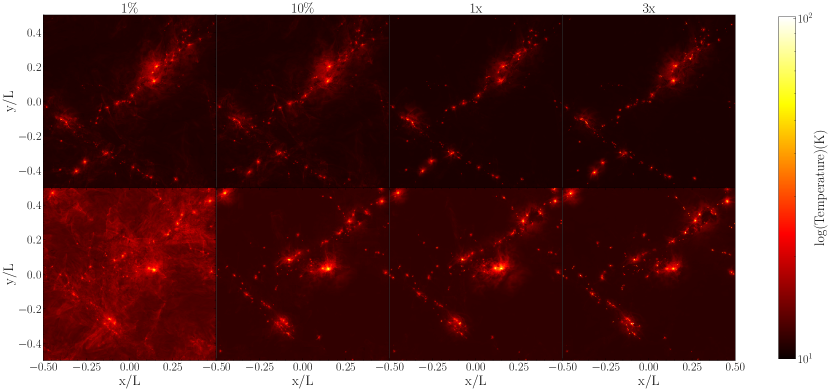
- 表面密度を一定に保つと、金属量の高い環境では金属量の低い環境よりもわずかに底部が重いIMFが形成される。これは主に、金属量が高いと噴出ガスの衝撃加熱がより効率的に冷却されるためである。
- IMFの高質量端は原始星の噴出フィードバックに特に感受性が高く、金属量が高い環境では、大質量星形成がより効果的に抑制される。
- IMFの低質量端は放射フィードバックによって形成され、金属量が低い環境では放射結合が弱いため、フラグメンテーションの抑制がより効果的である。
- 金属量に起因するIMFのネットシフトは小さく、初期期銀河における観測された質量対光度比の変動を説明するには不十分である。
- 表面密度の変化によるIMFシフトは、金属量によるものよりも顕著に大きく、表面密度がIMF変動の主因である。
- 本研究の結論として、表面密度が初期期銀河とスパイラル銀河の間で観測されたIMF差の主な要因であると結論づけた。
この論文を読む
Nubintのビューアで原文を開き、読みながら気になる箇所をすぐに質問できます。
Nubintでこの論文を読むこのレビューはAIが論文の原文をもとに作成しました。引用する前に原文をご確認ください。