
[論文レビュー] The Spatial Complexity of Optical Computing and How to Reduce It
本論文は、物理学にインspiredされた構造的スパarsity(自由空間光学における局所的スパarsityおよびフォトニクスチップにおけるブロック対角スパarsity)を活用することで、光学コンピューティングシステムの空間的複雑性を低減する、空間効率的な神経モルフィック光学のパラダイムを提唱する。性能損失を最小限に抑えつつ、最大90%のサイズ削減を達成し、最適なスケーリング則とバランスの取れた空間-精度トレードオフを示している。
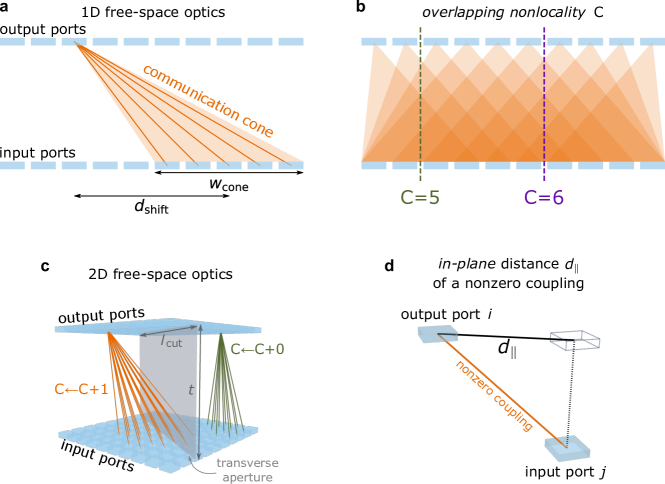
Similar to algorithms, which consume time and memory to run, hardware requires resources to function. For devices processing physical waves, implementing operations needs sufficient "space," as dictated by wave physics. How much space is needed to perform a certain function is a fundamental question in optics, with recent research addressing it for given mathematical operations, but not for more general computing tasks, e.g., classification. Inspired by computational complexity theory, we study the "spatial complexity" of optical computing systems in terms of scaling laws - specifically, how their physical dimensions must scale as the dimension of the mathematical operation increases - and propose a new paradigm for designing optical computing systems: space-efficient neuromorphic optics, based on structural sparsity constraints and neural pruning methods motivated by wave physics (notably, the concept of "overlapping nonlocality"). On two mainstream platforms, free-space optics and on-chip integrated photonics, our methods demonstrate substantial size reductions (to 1%-10% the size of conventional designs) with minimal compromise on performance. Our theoretical and computational results reveal a trend of diminishing returns on accuracy as structure dimensions increase, providing a new perspective for interpreting and approaching the ultimate limits of optical computing - a balanced trade-off between device size and accuracy.
研究の動機と目的
- 与えられた計算タスクに対して光学コンピューティングシステムがどのくらい小さくできるかという根本的問いに答えること、特に分類のような汎用関数に対して。
- タスクの複雑性が増加するに従い、波動に基づくコンピューティングシステムの空間的スケーリング則を特定すること。
- 計算複雑性理論および波動物理学にインspiredされた、物理的サイズを犠牲にせずに性能を維持する新しい設計パラダイムの開発。
- 光学コンピューティングにおけるデバイスサイズと精度のトレードオフを調査し、ある複雑性の閾値を超えると収益が減少する傾向を特定すること。
- 物理学的プリーニングにインspiredされた手法により、神経ネットワークのスパarsityパターンと光学ハードウェア設計を一致させることで、ハードウェア-ソフトウェア連携を実現すること。
提案手法
- 波動物理学に由来する構造的スパarsity制約に基づく、空間効率的な神経モルフィック光学フレームワークを提唱する。特に「重なり合う非局所性」に着目する。
- 神経ネットワークのプリーニング技術を光学システムに適用するが、純粋にアルゴリズム的な制約ではなく、物理的波の制約に適応させる。
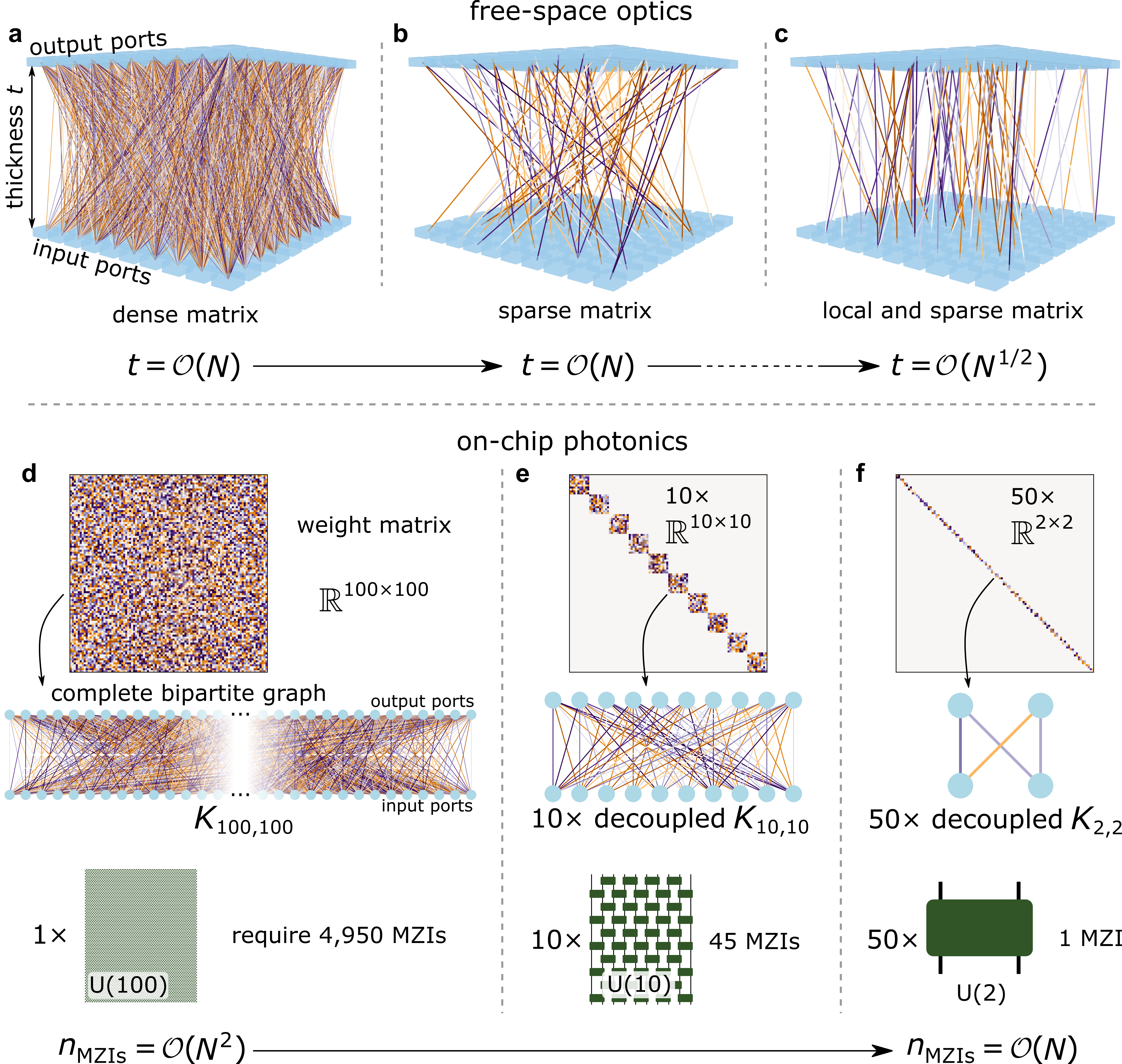
- 自由空間光学では、「局所的スパース」なカーネル行列構造を導入し、結合係数を対角線に近い領域に制限することで、厚さのスケーリングをO(N)からO(N^{1/2})に低減する。
- オンチップフォトニクスチップでは、カーネル行列を小さな独立した完全二部グラフ(K_{N',N'})にブロック対角化することで、Mach-Zehnder干渉計(MZI)の数をO(N^2)から準線形のO(N)に削減する。
- グラフ理論的解釈を用いてフォトニクスチップの接続性をモデル化し、独立したサブネットワークへの効率的分解を可能にする。
- 計算モデリングとシミュレーションを用いて、自由空間および統合フォトニクスプラットフォームの両方で、スパース光学システムのスケーリング則と性能を検証する。
実験結果
リサーチクエスチョン
- RQ1計算タスクの次元が増加するに従い、光学コンピューティングシステムのサイズを支配する根本的な空間的スケーリング則は何か?
- RQ2物理的断面積を最小限に抑えつつ高い正確性を維持できるように、光学コンピューティングシステムをどのように設計できるか?
- RQ3局所的スパarsityやブロック対角化といった構造的スパarsityは、性能を劣化させることなく、空間的複雑性をどの程度低減できるか?
- RQ4光学コンピューティングにおける空間-精度トレードオフの性質は何か?あるサイズを超えると収益が減少する傾向を示すか?
- RQ5波動物理学にインスパイアされたプリーニング手法は、ニューラルネットワークのスパarsityと光学ハードウェア設計の間でより統合的な一致を可能にするか?
主な発見
- 提案された空間効率的設計により、自由空間光学およびオンチップフォトニクスプラットフォームの両方で、従来設計の1%~10%の物理的サイズにまで縮小可能である。
- 自由空間光学において、局所的スパースカーネル行列構造を採用することで、厚さのスケーリング則がO(N)からO(N^{1/2})に改善された。
- フォトニクスチップにおけるカーネル行列のブロック対角化により、必要とされるMach-Zehnder干渉計(MZI)の数がO(N^2)から準線形のO(N)に削減され、スケーラブルな統合が可能になった。
- 空間リソースが増加するに従い、精度の収益が減少する傾向が観察され、サイズと性能のバランスの取れたトレードオフが示された。
- 最適にプリーニングされた光学ニューラルネットワークは、未プリーニングのものと同等の正確性を達成しながら、空間リソースの1%~10%しか消費しない。
- 本研究では、光学システムのグローバル接続トポロジーの調整が、屈折率対比などの従来の光学パrameterの調整と同等に、性能最適化において極めて重要であることが明らかになった。
この論文を読む
Nubintのビューアで原文を開き、読みながら気になる箇所をすぐに質問できます。
Nubintでこの論文を読むこのレビューはAIが論文の原文をもとに作成しました。引用する前に原文をご確認ください。