
[論文レビュー] Training Deep Boltzmann Networks with Sparse Ising Machines
本論文は、FPGAに実装されたスパースで非同期なイジングマシンを用いたハイブリッドハードウェア・ソフトウェアフレームワークを提案し、深層ボルツマンマシン(DBMs)の学習を桁違いの高速化を実現する。確率的ビット(p-bit)アーキテクチャを活用して高速なマルコフ連鎖モンテカルロサンプリングを実現し、わずか4,264個のp-bitを用いてMNIST分類で90%の精度を達成。これは325万パラメータのソフトウェアRBMと同等の性能であり、さらに新規サンプルの生成というソフトウェアモデルにはない機能も有している。
The slowing down of Moore's law has driven the development of unconventional computing paradigms, such as specialized Ising machines tailored to solve combinatorial optimization problems. In this paper, we show a new application domain for probabilistic bit (p-bit) based Ising machines by training deep generative AI models with them. Using sparse, asynchronous, and massively parallel Ising machines we train deep Boltzmann networks in a hybrid probabilistic-classical computing setup. We use the full MNIST and Fashion MNIST (FMNIST) dataset without any downsampling and a reduced version of CIFAR-10 dataset in hardware-aware network topologies implemented in moderately sized Field Programmable Gate Arrays (FPGA). For MNIST, our machine using only 4,264 nodes (p-bits) and about 30,000 parameters achieves the same classification accuracy (90%) as an optimized software-based restricted Boltzmann Machine (RBM) with approximately 3.25 million parameters. Similar results follow for FMNIST and CIFAR-10. Additionally, the sparse deep Boltzmann network can generate new handwritten digits and fashion products, a task the 3.25 million parameter RBM fails at despite achieving the same accuracy. Our hybrid computer takes a measured 50 to 64 billion probabilistic flips per second, which is at least an order of magnitude faster than superficially similar Graphics and Tensor Processing Unit (GPU/TPU) based implementations. The massively parallel architecture can comfortably perform the contrastive divergence algorithm (CD-n) with up to n = 10 million sweeps per update, beyond the capabilities of existing software implementations. These results demonstrate the potential of using Ising machines for traditionally hard-to-train deep generative Boltzmann networks, with further possible improvement in nanodevice-based realizations.
研究の動機と目的
- 確率的イジングマシンが、従来のソフトウェアベースの学習に制限がある深層生成モデル(たとえば深層ボルツマンマシン)を効率的に学習できることを示すこと。
- 従来のハードウェアでは計算的に非現実的である深層ボルツマンネットワークの学習を、p-bitベースのイジングマシンが提供する大規模並列かつ低遅延のサンプリングによって克服すること。
- スパースでハードウェアに配慮したDBMトポロジーが、最小限のハードウェアリソースで高い性能を達成できることを示し、深層生成モデルのエネルギ効率の良い学習を可能にすること。
- MNIST、FMNIST、CIFAR-10といった標準データセットを用いて、ソフトウェアベースのRBM実装と比較することで、このハイブリッド手法のスケーラビリティと効率性を検証すること。
- 今後のエネルギ効率の良いAIハードウェアのため、このフレームワークをナノデバイスベースのpコンピュータに拡張可能かどうかを検討すること。
提案手法
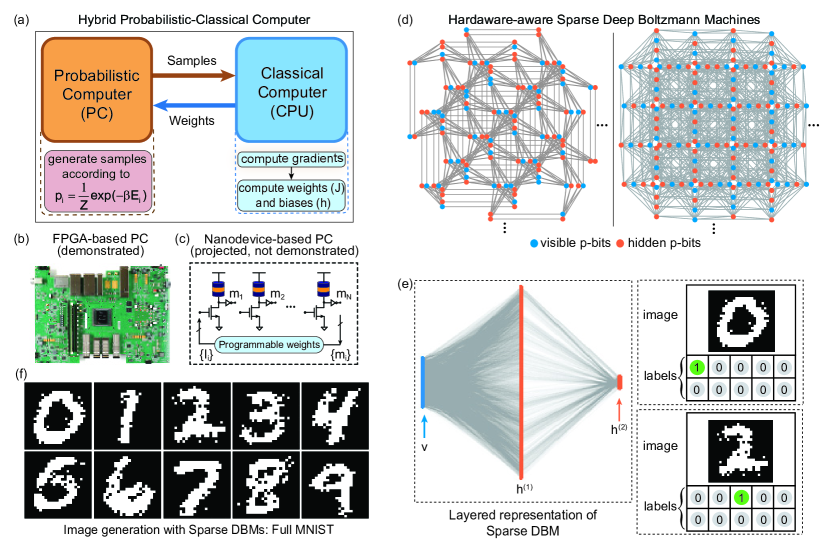
- システムはハイブリッドアーキテクチャを採用し、FPGA上に実装されたp-bitベースのイジングマシンがボルツマン=ギブス分布からの高速確率的サンプリングを実行し、CPUが勾配計算と重み更新を担当する。
- イジングマシンはFPGA上にデジタルCMOS論理で構築され、各p-bitは擬似乱数生成器、tanh活性化のルックアップテーブル、およびバイナリ出力のためのしきい値処理ユニットから構成される。
- ネットワークトポロジーはスパースで非同期的であり、グローバルクロックを必要とせず、p-bitが複数のカラーブロックにわたり並列で動的に更新され、高スループットのサンプリングが可能である。
- FPGAの物理的接続に効率的にマッピングできるように、PegasusおよびZephyrのグラフトポロジーを用いて、ハードウェアに配慮したスパースなDBM構造を採用している。
- PCIeインタフェースによりFPGAとCPU間の双方向通信が可能であり、定期的な重みおよびバイアスの更新が可能。p-bitの状態はデータ転送前にブロックRAM(BRAM)に保存される。
- サンプリング速度は、FPGA内に組み込まれたプログラム可能なカウンタを用いて測定され、p-bitのスイッチング回数を基準クロックと比較することで、リアルタイムでナノ秒あたりのスイッチング回数を算出している。
実験結果
リサーチクエスチョン
- RQ1FPGAに実装されたスパースで非同期なイジングマシンは、ソフトウェアベースのRBMと同等の性能を発揮する深層ボルツマンネットワークを効果的に学習できるか?
- RQ2ハイブリッドpコンピュータアーキテクチャは、コントラストダイバージェンス学習においてGPU/TPUベースの実装と比較して、確率的サンプリングの高速化を顕著に実現できるか?
- RQ3同じハードウェア効率の良い構成で、新規サンプル(例:手書き数字)の生成が可能であり、かつ高い分類精度を維持できるか。これは、ソフトウェアRBMが同等の精度を達成しても生成機能を欠いているという点で重要である。
- RQ4DBMのスパarsityとハードウェアに配慮したトポロジーが、モデル性能を損なわず、パrameter数とリソース使用量をどれほど削減できるか。
- RQ5pコンピュータのサンプリングレート(スイッチング回数/秒)は従来のハードウェアと比較してどの程度優れているか。また、高スケールのコントラストダイバージェンス(例:CD-10^7)学習を維持できるか。
主な発見
- FPGAベースのpコンピュータは、測定されたサンプリングレートが秒間500億~640億回の確率的スイッチングを達成し、GPU/TPUベースの実装を少なくとも1桁以上上回る性能を示した。
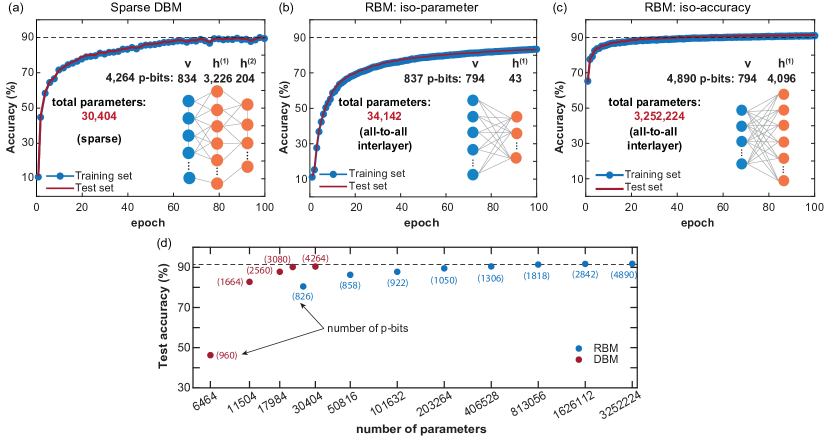
- 本システムは、わずか4,264個のp-bitと約3万パラメータのスパースなDBMを用いて、完全なMNISTデータセットで90%の分類精度を達成。これは325万パラメータのソフトウェアRBMと同等の性能である。
- 同一の精度を達成したにもかかわらず、325万パラメータのソフトウェアRBMは新規の手書き数字を生成できなかったが、pコンピュータ上で学習されたスパースなDBMは、現実的で信頼性の高いサンプルを生成できた。
- 本ハイブリッドトレーニングパイプラインは、CD-10^5を用いて完全なMNISTデータセットで100エポックを約20時間で完了した。これに対して、同様のCPUベースのRBMでCD-10^4を用いると、100エポック完了までに約24日を要する。
- 本システムは、1回の更新あたり最大n = 1000万回のスイープを含むコントラストダイバージェンスをサポートでき、これは通常のソフトウェア実装では到達できないスケールである。
- 結果は他のデータセットにもスケーラブルである:Fashion-MNISTおよび縮小版CIFAR-10データセットでも同様の性能が得られ、本手法の汎用性を確認した。
この論文を読む
Nubintのビューアで原文を開き、読みながら気になる箇所をすぐに質問できます。
Nubintでこの論文を読むこのレビューはAIが論文の原文をもとに作成しました。引用する前に原文をご確認ください。