
[논문 리뷰] A Multi-Agent Conversational Recommender System
이 논문은 대화 흐름을 구조화된 대화 액트 기획과 피드백 인식 반사 메커니즘을 통해 동적으로 사용자 선호도에 적응하는 네 개의 LLM 기반 에이전트를 사용하는 다중 에이전트 대화 추천 시스템인 MACRS를 제안한다. 실험 결과, 특히 저인기 항목에 대해 LLM 전용 기준 대비 추천 정확도와 사용자 참여도가 크게 향상됨을 보여줌.
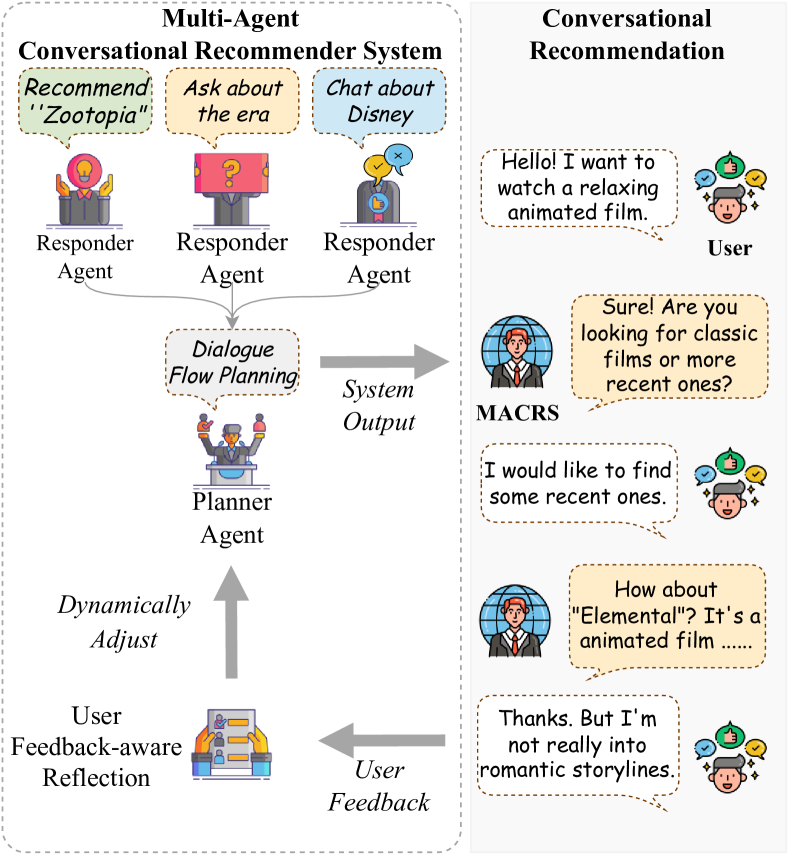
Due to strong capabilities in conducting fluent, multi-turn conversations with users, Large Language Models (LLMs) have the potential to further improve the performance of Conversational Recommender System (CRS). Unlike the aimless chit-chat that LLM excels at, CRS has a clear target. So it is imperative to control the dialogue flow in the LLM to successfully recommend appropriate items to the users. Furthermore, user feedback in CRS can assist the system in better modeling user preferences, which has been ignored by existing studies. However, simply prompting LLM to conduct conversational recommendation cannot address the above two key challenges. In this paper, we propose Multi-Agent Conversational Recommender System (MACRS) which contains two essential modules. First, we design a multi-agent act planning framework, which can control the dialogue flow based on four LLM-based agents. This cooperative multi-agent framework will generate various candidate responses based on different dialogue acts and then choose the most appropriate response as the system response, which can help MACRS plan suitable dialogue acts. Second, we propose a user feedback-aware reflection mechanism which leverages user feedback to reason errors made in previous turns to adjust the dialogue act planning, and higher-level user information from implicit semantics. We conduct extensive experiments based on user simulator to demonstrate the effectiveness of MACRS in recommendation and user preferences collection. Experimental results illustrate that MACRS demonstrates an improvement in user interaction experience compared to directly using LLMs.
연구 동기 및 목표
- 가이드 없이 생성되는 대화로 인해 관련 없거나 목표에서 벗어난 상호작용이 발생하는 LLM 기반 대화 추천 시스템(CRS)에서 대화 흐름을 통제하지 못하는 문제를 해결하기 위해.
- 기존의 LLM 전용 CRS가 사용자 피드백을 효과적으로 캡처하고 활용하여 대화 전략과 선호도 모델링을 개선하는 데 한계가 있다는 점을 극복하기 위해.
- 다양한 대화 액트를 위해 전문화된 역할을 부여한 LLM 기반 에이전트를 통해 구조적이고 목표 지향적인 대화를 가능하게 하는 협업형 다중 에이전트 프레임워크를 설계하기 위해.
- 피드백 인식 반사 기반의 깊은 사용자 선호도 추출을 통해 저인기 항목에 대한 추천 성능을 향상시키기 위해.
- 암묵적 사용자 피드백과 선호도 변화에 기반해 대화 전략을 동적으로 조정함으로써 사용자 경험을 향상시키기 위해.
제안 방법
- 네 명의 전문화된 LLM 기반 에이전트를 갖춘 다중 에이전트 액트 기획 프레임워크: 대화 액트를 선택하는 플래너 에이전트와 질문, 추천, 경청 대화 액트에 대한 응답을 생성하는 세 명의 리스폰더 에이전트.
- 플래너 에이전트는 현재 사용자 맥락과 대화 전략을 기반으로 리스폰더 에이전트의 후보 응답을 평가하여 목표 지향적인 흐름을 유지하는 데 가장 적합한 액트를 선택함.
- 사용자 피드백을 인식하는 반사 메커니즘으로, 이는 이전 대화 턴에서의 오류를 탐지하고 향후 기획을 위한 전략 수준의 제안을 생성함.
- 반사 메커니즘은 두 수준에서 작동함: 정보 수준 반사로 암묵적 의미에서 고수준 사용자 선호도를 추출하고, 전략 수준 반사로 향상된 대화 정책을 제안함.
- 피드백을 대화 기획에 통합하여 사용자 선호도 표현을 업데이트하고 향후 대화 액트 선택을 적절히 조정함.
- 프레임워크는 벤치마크 CRS 데이터셋을 사용한 사용자 시뮬레이터를 통해 평가되었으며, MACRS는 ChatGPT와 같은 LLM 전용 기준과 비교됨.
실험 결과
연구 질문
- RQ1다중 에이전트 프레임워크는 LLM 기반 대화 추천 시스템에서 대화 흐름 제어를 어떻게 향상시킬 수 있는가?
- RQ2사용자 피드백은 대화 전략 개선과 선호도 모델링 향상에 얼마나 효과적으로 활용될 수 있는가?
- RQ3협업형 다중 에이전트 아키텍처는 단일 LLM 에이전트 대비 추천 정확도와 사용자 참여도에서 뛰어난 성능을 낼 수 있는가?
- RQ4선호도 모호성이 더 높은 저인기 항목에서 시스템 성능은 어떠한가?
- RQ5전략 수준의 반사는 응답 품질과 대화 효과성에 어떤 영향을 미치는가?
주요 결과
- 응답 품질 비교에서 MACRS는 ChatGPT 대비 45.4% 승리, 33.0% 동점, 21.6% 패배를 기록하여 추천 정확도, 사용자 정보 획득, 간결성, 참여도 측면에서 뛰어난 응답 품질을 입증함.
- 피드백 인식 반사로 인해 향상된 선호도 추출 덕분에 특히 저인기 항목에 대해 추천 정확도가 크게 향상됨.
- 효과적인 대화 액트 스케줄링 덕분에 추천에 도달하기 위한 대화 라운드 수를 줄여 효율성을 향상시킴.
- 전략 수준 반사 메커니즘이 응답 품질을 향상시켜 평가자 선호도가 비교의 45.4%에서 확인됨.
- 사용자 피드백은 암묵적 선호도를 탐지하는 데 핵심적임 — 예를 들어 감독의 작품에 대한 불만을 인식함으로써 시스템이 적응하고 추천을 향상시킬 수 있음.
- 기준 모델에서는 시간이 지남에 따라 누적 추천 성공률이 감소하지만, MACRS는 지속적인 선호도 모델링 덕분에 높은 성능 유지함.

이 논문 읽기
누빈트 뷰어에서 원문을 열고, 읽으면서 궁금한 곳을 바로 물어보세요.
누빈트에서 이 논문 읽기이 리뷰는 AI가 논문 원문을 바탕으로 만들었습니다. 인용하기 전에 원문을 확인해 주세요.