
[논문 리뷰] CMOS + stochastic nanomagnets: heterogeneous computers for probabilistic inference and learning
본 논문은 CMOS + sMTJ 이질적 컴퓨터를 시연하며, 확률적 MTJ p-bits를 사용해 FPGA를 구동하여 디지털 CMOS p-bits에 비해 에너지와 면적이 크게 감소한 확률 추론 및 볼츠만 학습을 가능하게 한다.
Extending Moore's law by augmenting complementary-metal-oxide semiconductor (CMOS) transistors with emerging nanotechnologies (X) has become increasingly important. One important class of problems involve sampling-based Monte Carlo algorithms used in probabilistic machine learning, optimization, and quantum simulation. Here, we combine stochastic magnetic tunnel junction (sMTJ)-based probabilistic bits (p-bits) with Field Programmable Gate Arrays (FPGA) to create an energy-efficient CMOS + X (X = sMTJ) prototype. This setup shows how asynchronously driven CMOS circuits controlled by sMTJs can perform probabilistic inference and learning by leveraging the algorithmic update-order-invariance of Gibbs sampling. We show how the stochasticity of sMTJs can augment low-quality random number generators (RNG). Detailed transistor-level comparisons reveal that sMTJ-based p-bits can replace up to 10,000 CMOS transistors while dissipating two orders of magnitude less energy. Integrated versions of our approach can advance probabilistic computing involving deep Boltzmann machines and other energy-based learning algorithms with extremely high throughput and energy efficiency.
연구 동기 및 목표
- 몬테카를로 기반 확률 컴퓨팅을 가속하기 위한 CMOS + X 아키텍처를 동기 부여한다.
- sMTJ 기반 p-bits와 FPGA의 통합을 시연하여 진정한 난수성을 주입한다.
- 이질적 p-컴퓨터에서 확률 추론 및 딥 볼츠만 학습을 평가한다.
- 7-nm CMOS 공정을 사용한 디지털 CMOS p-bits와의 에너지 및 트랜지스터 수를 벤치마크한다.
- 비동기적이고 진정한 난수성을 갖는 확률 컴퓨팅의 확장 가능성를 보여준다.
제안 방법
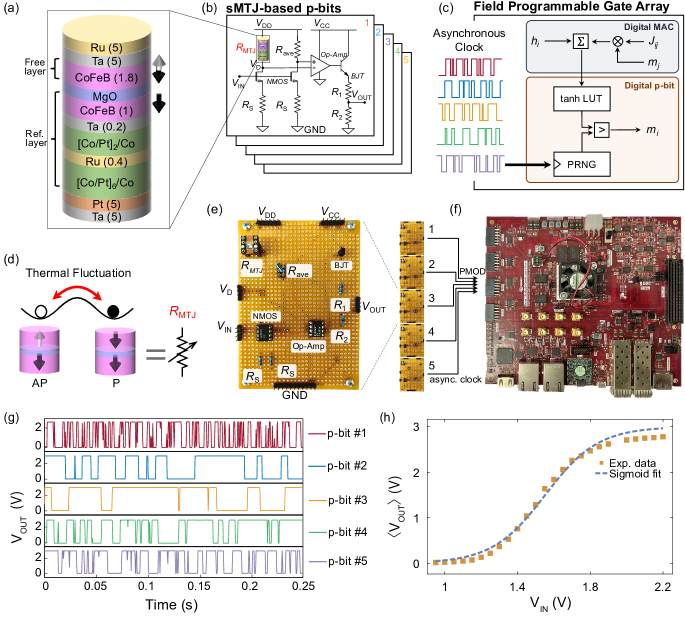
- 저장 장벽이 낮은 나노자석을 갖는 sMTJ 기반 p-bits를 제작하고 특성화한 다음, 이를 FPGA 기반 디지털 p-bit 배열의 비동기 시계로 통합한다.
- sMTJ의 요동을 전압으로 변환하여 연산 증폭기를 통해 디지털 p-bits를 구동시키는 새로운 p-bit 회로를 설계한다.
- FPGA에서 LUT 기반 tanh 활성화, PRNGs, 및 비교기를 갖춘 디지털 p-bits를 구현하며, PRNG 시계는 sMTJ 난수에 의해 구동된다.
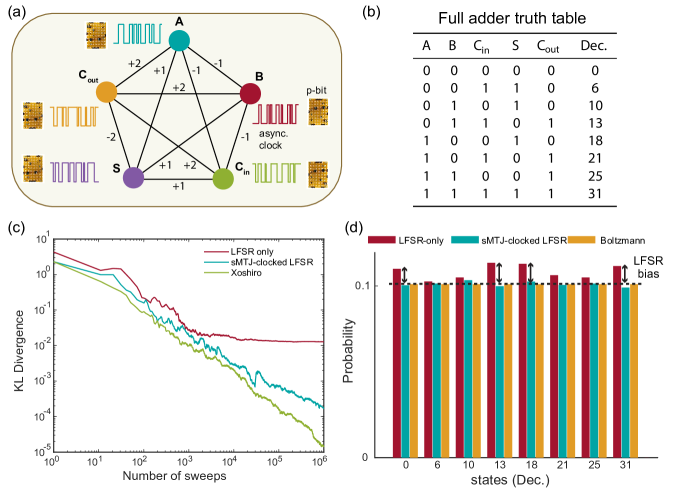
- 볼츠만 분포로부터의 KL 발산을 사용하여 LFSR, sMTJ-시계 LFSR 및 Xoshiro RNG를 비교하여 확률적 전가산기의 확률 추론을 평가한다.
- 이질적 시스템을 사용하여 32-노드 Chimera 딥 볼츠만 머신을 학습시키고 디지털 RNG 기준과 학습 성능을 비교한다.
실험 결과
연구 질문
- RQ1sMTJ 기반 p-bits가 FPGA 기반 디지털 p-bits를 구동하여 확률 추론 및 학습을 위한 고품질 난수성을 제공할 수 있는가?
- RQ2다른 PRNG들로부터의 난수성의 품질이 이질적 CMOS + sMTJ 시스템에서 샘플링 정확도와 볼츠만 학습에 어떤 영향을 미치는가?
- RQ3순수하게 디지털 CMOS p-bits에 비해 CMOS + sMTJ p-bits의 에너지, 면적, 처리량 이점은 무엇인가?
- RQ4비동기적이고 이질적인 p-컴퓨터를 사용하여 확장 가능한 성능으로 딥 볼츠만 머신을 학습시키는 것이 가능한가?
- RQ5sMTJ 간 기기 편차가 추론 및 학습 작업에 미치는 영향은 무엇인가?
주요 결과
- sMTJ 기반 p-bits는 sMTJ 편차에도 불구하고 정확한 확률 추론과 볼츠만 학습을 가능하게 하는 진정한 난수성을 제공한다.
- 디지털 CMOS p-bits와 비교하여, sMTJ 기반 p-bits는 약 10,000개의 트랜지스터를 대체하고 벤치마크에서 무작위 비트당 에너지를 두 자릿수 규모로 감소시킨다(2 fJ).
- LFSR 기반 RNG은 추론 및 학습에서 성능이 떨어진다; sMTJ-시계 LFSRs와 Xoshiro RNG은 FA 샘플링 및 DBM 학습에서 볼츠만 분포를 더 가깝게 맞춘다.
- 비동기식 sMTJ 시계는 FPGA p-bits와 결합하여 고품질 샘플링과 심층 볼츠만 머신의 확장 가능한 학습을 가능하게 한다.
- ASAP7 7-nm PDK를 사용한 에너지 및 트랜지스터 수 벤치마크는 완전한 디지털 p-bits에 비해 CMOS + sMTJ의 하드웨어 효율이 크게 향상됨을 보여준다.
이 논문 읽기
누빈트 뷰어에서 원문을 열고, 읽으면서 궁금한 곳을 바로 물어보세요.
누빈트에서 이 논문 읽기이 리뷰는 AI가 논문 원문을 바탕으로 만들었습니다. 인용하기 전에 원문을 확인해 주세요.