
[논문 리뷰] Complexity of Supersymmetric Systems and the Cohomology Problem
이 논문은 초대칭 시스템에서의 코homology 문제의 양자 계산 복잡도를 확립하며, $k$-로컬 코homology 문제는 $\text{QMA}$-완전임을 증명하고, 준-베티 수 추정이 $\text{DQC1}$-하드이지만 $\text{BQP}$에 속함을 보여준다. 또한, 변분 양자 고유값 알고리즘(VQE)에서 라플라스 연산자 $\Delta$ 대신 초전하 연산자 $B$를 사용할 경우, 구조화된 시스템에서 회로 깊이와 측정 횟수를 $d+1$ 배 줄일 수 있음을 입증하며, 알고리즘 스케일링을 향상시킨다.
We consider the complexity of the local Hamiltonian problem in the context of fermionic Hamiltonians with $\mathcal N=2 $ supersymmetry and show that the problem remains $\mathsf{QMA}$-complete. Our main motivation for studying this is the well-known fact that the ground state energy of a supersymmetric system is exactly zero if and only if a certain cohomology group is nontrivial. This opens the door to bringing the tools of Hamiltonian complexity to study the computational complexity of a large number of algorithmic problems that arise in homological algebra, including problems in algebraic topology, algebraic geometry, and group theory. We take the first steps in this direction by introducing the $k$-local Cohomology problem and showing that it is $\mathsf{QMA}_1$-hard and, for a large class of instances, is contained in $\mathsf{QMA}$. We then consider the complexity of estimating normalized Betti numbers and show that this problem is hard for the quantum complexity class $\mathsf{DQC}1$, and for a large class of instances is contained in $\mathsf{BQP}$. In light of these results, we argue that it is natural to frame many of these homological problems in terms of finding ground states of supersymmetric fermionic systems. As an illustration of this perspective we discuss in some detail the model of Fendley, Schoutens, and de Boer consisting of hard-core fermions on a graph, whose ground state structure encodes $l$-dimensional holes in the independence complex of the graph. This offers a new perspective on existing quantum algorithms for topological data analysis and suggests new ones.
연구 동기 및 목표
- 초대칭 양자 시스템에서 발생하는 코homology 문제의 양자 복잡도를 규명하는 것.
- 초대칭 상태가 코homology 군을 포함하고 있음을 보여주어 하미르토니안 복잡도와 호모로지 대수학을 연결하는 것.
- 양자 알고리즘에서 베티 수와 준-베티 수 추정의 계산 복잡도를 분석하는 것.
- 페르미온 시스템에서 라플라스 연산자 $\Delta$ 대신 초전하 연산자 $B$를 사용함으로써 VQE의 효율성을 향상시키는 것.
- $k$-로컬 코homology 문제의 $\text{QMA}$-완전성 여부를 확립하는 것.
제안 방법
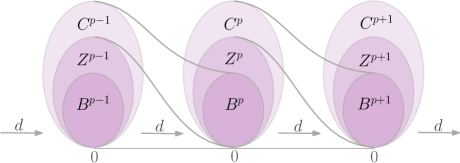
- 코바운더리 연산자 $d$를 사용하여 코homology 문제를 수학적으로 정의하고, $d^2 = 0$ 조건을 만족시키며, 하미르토니안 $H = \{\mathcal{Q}, \mathcal{Q}^\dagger\}$를 갖는 초대칭 양자역학적 시스템으로 매핑하는 것.
- 저지-위너 변환을 통해 페르미온 연산자를 큐비트 연산자로 변환하여 양자 컴퓨터에서의 시뮬레이션 가능하게 하는 것.
- 초전하 $B = \mathcal{Q}$와 라플라스 연산자 $\Delta = B^2$의 구조를 분석하고, 이들이 서로 가 commutative인 파울리 항으로 분해되는 방식을 집중적으로 고려하는 것.
- VQE 알고리즘에서 $B$와 $\Delta$를 상호작용하지 않는 파울리 항의 집합으로 분해함으로써 회로 깊이와 측정 횟수를 줄이는 전략을 제안하는 것.
- 독립 복합체의 경우, $\Delta$ 대비 $B$를 사용할 경우 상호작용하지 않는 집합의 수를 $d+1$ 배 줄일 수 있음을 입증하며, VQE의 스케일링을 향상시킴.
- 복잡도 이론적 도구를 적용하여 준-베티 수 추정이 $\text{DQC1}$에 대해 하드하지만 $\text{BQP}$에 속함을 증명하는 것.
실험 결과
연구 질문
- RQ1초대칭 시스템에서의 $k$-로컬 코homology 문제의 양자 계산 복잡도는 무엇인가?
- RQ2라플라스 연산자 $\Delta$ 대비 초전하 연산자 $B$를 사용할 경우 VQE 알고리즘의 효율성이 향상되는가?
- RQ3위상적 데이터 분석에서 베티 수의 근사치인 준-베티 수 추정은 근접한 양자 장치의 능력 범위에 있는가?
- RQ4기초가 되는 그래프의 구조는 $B$와 $\Delta$를 상호작용하지 않는 파울리 항으로 분해하는 데 어떤 영향을 미치는가?
- RQ5페르미온 격자 모델에서 초대칭 상태와 코homology 군 간의 관계는 무엇인가?
주요 결과
- $k$-로컬 코homology 문제는 $\text{QMA}$-완전임을 증명하여 그 기본적인 양자 난이도를 입증함.
- 준-베티 수 추정은 $\text{DQC1}$-하드임을 보여주며, 조건부 얽힘을 가진 양자 컴퓨터로도 해결하기 어려운 문제임을 시사함.
- 준-베티 수 추정은 $\text{BQP}$에 포함됨을 보여주며, 보편 양자 컴퓨터에서 효율적으로 해결 가능함을 입증함.
- 독립 복합체에서 라플라스 연산자 $\Delta$ 대신 초전하 $B$를 사용할 경우, 상호작용하지 않는 집합의 수를 $d+1$ 배 줄일 수 있으며, 이는 회로 깊이와 측정 횟수 향상에 기여함.
- 저지-위너 변환은 페르미온 연산자를 국소적이지 않은 큐비트 연산자로 매핑하지만, 구조화된 그래프 순서를 적용하면 비국소성의 영향을 최소화하고 분해 효율성을 향상시킬 수 있음.
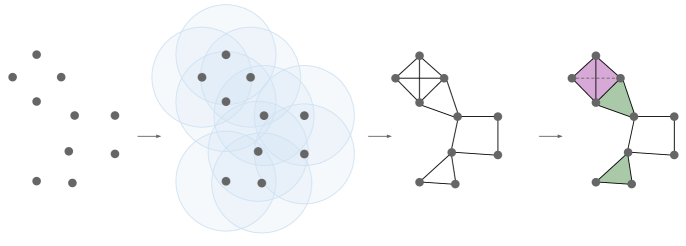
- 논문은 초대칭 양자역학과 위상적 데이터 분석 간의 직접적인 연결 고리를 확립하며, TDA의 코homology 문제들이 자연스럽게 양자 복잡도 클래스에 놓여 있음을 보여줌.
더 나은 연구,지금 바로 시작하세요
논문 읽기부터 검토까지, 연구 시간을 획기적으로 줄여보세요.
카드 등록 없음 · 무료 플랜 제공
이 리뷰는 AI가 만들고, 인간 에디터가 검토했습니다.