
[논문 리뷰] Entanglement Routing over Networks with Time Multiplexed Repeaters
이 논문은 시간 분할 다중화 재생기(시간-다중화 재생기)를 사용하여 양자 네트워크에서 국소적, 다중 경로 라우팅 프로토콜을 제안한다. 이는 양자 얽힘 분포 속도를 향상시킨다. 국소적 링크 상태 지식을 활용하고 시간-다중화 블록 길이 $k$를 최적화함으로써, 처리량 증가와 메모리의 붕괴 사이의 균형을 맞추며, 현실적인 붕괴 모델 하에서 최적의 $k_{\text{opt}}$를 도출한다.
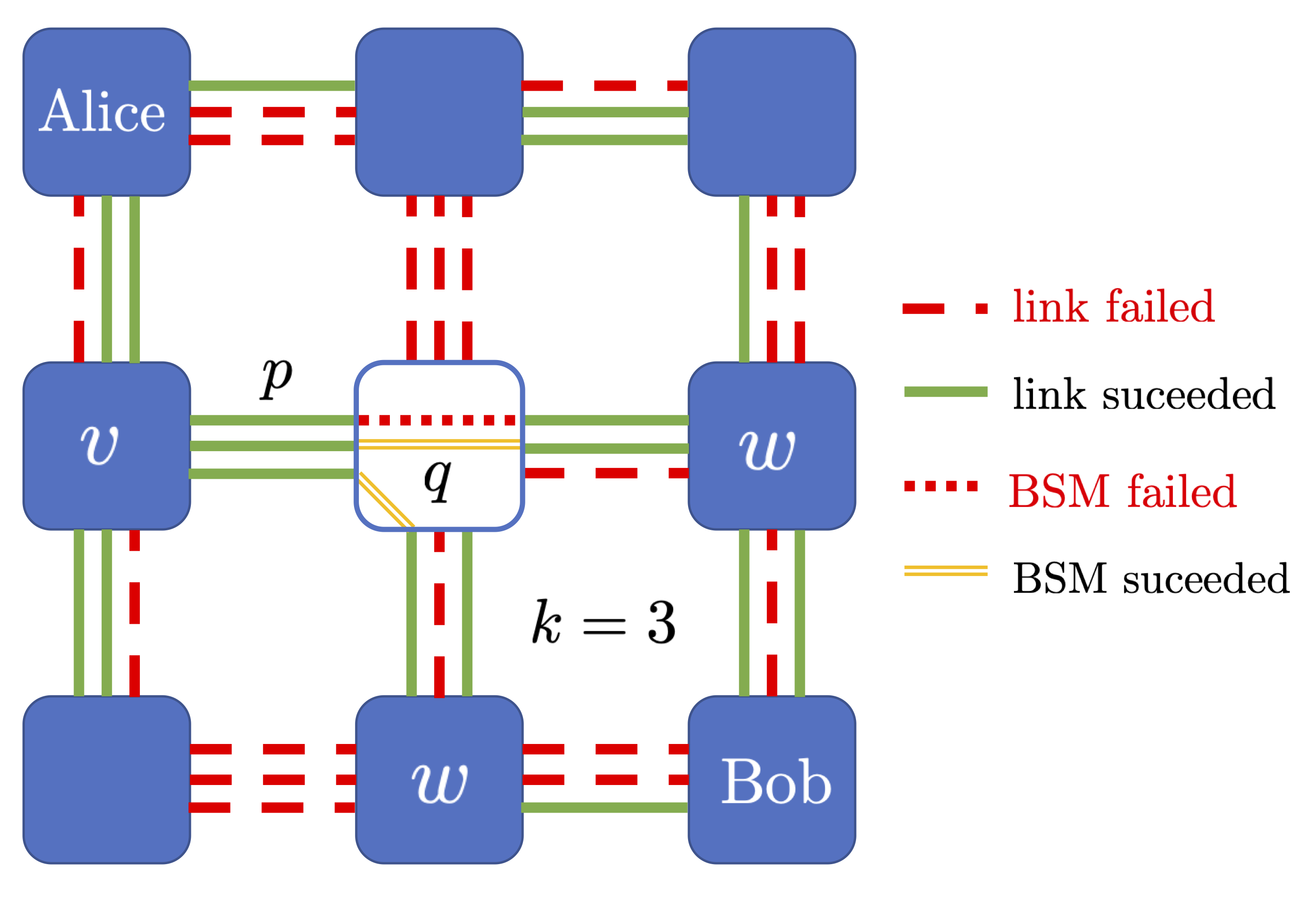
Quantum networks will be able to service consumers with long-distance entanglement by use of quantum repeaters that generate Bell pairs (or links) with their neighbors, iid with probability $p$ and perform Bell State Measurements (BSMs) on the links that succeed iid with probability $q$. While global link state knowledge is required to maximize the rate of entanglement generation between any two consumers, it increases the protocol latency due to the classical communication requirements and requires long quantum memory coherence times. We propose two entanglement routing protocols that require only local link state knowledge to relax the quantum memory coherence time requirements and reduce the protocol latency. These protocols utilize multi-path routing protocol and time multiplexed repeaters. The time multiplexed repeaters first generate links for $k$-time steps before performing BSMs on any pairs of links. Our two protocols differ in the decision rule used for performing BSMs at the repeater: the first being a static path based routing protocol and second a dynamic distance based routing protocol. The performance of these protocols depends on the quantum network topology and the consumers' location. We observe that the average entanglement rate and the latency increase with the time multiplexing block length, $k$, irrespective of the protocol. When a step function memory decoherence model is introduced such that qubits are held in the quantum memory for an exponentially distributed time with mean $μ$, an optimal $k$ ($k_ ext{opt}$) value appears, such that for increasing $k$ beyond $k_{ m opt}$ hurts the entanglement rate. $k_{ m opt}$ decreases with $p$ and increases with $μ$. $k_{ m opt}$ appears due to the tradeoff between benefits from time multiplexing and the increased likelihood of previously established Bell pairs decohering due to finite memory coherence times.
연구 동기 및 목표
- 장거리 양자 얽힘 분포에서 높은 지연과 제한된 양자 메모리 수명 주기의 과제를 해결하기 위해.
- 대규모이고 동적인 양자 네트워크에서는 비현실적인 전 세계 네트워크 상태 지식에 의존하는 것을 줄이기 위해.
- 시간-다중화 재생기를 사용하여 양자 얽힘 생성 속도를 향상시키는 확장 가능한 국소 라우팅 프로토콜을 개발하기 위해.
- 실제 메모리 모델에서 시간-다중화의 이점과 붕괴로 인한 링크 손실 간의 상충 관계를 분석하기 위해.
- 확률적 링크 생성과 메모리 붕괴 조건 하에서 얽힘 속도를 최대화하는 최적의 시간-다중화 블록 길이 $k_{\text{opt}}$를 규명하기 위해.
제안 방법
- 각 재생기가 자신의 얽힘 시도와 네트워크 구조를 기반으로 스위칭 결정을 내리는 국소적 링크 상태 지식만을 사용하는 거리 기반 다중 경로 라우팅 프로토콜을 구현한다.
- 다양한 시간 슬롯에서 여러 번의 벨 상태 측정(Bell State Measurements, BSM)을 수행할 수 있는 시간-다중화 재생기를 모델링한다. 이는 성공적인 얽힘 스위칭 확률을 높인다.
- 큐비트가 지수 분포된 시간(평균 $\mu$) 동안 저장되는 단계 함수 메모리 붕괴 모델을 도입한다. 이는 링크 생존 확률에 영향을 준다.
- 네트워크 스냅샷 간 최대 이항 얽힘 용량을 계산하기 위해 혼합정수이차제약프로그래밍(Mixed-Integer Quadratically Constrained Programming, MIQCP)을 사용한다.
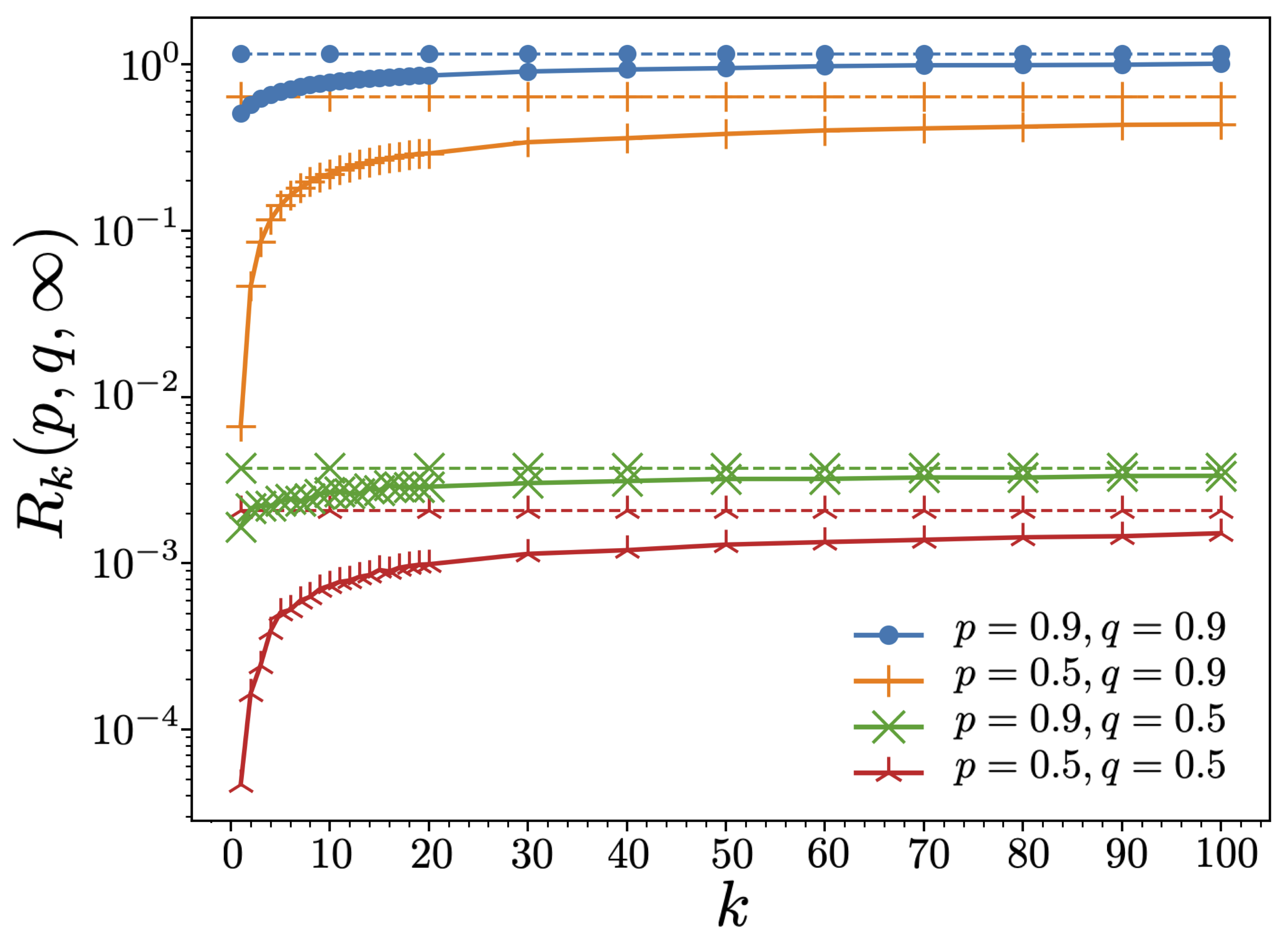
- 메모리 붕괴를 고려한 결정론적 링크 생성($p=1$)에 대한 분석적 속도 방정식을 유도하며, 링크 생존 확률을 $s(t) = e^{-t/\mu}$로 모델링한다.
- 시간 $k$, $q$, $\mu$에 따라 평균 얽힘 속도 $R_k(1,q,\mu)$를 계산하며, 시간에 따른 다중 사용 가능한 링크 확률을 통합한다.
실험 결과
연구 질문
- RQ1확률적 링크 생성 조건 하에서 시간-다중화 블록 길이 $k$는 양자 네트워크에서 평균 얽힘 분포 속도에 어떤 영향을 미치는가?
- RQ2메모리 붕괴가 존재할 경우, 얽힘 속도를 최대화하는 최적의 $k_{\text{opt}}$는 무엇인가?
- RQ3시간-다중화의 이점 증가와 붕괴로 인한 손실 위험 증가 간의 상충 관계는 프로토콜 성능에 어떤 영향을 미치는가?
- RQ4최소한의 전 세계 상태 지식을 가진 국소 라우팅 프로토콜이 전역 최적화 방법과 비교해 유사한 성능을 달성할 수 있는가?
- RQ5메모리 붕괴($\mu$)의 존재는 시간-다중화 재생기 네트워크의 확장성과 성능에 어떤 영향을 미치는가?
주요 결과
- 시간-다중화 블록 길이 $k$가 증가할수록 평균 얽힘 분포 속도는 증가하지만, 이에 따라 초기 지연도 증가한다.
- 메모리 붕괴가 지수 분포 수명 주기($\mu$)로 모델링될 경우, 다중화 이득과 붕괴 손실 간의 균형을 맞추기 위해 최적의 $k_{\text{opt}}$가 도출된다.
- 링크 생성 확률 $p$가 감소하거나 메모리 공명 시간 $\mu$가 증가할수록 $k_{\text{opt}}$는 성능 최적화를 유지하기 위해 증가한다.
- 확률 $p=1$ 조건에서 분석적 속도 $R_k(1,q,\mu)$가 유도되었으며 시뮬레이션을 통해 검증되었으며, 기본 항 $q^{d-1}/k$에 대해 역수비례 관계를 보였다.
- 단일 경로 라우팅보다 높은 속도를 달성하며, 전역 최적화 성능에 도달하기까지 국소 지식만으로도 유사한 성능을 보였다.
- MIQCP 기반 용량 계산은 확률적 링크 가용성과 BSM 성공률을 고려하여 네트워크 스냅샷 간 최대 얽힘 흐름을 정확하게 추정할 수 있게 한다.
더 나은 연구,지금 바로 시작하세요
논문 읽기부터 검토까지, 연구 시간을 획기적으로 줄여보세요.
카드 등록 없음 · 무료 플랜 제공
이 리뷰는 AI가 만들고, 인간 에디터가 검토했습니다.