
[논문 리뷰] Fourier Neural Operators for Arbitrary Resolution Climate Data Downscaling
이 논문은 저해상도 기후 데이터에서 훈련하고 임의의 고해상도로 제로샷 일반화가 가능한 푸리에 신경 연산자(Fourier Neural Operator, FNO) 기반의 다운스케일링 방법을 제안한다. 이는 ERA5 재분석 데이터와 나비에-스토크스 해법 데이터에서 표준 및 제로샷 다운스케일링 모두에서 최신 기술보다 뛰어난 성능을 보이며, 특히 계산 비용이 높은 고해상도 기후 시뮬레이션 문제를 해결하는 데 효과적이다.
Climate simulations are essential in guiding our understanding of climate change and responding to its effects. However, it is computationally expensive to resolve complex climate processes at high spatial resolution. As one way to speed up climate simulations, neural networks have been used to downscale climate variables from fast-running low-resolution simulations, but high-resolution training data are often unobtainable or scarce, greatly limiting accuracy. In this work, we propose a downscaling method based on the Fourier neural operator. It trains with data of a small upsampling factor and then can zero-shot downscale its input to arbitrary unseen high resolution. Evaluated both on ERA5 climate model data and on the Navier-Stokes equation solution data, our downscaling model significantly outperforms state-of-the-art convolutional and generative adversarial downscaling models, both in standard single-resolution downscaling and in zero-shot generalization to higher upsampling factors. Furthermore, we show that our method also outperforms state-of-the-art data-driven partial differential equation solvers on Navier-Stokes equations. Overall, our work bridges the gap between simulation of a physical process and interpolation of low-resolution output, showing that it is possible to combine both approaches and significantly improve upon each other.
연구 동기 및 목표
- 딥러닝을 활용해 빠르고 미분 가능한 다운스케일링을 가능하게 하여 고해상도 기후 시뮬레이션의 높은 계산 비용 문제를 해결한다.
- 입력 크기가 고정된 딥러닝 모델의 한계를 극복하여, 예측되지 않은 해상도 요인에 일반화할 수 있도록 한다.
- 저해상도 데이터에서 훈련한 후, 사전에 보지 못한 임의의 고해상도로 제로샷 다운스케일링이 가능한 단일 FNO 기반 모델을 개발한다.
- 소프트맥스 레이어를 통한 보존법칙 제약 조건 통합을 통해 기후 다운스케일링의 물리적 일致성과 정확도를 향상시킨다.
- 합성 PDE 해법(Navier-Stokes)과 실제 관측 기후 데이터(ERA5 수증기 함량) 양쪽 모두에서 방법의 효과성을 입증한다.
제안 방법
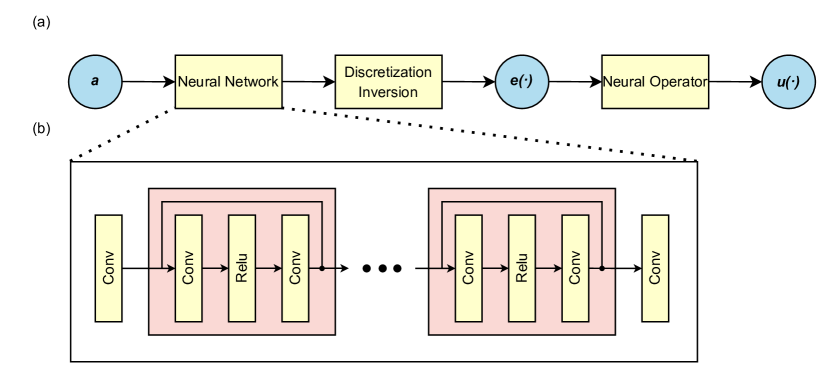
- 푸리에 스펙트럼 도메인에서 작동하는 푸리에 신경 연산자(FNOs)를 활용하여 저해상도와 고해상도 기후 필드 간의 매핑을 학습한다.
- 저업샘플링 요인 데이터(예: 2×)에서만 FNO 모델을 훈련시켜, 재훈련 없이도 더 높은 해상도(예: 4×, 8×)에서 제로샷 추론이 가능하도록 한다.
- 출력에 소프트맥스 제약 레이어를 적용하여 물리적 보존 법칙을 강제로 준수함으로써, 다운샘플링된 출력의 정밀도를 향상시킨다.
- 기후 및 유체역학 데이터의 부드러움과 낮은 질서 구조를 푸리에 도메인에서 활용하는 FNO의 스펙트럼 인덕티브 바이어스를 활용한다.
- 절단된 푸리에 급수 표현을 사용하여 연산자를 효율적으로 모델링함으로써, 다양한 해상도 스케일 간의 일반화를 가능하게 한다.
- 특정 업샘플링 요인에서 훈련된 모델을 다른 해상도 타겟에서 평가하기 위해 평균 풀링 또는 모델 재귀를 통한 후처리를 수행한다.
실험 결과
연구 질문
- RQ1저해상도 데이터에서 훈련된 FNO 기반 모델이 사전에 보지 못한 임의의 고해상도 기후 다운스케일링 작업으로 제로샷 일반화가 가능한가?
- RQ2정확도와 다양한 해상도 요인에 대한 일반화 능력 측면에서 FNO 다운스케일링 모델은 최신 기술인 컨볼루션 및 GAN 기반 모델보다 어떻게 비교되는가?
- RQ3보존 법칙 제약 조건을 통한 제약이 기후 다운스케일링에서 물리적 일치성을 얼마나 잘 유지하는가?
- RQ4나비에-스토크스 방정식 통합 및 해법 정밀화에서 기존 FNO와 비교해 FNO 기반 접근법이 얼마나 뛰어나게 성능을 발휘하는가?
- RQ5모델이 ERA5의 총 수증기 함량과 같은 노이즈가 있는 관측 기후 데이터에 대해 얼마나 잘 일반화되는가?
주요 결과
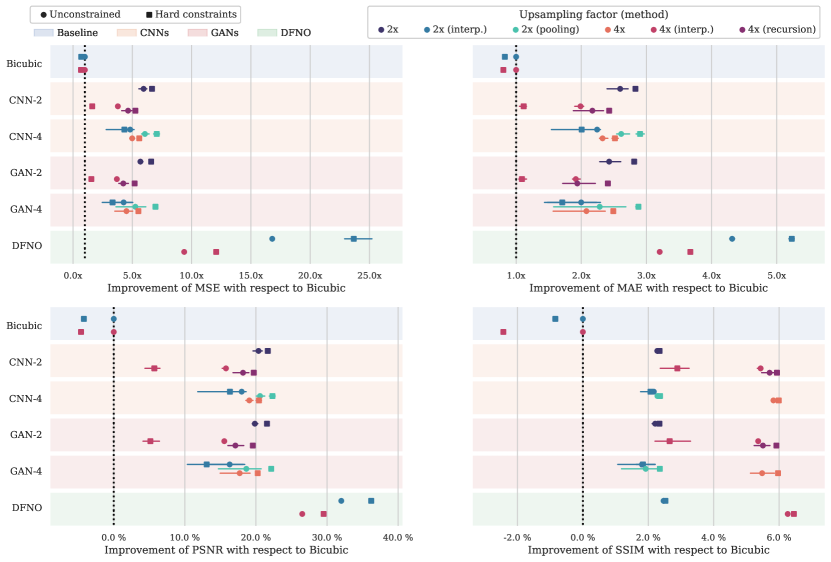
- 제안된 FNO 다운스케일링 모델은 나비에-스토크스 해법 다운스케일링과 ERA5 수증기 함량 다운스케일링 모두에서 최고 성능을 기록하였으며, 이전 모델보다 더 낮은 MSE와 더 높은 PSNR를 달성하였다.
- 나비에-스토크스 데이터셋에서 소프트맥스 제약 조건을 적용한 FNO 모델은 2× 해상도에서 PSNR 48.95, 4× 해상도에서 PSNR 47.17를 기록하였으며, 원본 FNO 솔버를 초월하는 성능을 보였다.
- ERA5 수증기 함량 데이터셋에서 소프트맥스 레이어를 적용한 FNO 모델은 2×에서 PSNR 48.95, 4×에서 PSNR 47.17를 기록하였으며, CNN 및 GAN 기반 베이스라인 모델을 크게 앞서갔다.
- 모델는 강력한 제로샷 일반화 능력을 보였으며, 2× 데이터에서 훈련한 모델가 4× 해상도에서 4× 데이터에서 전용으로 훈련된 모델보다 더 낮은 MSE와 더 높은 PSNR를 기록하였다.
- 소프트맥스 제약 레이어의 추가로 물리적 일치성이 향상되어, 모든 해상도 요인에서 MAE와 MSE가 감소하고 SSIM 점수가 향상되었다.
- 소프트맥스 레이어를 적용한 FNO 모델는 2×에서 훈련했을 때 1× 해상도에서 PSNR 164.18을 기록하여 가장 낮은 해상도에서 거의 완벽한 재구성 성능를 보였으며, 모든 스케일에서 높은 성능를 유지하였다.
더 나은 연구,지금 바로 시작하세요
논문 읽기부터 검토까지, 연구 시간을 획기적으로 줄여보세요.
카드 등록 없음 · 무료 플랜 제공
이 리뷰는 AI가 만들고, 인간 에디터가 검토했습니다.