
[논문 리뷰] Hardware-efficient ansatz without barren plateaus in any depth
이 논문은 하드웨어 효율적인 앤사츠(HEA) 회로에 대해 어떤 회로 깊이에서도 비어 있는 평평한 골짜기(barren plateaus)를 제거하는 두 가지 새로운 매개변수 초기화 조건을 제안한다. 이는 시스템 크기나 연결성과 관계없이 일정한 기울기 크기를 보장하며, 국소 해밀토니안 하에서의 시간 진동 또는 다체 국소화(MBL) 상태로의 매핑을 통해, 근접한 양자 장치에서 기울기 소실 없이 효율적인 학습을 가능하게 한다.
Variational quantum circuits have recently gained much interest due to their relevance in real-world applications, such as combinatorial optimizations, quantum simulations, and modeling a probability distribution. Despite their huge potential, the practical usefulness of those circuits beyond tens of qubits is largely questioned. One of the major problems is the so-called barren plateaus phenomenon. Quantum circuits with a random structure often have a flat cost-function landscape and thus cannot be trained efficiently. In this paper, we propose two novel parameter conditions in which the hardware-efficient ansatz (HEA) is free from barren plateaus for arbitrary circuit depths. In the first condition, the HEA approximates to a time-evolution operator generated by a local Hamiltonian. Utilizing a recent result by [Park and Killoran, Quantum 8, 1239 (2024)], we prove a constant lower bound of gradient magnitudes in any depth both for local and global observables. On the other hand, the HEA is within the many-body localized (MBL) phase in the second parameter condition. We argue that the HEA in this phase has a large gradient component for a local observable using a phenomenological model for the MBL system. By initializing the parameters of the HEA using these conditions, we show that our findings offer better overall performance in solving many-body Hamiltonians. Our results indicate that barren plateaus are not an issue when initial parameters are smartly chosen, and other factors, such as local minima or the expressivity of the circuit, are more crucial.
연구 동기 및 목표
- 근접한 양자 하드웨어에서의 학습을 방해하는 하드웨어 효율적 앤사츠(HEA) 회로의 비어 있는 평탄한 골짜기 문제를 해결하기 위해.
- 회로 깊이나 큐비트 연결성과 관계없이 큰, 기울기 소실이 없는 기울기를 보장하는 매개변수 초기화 영역을 규명하기 위해.
- 비어 있는 평탄한 골짜기를 피하기 위해 회로 설계를 변경하는 것이 아니라, 지능적인 초기화를 통해 가능함을 보여주기 위해.
- 제안된 방법을 양자 기계학습 및 다체 해밀토니안 문제에 적용하여, 랜덤 초기화보다 뛰어난 성능을 보여주기 위해.
제안 방법
- 첫 번째 방법은 HEA를 국소 해밀토니안에 의해 생성된 시간 진동 연산자로 매핑하며, Park와 Killoran(2024)의 최근 결과를 활용하여 국소 및 전역 관측량에 대해 기울기 크기에 대한 일정한 하한을 증명한다.
- 두 번째 방법은 HEA를 다체 국소화(MBL) 시스템으로 해석하며, 현상학적 MBL 이론을 사용하여 국소 관측량에 대해 MBL 상태에서 큰 기울기 성분이 존재할 것이라고 주장한다.
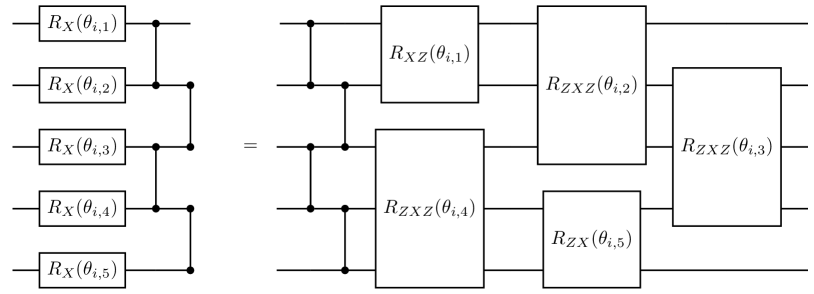
- 회로 항등식을 사용하여 HEA 블록에서 비매개변수화된 CZ 게이트를 제거함으로써, 완전히 매개변수화된 회로에 대해 유도된 기울기 한계를 적용할 수 있도록 한다.
- HEA는 고정된 초기 상태 |0⟩^⊗N 과 마지막 d 큐비트에 작용하는 데이터 인코딩 유니터리 E(ϕ)로 구성되며, 비용 함수는 이진 교차 엔트로피 손실을 통해 정의된다.
- 매개변수 초기화는 작은 분산을 가진 가우시안 샘플링(Small), MBL에 영감을 받은 값, 또는 균일한 랜덤 샘플링(Random)을 사용하며, 최적화는 Adam을 통해 수행된다.
- MNIST 주성분 분석(PCA) 데이터를 사용한 양자 기계학습 모델에 대한 수치 시뮬레이션을 통해 다양한 초기화 방법의 성능을 검증한다.
실험 결과
연구 질문
- RQ1하드웨어 효율적 앤사츠 회로는 어떤 깊이이든 비어 있는 평탄한 골짜기 없이 학습될 수 있는가?
- RQ2특정한 매개변수 초기화 영역이 시스템 크기나 연결성과 관계없이 HEA에서 일정한 기울기 크기를 보장하는가?
- RQ3HEA는 시간 진동 또는 MBL 시스템으로 매핑되어 큰 기울기를 보장할 수 있는가?
- RQ4지능적인 초기화가 변량 양자 알고리즘의 학습 효율성과 정확도에서 랜덤 초기화를 능가하는가?
- RQ5비어 있는 평탄한 골짜기가 HEA 학습의 주요 장애물인가, 아니면 국소 최소값과 같은 다른 요소가 더 중요한가?
주요 결과
- 제안된 매개변수 초기화 조건은 회로 깊이나 큐비트 연결성과 관계없이 국소 및 전역 관측량에 대해 기울기 크기에 대한 일정한 하한을 보장한다.
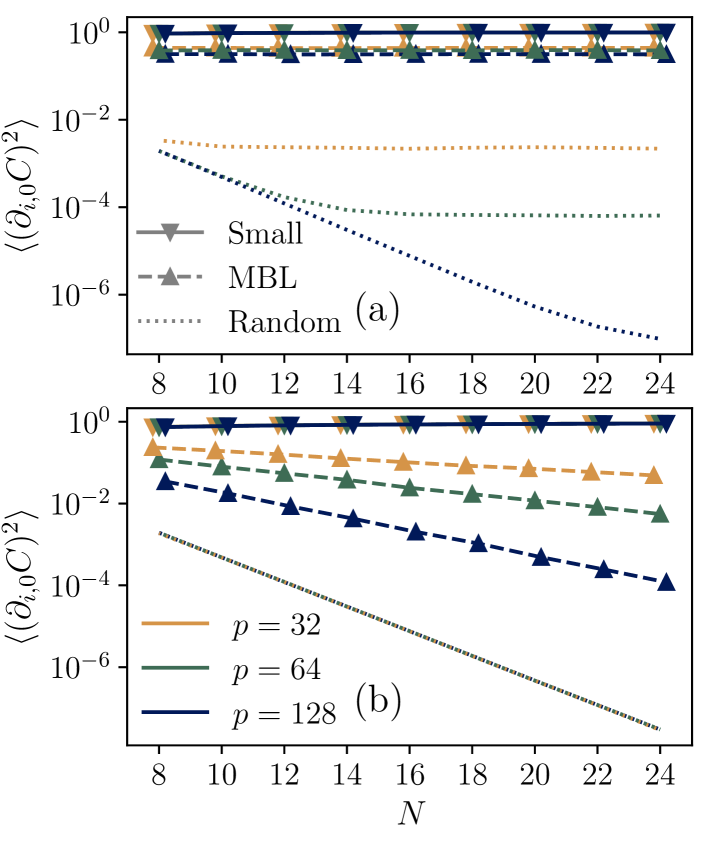
- 시간 진동 조건에 따라 매개변수가 초기화되면, 큐비트 수가 증가함에 따라 기울기 크기가 0에서 멀리 떨어져 있음을 유지한다.
- MBL 상태에서는 현상학적 MBL 이론이 예측한 바와 같이, 국소 관측량에 대해 HEA가 큰 기울기 성분을 보인다.
- 수치 결과에 따르면, Small 및 MBL 초기화 방법이 랜덤 초기화보다 유의미하게 뛰어나며, 양자 기계학습 과제에서 더 빠른 손실 감소와 높은 테스트 정확도를 보인다.
- Small 초기화로 학습된 모델이 가장 뛰어난 성능을 보이며, 그 다음으로 MBL 초기화가 뒤를 이르고, 랜덤 초기화는 느린 수렴과 낮은 정확도를 보인다.
- 결과적으로, 매개변수를 적절히 초기화하면 HEA에서 비어 있는 평탄한 골짜기는 본질적으로 문제가 되지 않으며, 표현력과 국소 최소값이 VQA 설계에서 더 중요한 과제임을 시사한다.
이 논문 읽기
누빈트 뷰어에서 원문을 열고, 읽으면서 궁금한 곳을 바로 물어보세요.
누빈트에서 이 논문 읽기이 리뷰는 AI가 논문 원문을 바탕으로 만들었습니다. 인용하기 전에 원문을 확인해 주세요.