
[논문 리뷰] Position: What Can Large Language Models Tell Us about Time Series Analysis
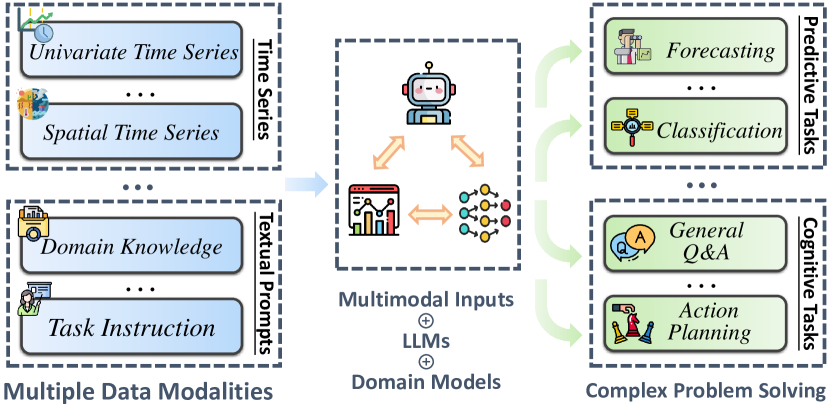
이 위치 논문은 대형 언어 모델(LLMs)이 시계열 분석의 중심 허브로 작동할 수 있으며 데이터/모델 강화자, 예측자, 에이전트로 기능하고 통합 전략과 연구 방향을 개략한다.
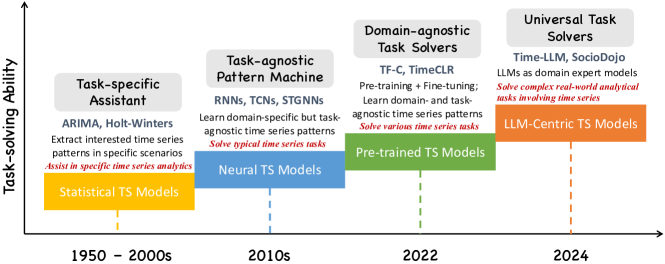
Time series analysis is essential for comprehending the complexities inherent in various realworld systems and applications. Although large language models (LLMs) have recently made significant strides, the development of artificial general intelligence (AGI) equipped with time series analysis capabilities remains in its nascent phase. Most existing time series models heavily rely on domain knowledge and extensive model tuning, predominantly focusing on prediction tasks. In this paper, we argue that current LLMs have the potential to revolutionize time series analysis, thereby promoting efficient decision-making and advancing towards a more universal form of time series analytical intelligence. Such advancement could unlock a wide range of possibilities, including time series modality switching and question answering. We encourage researchers and practitioners to recognize the potential of LLMs in advancing time series analysis and emphasize the need for trust in these related efforts. Furthermore, we detail the seamless integration of time series analysis with existing LLM technologies and outline promising avenues for future research.
연구 동기 및 목표
- LLMs가 시계열 분석을 혁신하고 보편적 지능 시스템을 촉진할 수 있는 잠재력을 명확히 밝힌다.
- 기존 연구를 체계적으로 검토하고 LLMs와 시계열 분석의 통합 형태를 분류한다.
- LLM 중심 시계열 연구를 위한 향후 기회, 도전 과제 및 연구 방향을 제안한다.
제안 방법
- 시계열 작업과 LLM 통합을 데이터 기반 강화자, 모델 기반 강화자, 그리고 LLM 중심 예측자로 분류한다.
- 패칭, 토크나이제이션, 프롬프트를 통해 시계열 데이터에 LLM을 적응시키는 튜닝 기반과 비튜닝 기반 접근법을 설명한다.
- 일반 시계열 분석을 위한 LLM의 에이전트 기반 사용에 대해 논의하고 제로샷 실험의 실증적 통찰을 보고한다.
실험 결과
연구 질문
- RQ1LLMs가 시계열 분석에서 효과적인 강화자, 예측자, 에이전트 역할을 할 수 있는가?
- RQ2LLMs를 시계열 모델과 결합하기 위한 주요 통합 형태와 방법은 무엇인가?
- RQ3LLM 중심의 시계열 분석을 신뢰성과 확장성을 갖추게 만드는 데 어떤 도전과 기회가 나타나는가?
주요 결과
- LLMs는 외부 지식과 추론으로 시계열 데이터와 모델을 보강할 잠재력이 있다.
- LLMs는 시계열 작업에 대해 제로샷 또는 파샷 예측기로 작동할 수 있으며, 특정 설정에서 도메인 특화 모델을 능가하기도 한다.
- 튜닝 기반 LLM 예측기는 적응성을 제공하지만 재앙적 망각과 높은 학습 비용의 위험이 있고, 비튜닝 방식은 프롬프트 엔지니어링에 의존하며 안정성 문제에 직면한다.
- LLMs는 시계열 에이전트로 기능할 수 있지만, 환각과 분포 이해는 여전히 주요 한계이며 도메인 지식의 통합과 견고한 프롬프트가 필요하다.
이 논문 읽기
누빈트 뷰어에서 원문을 열고, 읽으면서 궁금한 곳을 바로 물어보세요.
누빈트에서 이 논문 읽기이 리뷰는 AI가 논문 원문을 바탕으로 만들었습니다. 인용하기 전에 원문을 확인해 주세요.