
[논문 리뷰] Regularized dynamical parametric approximation
이 논문은 시간에 따라 변화하는 진화 방정식을 비선형 파arametrization(예: 가우시안 합 또는 신경망)을 사용하여 풀기 위한 정규화된 동적 파arametric 근사법을 제안한다. 파arametrization이 비정규화되어 있어도, 작은 특이값을 가진 파arameter 유도의 악조건성에도 불구하고, 정규화와 시간 이산화의 균형을 통해 안정적인 수렴을 달성한다. 양자 역학적 동역학과 ODE의 흐름 맵에 대해 이론적 및 수치적 검증이 이루어졌다.
This paper studies the numerical approximation of evolution equations by nonlinear parametrizations $u(t)=Φ(\param(t))$ with time-dependent parameters $\param(t)$, which are to be determined in the computation. The motivation comes from approximations in quantum dynamics by multiple Gaussians and approximations of various dynamical problems by tensor networks and neural networks. In all these cases, the parametrization is typically irregular: the derivative $Φ'(\param)$ can have arbitrarily small singular values and may have varying rank. We derive approximation results for a regularized approach in the time-continuous case as well as in time-discretized cases. For the latter, there is a nontrivial interplay between the regularization parameter and the time stepsize, depending also on the defect size and local bounds of the second derivative of the parametrization map $Φ$. When this is appropriately taken into account, the approach can be successfully applied in irregular situations, even though it runs counter to the basic principle in numerical analysis to avoid solving ill-posed subproblems when aiming for a stable algorithm. The paper also includes two theoretical case studies: regularized parametric steepest descent for optimization and regularized parametric Strang splitting for the time-dependent Schrödinger equation. Numerical experiments with sums of Gaussians for approximating quantum dynamics and with neural networks for approximating the flow map of a system of ordinary differential equations illustrate and complement the theoretical results.
연구 동기 및 목표
- 시간에 따라 변화하는 비선형 파arametric 근사에서 파arametrization 유도의 특이값이 임의로 작아지거나 질량이 변할 수 있는 경우 발생하는 수치적 불안정성을 다루는 것.
- 기본 수치 원칙이 그러한 악조건 문제를 기각할 수 있는 상황에서도 안정적이고 수렴 가능한 정규화된 접근법을 개발하는 것.
- 정규화된 최소 제곱 문제의 시간 연속 및 시간 이산화 형태에 대한 이론적 수렴 분석을 제공하는 것.
- 다중 가우시안 근사법을 사용한 양자 역학적 동역학과 딥 뉴럴 네트워크를 사용한 ODE 흐름 맵에 대해 수치적으로 방법을 검증하는 것.
- 시간 이산화 및 정규화 파rameter에 대해 강건한 후행 오차 한계를 설정하는 것.
제안 방법
- 시간 연속 동적 파arametric 근사 문제를 정규화된 최소 제곱 문제로 공식화한다: $ \norm{\boldsymbol{\texttt{u}}} - f(\boldsymbol{\texttt{u}})}^2 + \tilde{\boldsymbol{\texttt{e}}}}^2 \norm{\boldsymbol{\texttt{q}}'}^2 $, 여기서 $ \boldsymbol{\texttt{u}} = \boldsymbol{\texttt{u}}(t) = \boldsymbol{\texttt{F}}(q(t)) $, $ \tilde{\boldsymbol{\texttt{e}}} $는 시간에 따라 변하는 정규화 파ram터이다.
- 각 단계에서 정규화된 선형 최소 제곱 문제를 풀며, 표준 시간 스텝 스킴을 사용해 $ q(t) $에 대한 유도된 미분 방정식을 푼다.
- 만약 $ f(y) = Ay + g(y) $ 이고 $ A $ 가 유계가 아니면, $ \boldsymbol{\texttt{y}}' - Ay $ 가 $ \boldsymbol{\texttt{F}}(q) $ 의 탄젠트 공간에서 잘 근사되어야 한다는 조건을 도입한다.
- 정규화된 최소 제곱 문제의 잔차를 바탕으로 후행 오차 한계를 유도하며, 이는 시간 이산화에 대해 안정적이다.
- 복소수 가우시안 합을 사용한 슈뢰딩거 방정식과 딥 뉴럴 네트워크를 사용한 ODE 흐름 맵에 방법을 적용한다.
- 다중 가우시안 설정에서 초기 파arameter 값과 야코비안을 효율적으로 계산하기 위해 가우시안 적분의 해석적 공식을 사용한다.
실험 결과
연구 질문
- RQ1악조건적인 파arameter 유도의 특이값이 임의로 작아지는 상황에서 정규화된 동적 파arametric 근사법이 수렴을 안정화시킬 수 있는가?
- RQ2기본 최소 제곱 하위 문제의 악조건성에도 불구하고 정규화된 접근법이 수렴 순서를 유지하는가?
- RQ3정규화 파arameter $ \tilde{\boldsymbol{\texttt{e}}} $ 의 선택이 시간 이산화 해의 정확도와 안정성에 어떤 영향을 미치는가?
- RQ4다중 가우시안 파arametrization을 사용한 양자 역학적 시뮬레이션에서 메모리와 노름 보존이 안정적으로 이루어지는가?
- RQ5정규화된 최소 제곱 문제의 잔차에서 유도된 후행 오차 한계가 시간 간격 크기와 정규화 파arameter의 변화에 대해 강건한가?
주요 결과
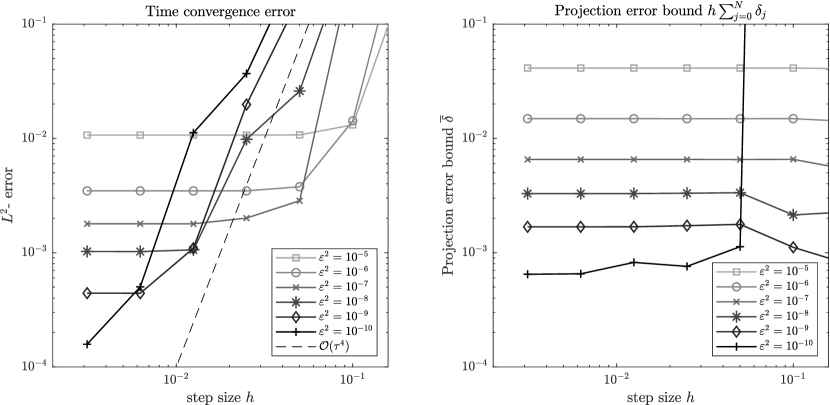
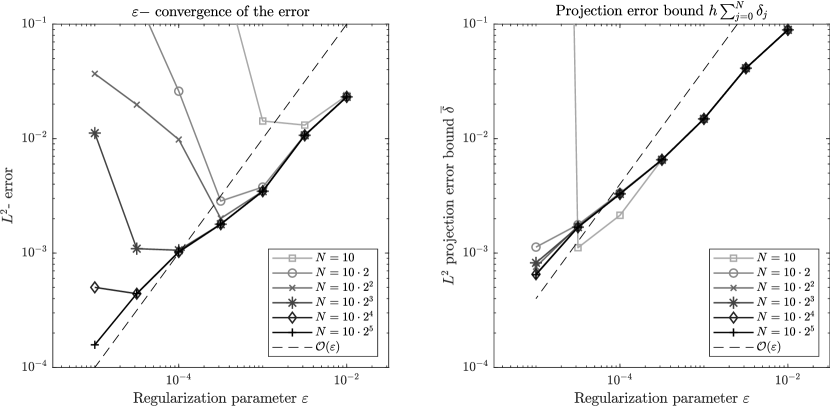
- 적절한 정규화 파arameter $ \tilde{\boldsymbol{\texttt{e}}} $ 와 시간 간격 크기 $ h $ 를 선택하면, 파arameter 유도의 특이값이 임의로 작아지는 경우에도 정규화된 동적 파arametric 근사법이 시간에 대해 최적의 수렴 순서를 달성한다.
- 36개의 복소수 가우시안을 사용한 더블웰 슈뢰딩거 문제에서 $ \tilde{\boldsymbol{\texttt{e}}} = 10^{-5} $ 일 경우, $ h = 4 \times 10^{-3} $ 에서 큰 에너지 오차와 조기 종료가 발생하여 작은 $ \tilde{\boldsymbol{\texttt{e}}} $ 에서의 불안정성을 나타낸다.
- 더 큰 정규화 파aram터(예: $ \tilde{\boldsymbol{\texttt{e}}} = 10^{-3} $)를 사용할 경우, 고전적 4차 룬게-쿠타 방법의 기대 순서를 따르며 시간 간격 제약 없이 에너지 오차가 유지되었다.
- 노름 보존은 상대적으로 큰 $ \tilde{\boldsymbol{\texttt{e}}} $ 에서만 관찰되었으며, 작은 $ \tilde{\boldsymbol{\texttt{e}}} $ 에서는 질량 오차가 크게 증가하여 정규화가 물리적 관측치를 유지하는 데 필수적임을 시사한다.
- 투영 오차에 대한 후행 오차 한계는 시간 간격 크기와 정확히 일치하며 $ \tilde{\boldsymbol{\texttt{e}}} $ 의 영향을 정확히 반영하여 수치 이산화에 대해 강건함을 입증했다.
- 딥 뉴럴 네트워크를 사용한 ODE 시스템의 흐름 맵을 성공적으로 근사했으며, 오차 한계는 정규화 효과를 반영했고 시간 이산화에 민감하지 않았다.
이 논문 읽기
누빈트 뷰어에서 원문을 열고, 읽으면서 궁금한 곳을 바로 물어보세요.
누빈트에서 이 논문 읽기이 리뷰는 AI가 논문 원문을 바탕으로 만들었습니다. 인용하기 전에 원문을 확인해 주세요.