
[논문 리뷰] Towards a universal analytical model for Population III star formation: interplay between feedback and fragmentation
이 논문은 피드백과 분할을 다양한 척도에서 자발적으로 연결하는 보편적인 분석 모델을 제시하며, 구름의 특성으로부터 최종 별 질량을 예측한다. 이 모델은 고적색도에서의 초거대 블랙홀을 형성하는 데 유력한 씨앗이 되는 초거대 질량의 초기 3형 별 군집(≥10⁴ M☉)이 약 20–70%의 고적색도 퀘이사 후원 은하구름에서 형성된다고 예측한다.
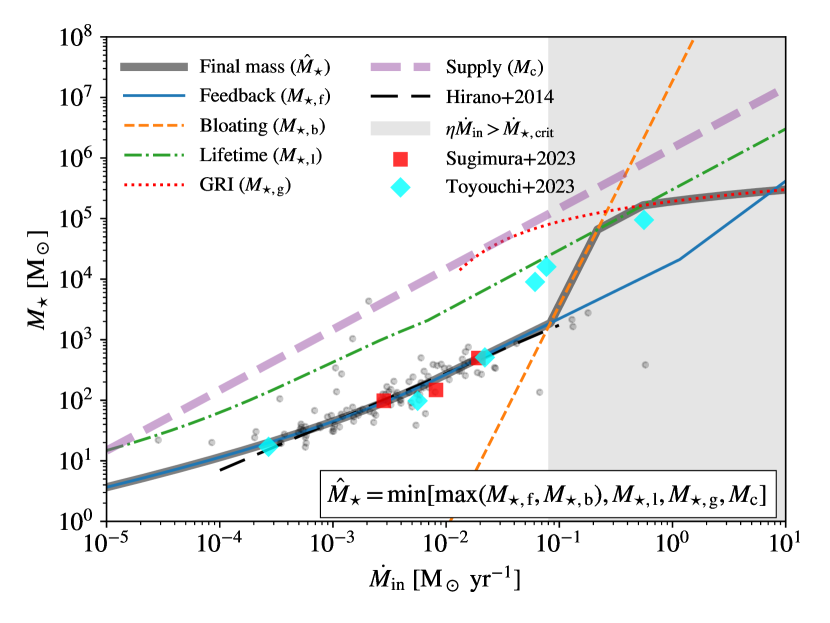
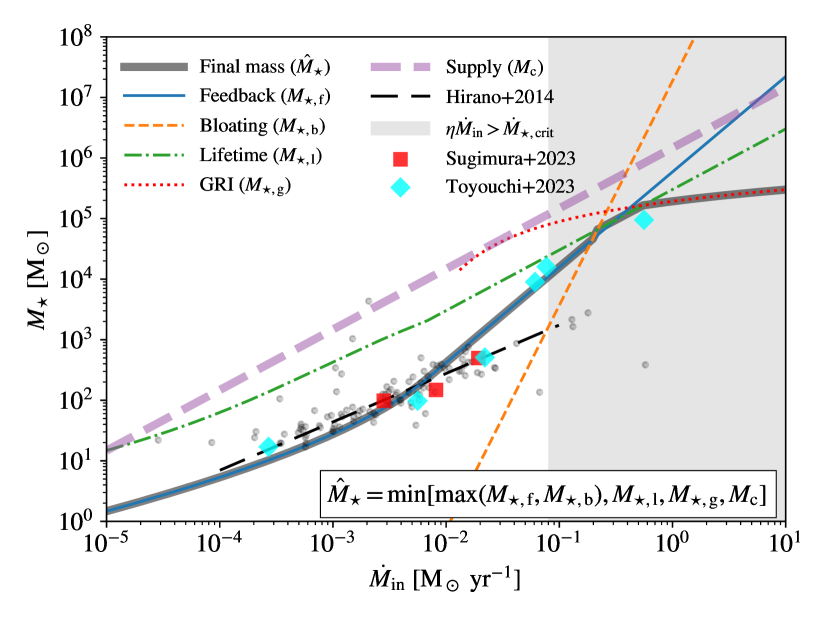
JWST has brought us new insights into Cosmic Dawn with tentative detection of the unique signatures of metal-free Population III (Pop III) stars, such as strong HeII emission, extremely blue UV spectrum, and enhanced nitrogen abundance. Self-consistent theoretical predictions of the formation rates, sites, and masses of Pop III stars are crucial for interpreting the observations, but are challenging due to complex physical processes operating over the large range of length scales involved. One solution is to combine analytical models for the small-scale star formation process with cosmological simulations that capture the large-scale physics such as structure formation, radiation backgrounds, and baryon-dark matter streaming motion that regulate the conditions of Pop III star formation. We build an analytical model to predict the final masses of Pop III stars/clusters from the properties of star-forming clouds, based on the key results of small-scale star formation simulations and stellar evolution models. Our model for the first time considers the interplay between feedback and fragmentation and covers different modes of Pop III star formation ranging from ordinary small ($\sim 10-2000\ m M_\odot$) clusters in molecular-cooling clouds to massive ($\gtrsim 10^{4}\ m M_\odot$) clusters containing supermassive ($\sim 10^{4}-3 imes 10^{5}\ m M_\odot$) stars under violent collapse of atomic-cooling clouds. As an example, the model is applied to the Pop III star-forming clouds in the progenitors of typical haloes hosting high-$z$ luminous quasars, which shows that formation of Pop III massive clusters is common ($\sim 20-70\%$) in such biased ($\sim4σ$) regions, and the resulting heavy black hole seeds from supermassive stars can account for a significant fraction of observed luminous ($\gtrsim 10^{46}\ m erg\ s^{-1}$) quasars at $z\sim 6$.
연구 동기 및 목표
- 다양한 형성 환경에서 초기 3형 별과 군집 질량을 예측하기 위한 통합된 분석 프레임워크를 개발하는 것.
- 작은 척도의 분할과 피드백에서부터 큰 척도의 천체역학적 조건까지의 다중 척도 물리 현상을 모델링하는 데 있어, JWST 시대 관측 결과를 해석하는 데 핵심적인 과제를 해결하는 것.
- 초기 적색도에서 빛나는 퀘이사(≥10⁴⁶ erg s⁻¹)를 지닌 은하구름에서 초기 3형 별과 군집의 형성 확률 및 질량 분포를 정량화하는 것.
- 초기 3형 별에서 형성된 초거대 질량의 별이 z≈6 퀘이사의 중심에 있는 거대 블랙홀을 형성하는 데 실현 가능한 씨앗이 되는지 평가하는 것.
- 우주론적 시뮬레이션과 반분석 모델에 통합될 수 있도록 하여, 초기 우주의 진화를 다중 척도에서 자발적으로 예측할 수 있도록 하는 것.
제안 방법
- 작은 척도의 유체역학 시뮬레이션과 별의 진화 모델을 조합하여 원시별의 질량 증가와 분할을 기반으로 한 분석 모델을 개발한다.
- 가스 질량 증가율과 구름 특성에 따라 변하는 피드백 조절 분할 조건을 도입하여, 피드백과 군집 질량 함수를 연결한다.
- 분할 효율성과 군집 질량 분포를 모델링하기 위해 다중성 계수 N과 원시별 질량 분포 기울기 α를 사용한다.
- 우주론적으로 대표적인 은하구름(M_h ≈ 10¹² M☉, z ≈ 6)에 모델을 적용하여 형성 확률를 평가한다.
- 고해상도 시뮬레이션(예: Sharda et al. 2020)의 질량 증가력 데이터를 통합하여 원시별 성장과 피드백 효과를 校정한다.
- 모델을 확장하여 초기 질량 함수(IMF)의 전체적인 특성을 예측하며, 이는 큰 척도의 유입과 작은 척도의 분할 간의 균형에 따라 달라진다.
실험 결과
연구 질문
- RQ1피드백과 분할의 상호작용이 다양한 질량 증가 조건에서 초기 3형 별과 군집의 최종 질량을 어떻게 조절하는가?
- RQ2z≈6에서 빛나는 퀘이사(≥10⁴⁶ erg s⁻¹)를 지닌 은하구름(M_h ≈ 10¹² M☉) 중에서 원자 냉각 구름의 폭발적 붕괴를 통해 초거대 질량의 초기 3형 별 군집(≥10⁴ M☉)이 형성되는 비율은 얼마인가?
- RQ3이러한 군집에서 형성된 초기 3형 별의 초거대 질량 별(10⁴–3×10⁵ M☉)이 관측된 빛나는 z≈6 퀘이사의 인구 중 얼마나 큰 비율을 차지하는가?
- RQ4전체 초기 3형 IMF는 큰 척도의 가스 유입과 작은 척도의 분할 및 피드백 간의 균형에 따라 어떻게 달라지는가?
- RQ5모델의 예측 능력을 향상시키기 위해 필요한 주요 누락된 물리적 요소들(예: 자기장, 확률적 질량 증가, 복잡한 다중성 등)은 무엇인가?
주요 결과
- 모델은 z≈6에서 빛나는 퀘이사의 후원이 되는 고밀도(4σ 편향) 영역의 약 20–70%에서 초거대 질량의 초기 3형 별 군집(≥10⁴ M☉)이 형성된다고 예측한다.
- 이러한 군집에서 형성된 초거대 질량의 초기 3형 별(10⁴–3×10⁵ M☉)은 z≈6에서 볼로메트릭 빛나는 에너지가 ≥10⁴⁶ erg s⁻¹인 관측된 빛나는 퀘이사의 상당 부분(>7%)을 설명할 수 있다.
- 최종 초기 3형 IMF는 큰 척도의 유입률과 작은 척도의 분할/피드백에 의해 조절되며, 분할 효율성(N ≲ 3)이 군집 질량 분포 또는 원시별 질량 분포 중 어느 것이 지배적인지를 결정한다.
- 분할 효율성이 낮은 경우(N ≲ 3), 모델은 관측된 초거대 질량의 초기 3형 별 군집과 초거대 별 형성과 일치하는 상위 무게 중심의 IMF를 예측한다.
- 모델은 분할이 효율적일 경우 전체 초기 3형 IMF가 거의 보편적이 되지만, 초기 우주적 조건에서는 여전히 환경 조건에 민감하게 반응함을 보여준다.
- 이 모델는 우주론적 시뮬레이션과 반분석 프레임워크에 통합될 수 있도록 설계되어, 초기 별과 블랙홀 형성의 자발적이고 다중 척도의 모델링을 가능하게 한다.
이 논문 읽기
누빈트 뷰어에서 원문을 열고, 읽으면서 궁금한 곳을 바로 물어보세요.
누빈트에서 이 논문 읽기이 리뷰는 AI가 논문 원문을 바탕으로 만들었습니다. 인용하기 전에 원문을 확인해 주세요.