
[Paper Review] A comparative analysis of transient finite-strain coupled diffusion-deformation theories for hydrogels
This paper presents a unified thermodynamic framework for finite-strain, transient diffusion-deformation models in hydrogels, comparing established theories through consistent variational formulations and FEniCS-based finite element implementations. It demonstrates that the choice of volumetric response model—often overlooked—significantly influences swelling behavior, with key differences emerging in benchmark simulations despite shared thermodynamic foundations.
This work presents a comparative review and classification between some well-known thermodynamically consistent models of hydrogel behavior in a large deformation setting, specifically focusing on solvent absorption/desorption and its impact on mechanical deformation and network swelling. The proposed discussion addresses formulation aspects, general mathematical classification of the governing equations, and numerical implementation issues based on the finite element method. The theories are presented in a unified framework demonstrating that, despite not being evident in some cases, all of them follow equivalent thermodynamic arguments. A detailed numerical analysis is carried out where Taylor-Hood elements are employed in the spatial discretization to satisfy the inf-sup condition and to prevent spurious numerical oscillations. The resulting discrete problems are solved using the FEniCS platform through consistent variational formulations, employing both monolithic and staggered approaches. We conduct benchmark tests on various hydrogel structures, demonstrating that major differences arise from the chosen volumetric response of the hydrogel. The significance of this choice is frequently underestimated in the state-of-the-art literature but has been shown to have substantial implications on the resulting hydrogel behavior.
Motivation & Objective
- To provide a unified, thermodynamically consistent framework for transient, large-deformation diffusion-deformation models in hydrogels.
- To classify and compare existing macro-scale poroelastic theories based on their mathematical structure and constitutive assumptions.
- To investigate the numerical performance of monolithic and staggered finite element schemes using Taylor-Hood elements to satisfy the inf-sup condition.
- To demonstrate that the choice of volumetric response model—frequently underestimated in the literature—has substantial, non-trivial effects on hydrogel behavior.
Proposed method
- Formulate a unified thermodynamic framework using the intermediate configuration and the elastic right Cauchy-Green tensor to describe the coupled chemo-mechanical response.
- Derive governing equations from the second law of thermodynamics, enforcing entropy inequality via the free energy function Ψₑᴿ(Fₑ, cᴿ) and active chemical potential μₐcₜ.
- Implement the weak forms using consistent variational formulations in the FEniCS finite element platform with Taylor-Hood elements to stabilize the mixed formulation.
- Solve the resulting discrete problems using both monolithic and staggered time integration schemes to assess robustness and accuracy.
- Define the volumetric response through the fluid volume fraction J_f = (1 + Ωc_R)^{1/3}, linking deformation to concentration via the elastic stretch.
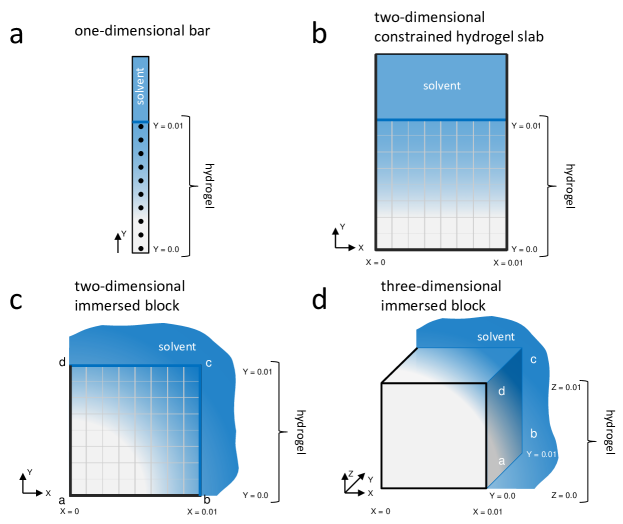
- Validate the framework through benchmark simulations on hydrogel structures, comparing results across different volumetric response assumptions.
Experimental results
Research questions
- RQ1How do different finite-strain, thermodynamically consistent diffusion-deformation theories for hydrogels compare in terms of their mathematical structure and constitutive assumptions?
- RQ2To what extent does the choice of volumetric response model—specifically the functional dependence of J_f on c_R—affect the predicted swelling and deformation behavior?
- RQ3Can a unified variational formulation be derived that recovers all considered theories under a common thermodynamic framework?
- RQ4How do monolithic and staggered finite element approaches perform in terms of stability and accuracy for transient, nonlinear, coupled chemo-mechanical problems?
- RQ5What are the implications of neglecting the distinction between the intermediate and current configurations in the stress and potential definitions?
Key findings
- All considered theories are thermodynamically consistent and can be unified under a single framework based on the intermediate configuration and the free energy Ψₑᴿ(Fₑ, cᴿ).
- The active chemical potential μₐcₜ = ∂Ψₑᴿ/∂cᴿ ensures thermodynamic consistency and links the chemical potential to the elastic response.
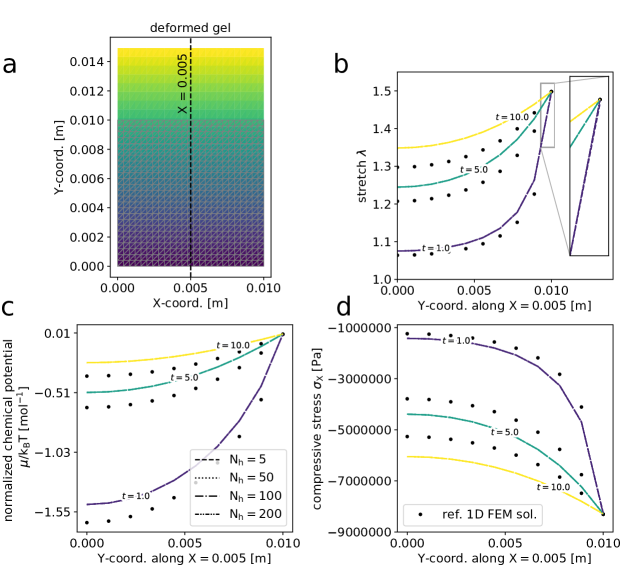
- The volumetric response model, particularly the functional form of J_f = (1 + Ωc_R)^{1/3}, has a dominant influence on the predicted swelling behavior, with significant differences observed in benchmark simulations.
- Taylor-Hood elements effectively satisfy the inf-sup condition, preventing spurious pressure oscillations in the mixed formulation.
- The monolithic and staggered finite element approaches both converge to consistent solutions, but the monolithic scheme shows better stability in highly nonlinear regimes.
- The equivalence between the PK1 stress tensor P_e and the original P = ∂Ψ_R/∂F is rigorously proven under the assumed kinematic constraint, validating the consistency of the framework.
Read this paper
Open the full text in the Nubint reader and ask about any passage as you read.
Read this paper on NubintThis review was generated by AI from the original paper. Please check the paper before citing it.