
[Paper Review] A Decision-Language Model (DLM) for Dynamic Restless Multi-Armed Bandit Tasks in Public Health
This paper introduces a Decision-Language Model (DLM) that leverages large language models (LLMs) to dynamically adapt reward functions in restless multi-armed bandit (RMAB) frameworks for public health resource allocation. By interpreting human-language policy commands and iteratively refining reward functions via RMAB simulation feedback, DLM achieves near-human-level policy alignment without retraining, enabling real-time adaptation to evolving public health priorities.
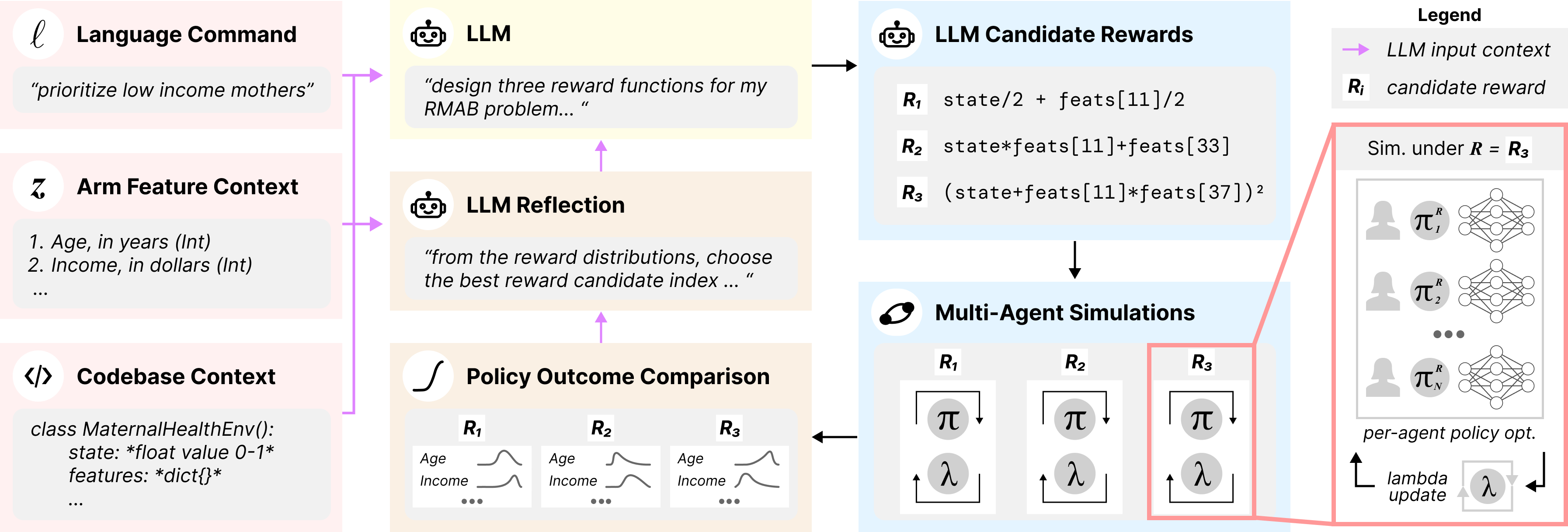
Restless multi-armed bandits (RMAB) have demonstrated success in optimizing resource allocation for large beneficiary populations in public health settings. Unfortunately, RMAB models lack flexibility to adapt to evolving public health policy priorities. Concurrently, Large Language Models (LLMs) have emerged as adept automated planners across domains of robotic control and navigation. In this paper, we propose a Decision Language Model (DLM) for RMABs, enabling dynamic fine-tuning of RMAB policies in public health settings using human-language commands. We propose using LLMs as automated planners to (1) interpret human policy preference prompts, (2) propose reward functions as code for a multi-agent RMAB environment, and (3) iterate on the generated reward functions using feedback from grounded RMAB simulations. We illustrate the application of DLM in collaboration with ARMMAN, an India-based non-profit promoting preventative care for pregnant mothers, that currently relies on RMAB policies to optimally allocate health worker calls to low-resource populations. We conduct a technology demonstration in simulation using the Gemini Pro model, showing DLM can dynamically shape policy outcomes using only human prompts as input.
Motivation & Objective
- To address the challenge of adapting RMAB-based public health resource allocation to evolving policy priorities without retraining.
- To enable non-expert public health practitioners to specify desired outcomes using natural language commands.
- To develop a feedback loop that improves LLM-generated reward functions using simulation results from RMAB environments.
- To validate the approach in a real-world maternal and child health intervention context with ARMMAN in India.
- To demonstrate that LLMs can effectively generate and refine reward functions for complex, dynamic public health decision-making.
Proposed method
- Using LLMs to interpret human policy preference prompts and extract semantic intent for desired health outcomes.
- Generating code-based reward functions from natural language using the LLM’s code generation capability.
- Implementing an iterative refinement loop where RMAB simulation results provide feedback to improve the LLM’s reward function proposals.
- Employing a simulation-based feedback mechanism to align LLM-generated rewards with target policy objectives without ground-truth feedback.
- Integrating the LLM-generated reward functions into a multi-agent reinforcement learning environment for RMABs to train adaptive allocation policies.
- Validating the system using a real-world maternal health program where health workers assign calls to pregnant beneficiaries under resource constraints.
Experimental results
Research questions
- RQ1Can LLMs effectively interpret human-language policy commands and translate them into functional reward functions for RMABs in public health?
- RQ2Can an iterative feedback loop using RMAB simulation results improve the alignment of LLM-generated reward functions with desired policy outcomes?
- RQ3To what extent can LLM-generated reward functions achieve performance comparable to human-designed rewards in dynamic public health allocation tasks?
- RQ4How well does the DLM system adapt to changing priorities in a real-world maternal health intervention setting?
- RQ5Can the system enable non-expert users to dynamically adjust public health policies using only natural language input?
Key findings
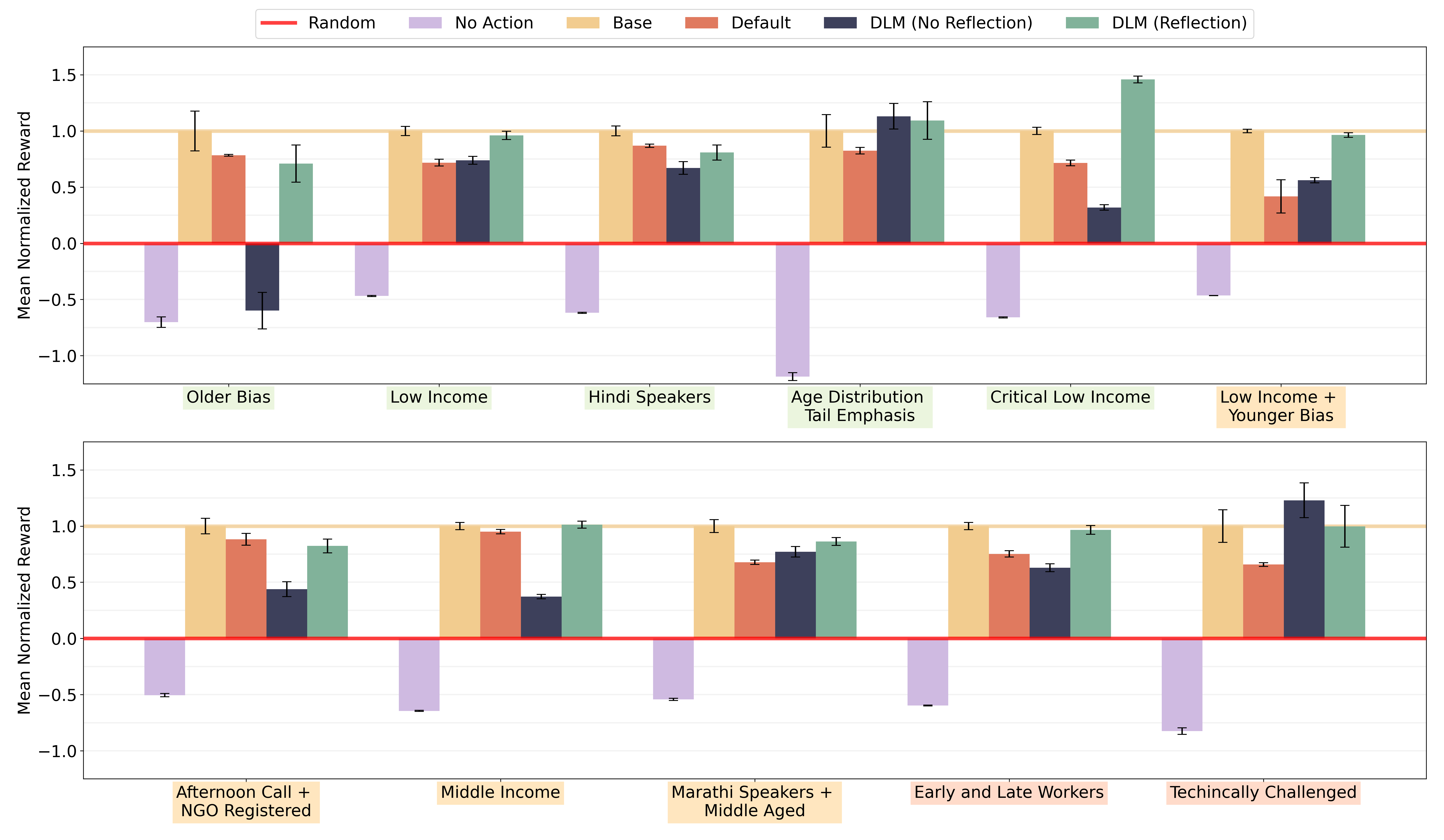
- The DLM system successfully translates natural language policy commands into effective reward functions that guide RMAB policies toward desired outcomes.
- The iterative feedback loop significantly improves the quality of LLM-generated reward functions, enabling convergence toward target policy objectives.
- DLM achieves near-human-level performance in reward function design, as measured by simulation outcomes matching expert-designed benchmarks.
- The system enables dynamic policy adaptation without retraining, allowing rapid response to shifting public health priorities.
- In the ARMMAN case study, DLM demonstrated effective reallocation of limited health worker resources based on evolving beneficiary risk profiles and timing preferences.
- The approach reduces reliance on expert intervention for reward function engineering, making RMAB-based planning accessible to non-technical public health practitioners.
Read this paper
Open the full text in the Nubint reader and ask about any passage as you read.
Read this paper on NubintThis review was generated by AI from the original paper. Please check the paper before citing it.