
[Paper Review] A General-Purpose Self-Supervised Model for Computational Pathology
UNI is a general-purpose self-supervised Vision Transformer model pretrained on over 100 million tissue patches (Mass-100K) that achieves state-of-the-art performance on 33 diverse computational pathology tasks, enabling resolution-agnostic classification, few-shot slide classification, and broad generalization across 108 OncoTree codes.
Tissue phenotyping is a fundamental computational pathology (CPath) task in learning objective characterizations of histopathologic biomarkers in anatomic pathology. However, whole-slide imaging (WSI) poses a complex computer vision problem in which the large-scale image resolutions of WSIs and the enormous diversity of morphological phenotypes preclude large-scale data annotation. Current efforts have proposed using pretrained image encoders with either transfer learning from natural image datasets or self-supervised pretraining on publicly-available histopathology datasets, but have not been extensively developed and evaluated across diverse tissue types at scale. We introduce UNI, a general-purpose self-supervised model for pathology, pretrained using over 100 million tissue patches from over 100,000 diagnostic haematoxylin and eosin-stained WSIs across 20 major tissue types, and evaluated on 33 representative CPath clinical tasks in CPath of varying diagnostic difficulties. In addition to outperforming previous state-of-the-art models, we demonstrate new modeling capabilities in CPath such as resolution-agnostic tissue classification, slide classification using few-shot class prototypes, and disease subtyping generalization in classifying up to 108 cancer types in the OncoTree code classification system. UNI advances unsupervised representation learning at scale in CPath in terms of both pretraining data and downstream evaluation, enabling data-efficient AI models that can generalize and transfer to a gamut of diagnostically-challenging tasks and clinical workflows in anatomic pathology.
Motivation & Objective
- Motivate the need for scalable, generalizable self-supervised representations in computational pathology (CPath).
- Develop a foundation model (UNI) trained on massive, diverse histology data to generalize across tissue types and tasks.
- Demonstrate UNI's performance across ROI-, patch-, and slide-level CPath tasks, including few-shot learning and resolution-agnostic classification.
- Show scalability effects and data-efficiency of self-supervised pretraining for CPath.
Proposed method
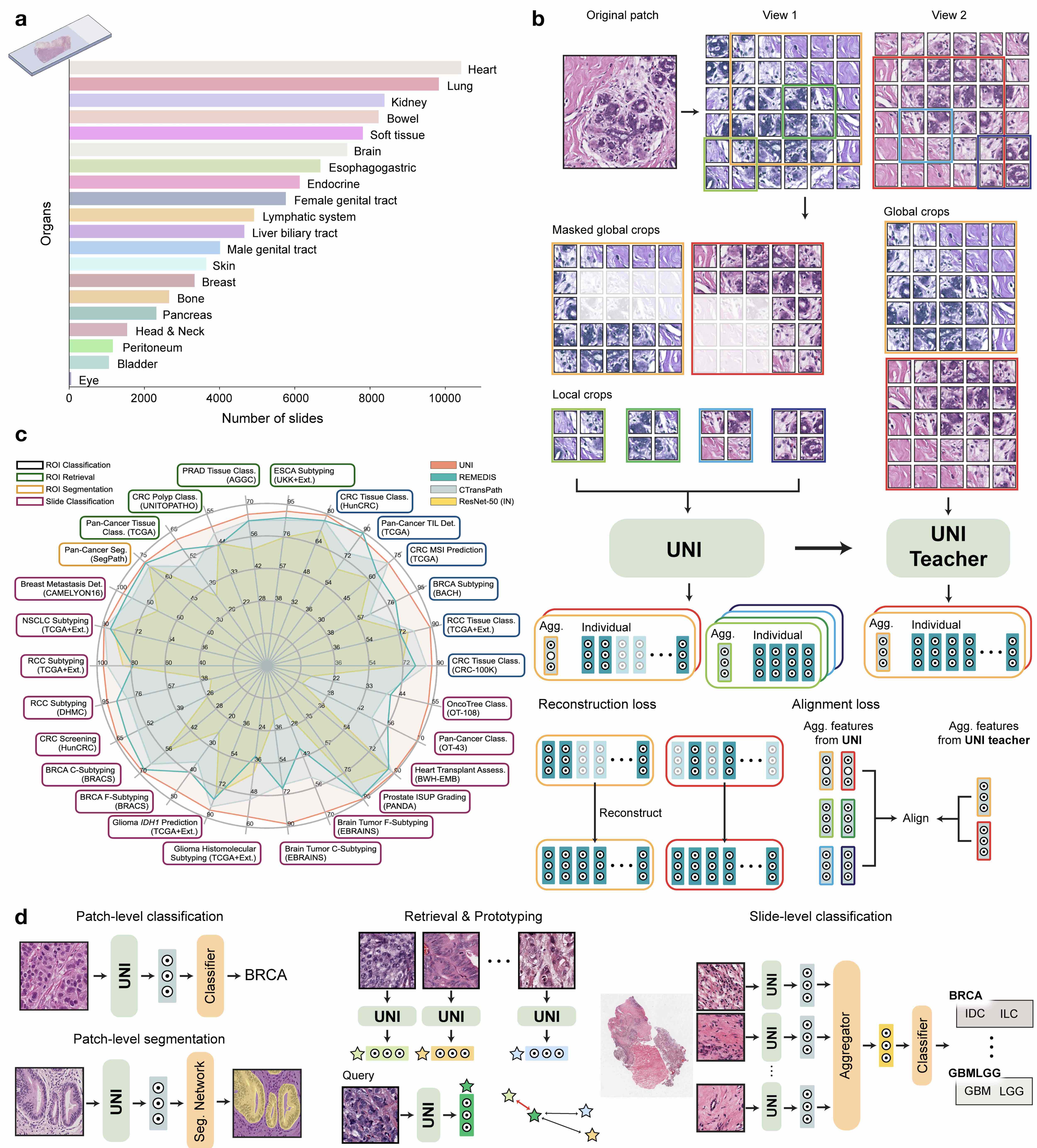
- Pretrain UNI (ViT-Large) on Mass-100K, a dataset with over 100 million tissue patches from 100,426 WSIs across 20 tissue types.
- Use the DINOv2 self-supervised training objective with a mask image modeling and self-distillation components.
- Evaluate UNI on 33 downstream CPath tasks spanning ROI classification, segmentation, image retrieval, and slide-level classification (including OncoTree OT-43 and OT-108).
- Compare against ResNet-50 (IN-1K), CTransPath, and REMEDIS, and assess data-scale effects (Mass-1K, Mass-22K, Mass-100K).
- Investigate few-shot slide-level learning (C×K setups) and ROI-level linear and KNN probing to assess representation quality and label efficiency.
- Explore resolution-agnostic representations and high-resolution feature robustness, including MHSA attention visualizations.
Experimental results
Research questions
- RQ1Can a self-supervised Vision Transformer pretrained on a large, diverse histology corpus generalize across diverse CPath tasks beyond the training organ types?
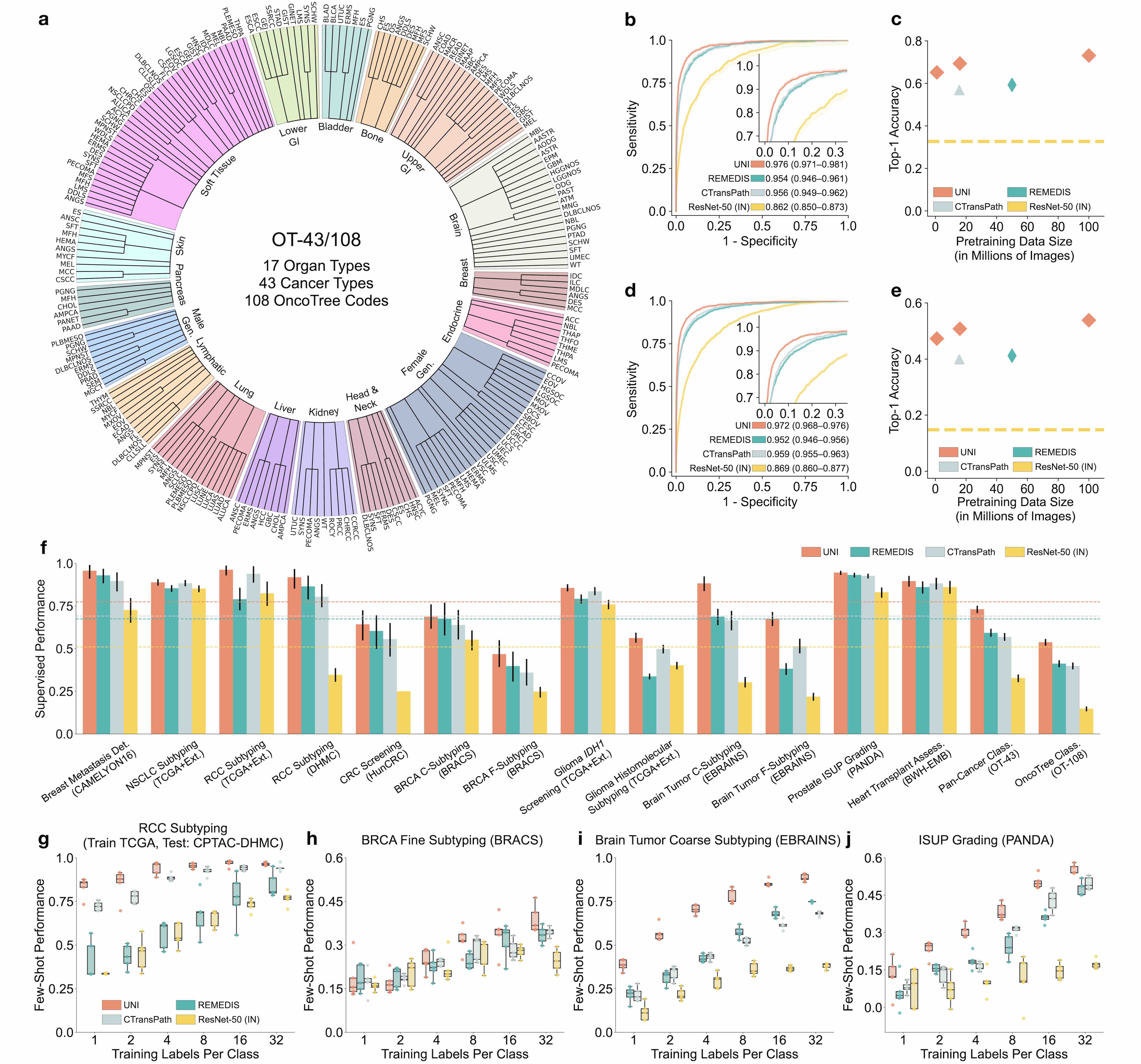
- RQ2How does data scale (Mass-1K, Mass-22K, Mass-100K) affect performance on OncoTree OT-43/OT-108 and other downstream tasks?
- RQ3Is UNI effective for few-shot slide classification and ROI-level probing, and does it maintain performance across varying image resolutions?
- RQ4Does pretraining on histology data reduce data-annotation needs while improving cross-task transfer compared to prior baselines (ResNet-50, CTransPath, REMEDIS)?
- RQ5What are the qualitative characteristics (e.g., attention maps) of UNI’s representations across resolutions?
Key findings
- UNI outperforms baselines on 33 downstream tasks, achieving top-1 and top-5 gains on OT-43 and OT-108 with large margins over REMEDIS and CTransPath.
- Data scaling benefits: Mass-1K to Mass-22K yields +4.2% (top-1) and +3.6% (top-5) on OT-43, Mass-22K to Mass-100K yields +3.7% (top-1) and +0.7% (top-5); Mass-1K to Mass-100K yields +6.5% (top-1) and +8.6% (top-5) on OT-108.
- UNI achieves strong performance in weakly-supervised slide classification and 15 ROI-level tasks, with consistent outperformance and notable gains on higher-difficulty tasks.
- In external TCGA-evaluated data, UNI still outperforms ResNet-50 and is competitive with or superior to CTransPath/REMEDIS on several tasks, showing better generalization across external cohorts.
- Few-shot learning: UNI generally requires fewer examples per class to reach strong performance, showing superior label efficiency across multiple tasks.
- Resolution-agnostic capabilities: UNI maintains strong representations across greatly varying image resolutions, with attention maps revealing meaningful tissue localization at multiple scales.
Read this paper
Open the full text in the Nubint reader and ask about any passage as you read.
Read this paper on NubintThis review was generated by AI from the original paper. Please check the paper before citing it.