
[Paper Review] A Generative Adversarial Network for Climate Tipping Point Discovery (TIP-GAN)
This paper introduces TIP-GAN, a generative adversarial network that identifies climate tipping points by training generators to produce model configurations near critical thresholds and a discriminator to detect tipping point states using a surrogate climate model. The method successfully focuses sampling on uncertainty regions near the Atlantic Meridional Overturning Circulation (AMOC) collapse threshold, with 98.7% of generated samples falling within the uncertainty region when using three generators, and the trained discriminator achieving over 99% F1-score in predicting tipping points without oracle reliance.
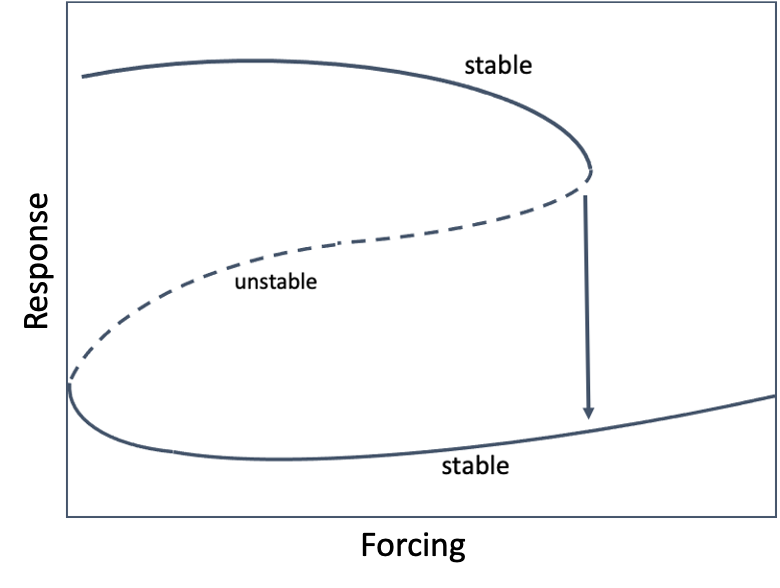
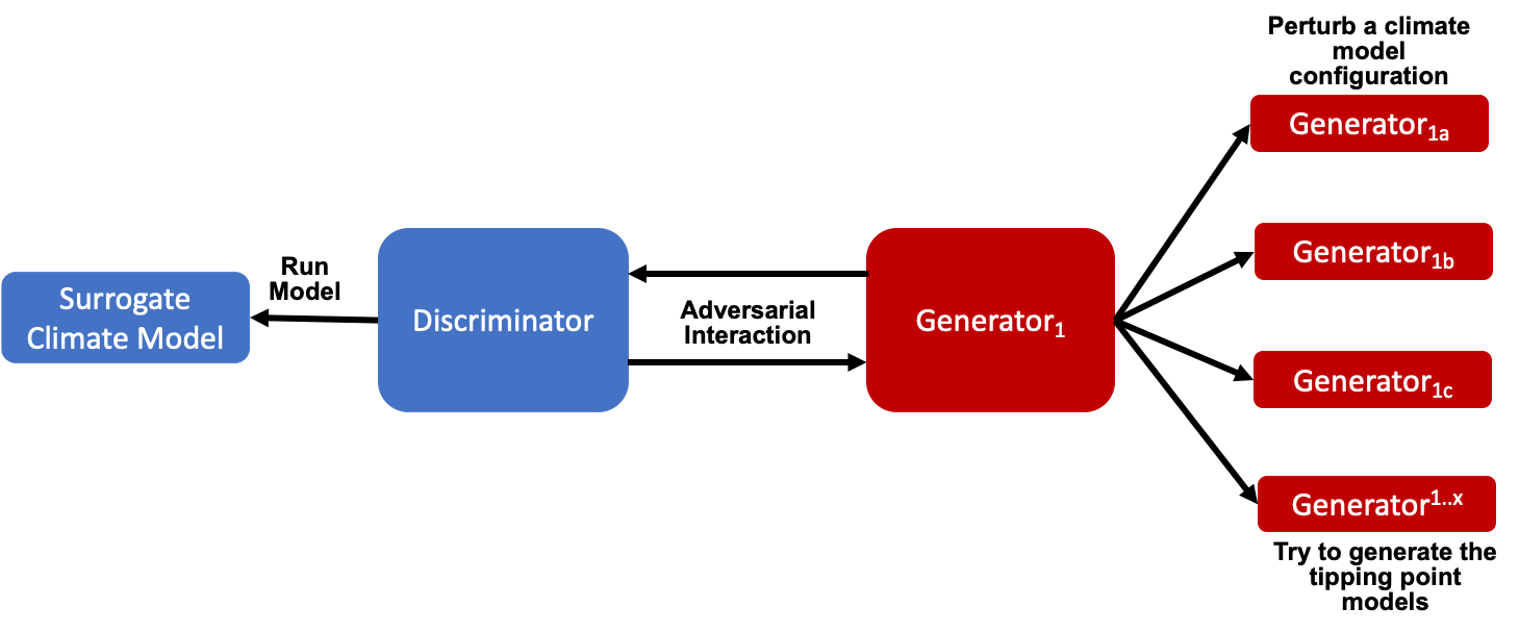
We propose a new Tipping Point Generative Adversarial Network (TIP-GAN) for better characterizing potential climate tipping points in Earth system models. We describe an adversarial game to explore the parameter space of these models, detect upcoming tipping points, and discover the drivers of tipping points. In this setup, a set of generators learn to construct model configurations that will invoke a climate tipping point. The discriminator learns to identify which generators are generating each model configuration and whether a given configuration will lead to a tipping point. The discriminator is trained using an oracle (a surrogate climate model) to test if a generated model configuration leads to a tipping point or not. We demonstrate the application of this GAN to invoke the collapse of the Atlantic Meridional Overturning Circulation (AMOC). We share experimental results of modifying the loss functions and the number of generators to exploit the area of uncertainty in model state space near a climate tipping point. In addition, we show that our trained discriminator can predict AMOC collapse with a high degree of accuracy without the use of the oracle. This approach could generalize to other tipping points, and could augment climate modeling research by directing users interested in studying tipping points to parameter sets likely to induce said tipping points in their computationally intensive climate models.
Motivation & Objective
- To address the challenge of identifying climate tipping points in high-dimensional, computationally expensive Earth system models.
- To reduce the need for brute-force simulation by guiding researchers toward parameter sets likely to induce tipping points.
- To develop a GAN-based framework that can generalize to other tipping points and scientific discovery problems.
- To explore how uncertainty in state space near bifurcations can be systematically discovered using adversarial training.
Proposed method
- A Generative Adversarial Network (GAN) is trained with multiple generators and a discriminator, where the discriminator uses a surrogate climate model (oracle) to evaluate whether generated configurations lead to AMOC collapse.
- The generator objective is modified with a custom loss function that incorporates uncertainty, encouraging exploration of regions near the separatrix in state space.
- The discriminator is trained to classify generated configurations as either leading to tipping point (collapse) or stable states, using the oracle’s output as ground truth.
- Multiple generators are used to improve coverage and focus on high-uncertainty regions near the tipping point threshold.
- The method leverages adversarial training to refine generator outputs until they concentrate on the boundary between stable and unstable states.
- After training, the discriminator is evaluated on test data without the oracle to assess its predictive capability for tipping points.
Experimental results
Research questions
- RQ1Can a GAN framework effectively identify and concentrate sampling on regions of high uncertainty near climate tipping points in Earth system models?
- RQ2How does increasing the number of generators affect the focus of generated samples on the tipping point threshold region?
- RQ3To what extent can a trained discriminator predict AMOC collapse without relying on the surrogate model (oracle)?
- RQ4Can the loss function incorporating uncertainty improve the discovery of bifurcation boundaries in dynamical systems?
- RQ5How generalizable is the TIP-GAN approach to other climate tipping points or scientific discovery problems?
Key findings
- When using three generators, 98.7% of TIP-GAN-generated samples fell within the region of uncertainty near the AMOC tipping point, compared to 34.9% in the training dataset.
- The discriminator achieved a test F1-score of 0.998 for classifying configurations within the uncertainty region, indicating high predictive accuracy without oracle use.
- Increasing the number of generators significantly improved the concentration of samples on the uncertainty region, with a 67.4% uncertainty rate for N=1, 91.4% for N=2, and 98.7% for N=3.
- The discriminator performed nearly perfectly on stable configurations, achieving 100% precision, recall, and F1-score for non-uncertain regions.
- The method successfully learned the upper and lower bounds of the separatrix, corresponding to stable manifolds of the tipping point state.
- The results suggest that TIP-GAN can guide climate modelers toward high-impact parameter sets, reducing the number of required simulations.
Read this paper
Open the full text in the Nubint reader and ask about any passage as you read.
Read this paper on NubintThis review was generated by AI from the original paper. Please check the paper before citing it.