
[Paper Review] A high-flux cold-atom source utilising a grating atom chip
This paper presents a high-flux cold-atom source using a grating atom chip that generates all magneto-optical trap (MOT) beams from a single laser via a diffraction grating, combined with a 2D+ MOT for atomic loading. It achieves 1×10⁹ atoms in 1 second, cooled to 14.1(3) μK, and transfers 2.35(1)×10⁸ atoms into a magnetic chip trap—marking a major step toward compact, portable Bose-Einstein condensate devices for quantum sensing.
Bose-Einstein condensates (BECs) have been proposed for many applications in atom interferometry, as their coherence over long evolution times promises unprecedented sensitivity. To date, BECs can be efficiently created in devices using atom chips, but these are still complex and place high demands on size, weight and power. To further simplify these setups, we equipped an atom chip with a nano-structured diffraction-grating to derive all beams for the magneto-optical trap (MOT) from a single laser beam. Moreover, using a 2D$^+$-MOT as an atomic source and a beam with uniform intensity for the grating illumination, we capture $1 imes10^9$ atoms in one second, cool them to $14\,μ$K, and demonstrate magnetic trapping using the atom chip. This is a major step towards the simplification of portable BEC devices for quantum sensing on earth and in space.
Motivation & Objective
- To simplify the optical setup of atom chips for portable Bose-Einstein condensate (BEC) devices by reducing the number of laser beams required.
- To overcome the inefficiency of radial damping in grating-based MOTs by using a spatially uniform 'tophat' beam for grating illumination.
- To achieve high atomic flux and low temperature in a compact, integrated system suitable for field-deployable quantum sensors.
- To demonstrate efficient magnetic trapping of ultracold atoms on-chip using a single laser beam and a nano-structured atom chip.
- To enable future evaporative cooling toward quantum degeneracy by integrating high-compressibility magnetic traps on the chip.
Proposed method
- A 3-zone optical diffraction grating is fabricated on a multi-layer atom chip to split a single laser beam into multiple beams for a 3D MOT.
- A 'tophat' beam with uniform intensity profile is used to illuminate the grating, ensuring balanced laser intensities across a 20 mm × 20 mm area for stable and efficient cooling.
- A separate, differentially pumped 2D+ MOT is used as the atomic source, delivering up to 5×10⁹ atoms/s with tunable forward velocity.
- Magnetic fields from planar wire structures (Z-wire and H-wires) on the chip create a large-volume magnetic trap for the cooled atoms.
- The system uses external bias fields (Bz and By) to tune trap depth, frequency, and position for optimal loading and mode matching.
- Absorption imaging and time-of-flight measurements are used to characterize the atomic cloud's temperature, number, and phase-space density.
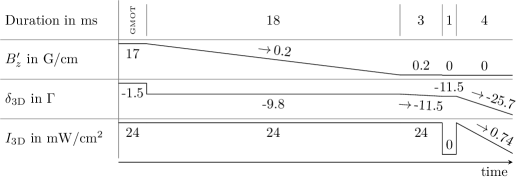
Experimental results
Research questions
- RQ1Can a single-laser-beam grating MOT with uniform illumination achieve high atomic flux and efficient cooling comparable to conventional multi-beam setups?
- RQ2How does the use of a 'tophat' beam profile improve the performance of a grating-based MOT compared to Gaussian or non-uniform beams?
- RQ3What is the maximum number of atoms that can be cooled and transferred into a magnetic chip trap using this integrated grating-atom chip approach?
- RQ4Can the system support subsequent evaporative cooling toward quantum degeneracy, and what trap parameters are required for this?
- RQ5To what extent can this design reduce the size, weight, and power (SWaP) of BEC sources for field-deployable quantum sensors?
Key findings
- The system achieves a cold-atom flux of 1×10⁹ atoms in 1 second, the highest reported in a grating MOT to date.
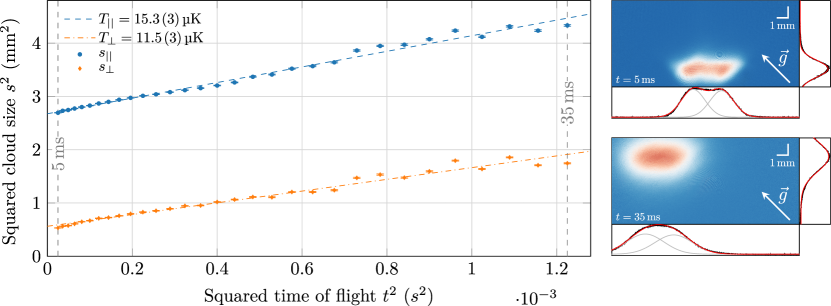
- Sub-Doppler cooling of 4.7(3)×10⁸ atoms is achieved to a temperature of 14.1(3) μK using the 'tophat' beam illumination.
- A total of 2.35(1)×10⁸ atoms are transferred into a large-volume magnetic chip trap at a temperature of 111.1(6) μK and a phase-space density of 1.1(1)×10⁻⁷.
- Optimizing for phase-space density yields 4.2(2)×10⁷ atoms at 18.8(2) μK with a higher phase-space density of 2.1(1)×10⁻⁶, indicating improved mode matching.
- The trap frequencies are measured as (νx′, νy′, νz′) = (10.6, 103.4, 105.6) Hz in the high-flux configuration, with a trap lifetime of 1.4–4.4 s.
- The current setup lacks sufficient trap frequencies for efficient evaporative cooling, necessitating future integration of high-frequency wire structures on the chip.
Read this paper
Open the full text in the Nubint reader and ask about any passage as you read.
Read this paper on NubintThis review was generated by AI from the original paper. Please check the paper before citing it.