
[Paper Review] A Learning-based Nonlinear Model Predictive Controller for a Real Go-Kart based on Black-box Dynamics Modeling through Gaussian Processes
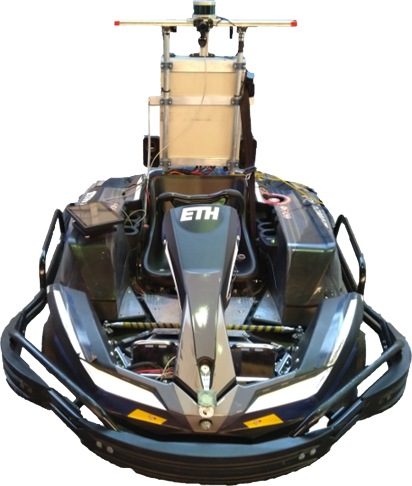
This paper presents a learning-based nonlinear Model Predictive Control (LbNMPC) framework for a real go-kart using a continuous-time black-box dynamics model derived from Gaussian Process Regression (GPR) of IMU and localization data. The approach achieves real-time control on embedded hardware through local GP approximations and non-uniform integration, enabling stable lap completion with performance comparable to a nominal model-based NMPC, albeit with a 3.75% slower lap time due to computational trade-offs.
Lately, Nonlinear Model Predictive Control (NMPC)has been successfully applied to (semi-) autonomous driving problems and has proven to be a very promising technique. However, accurate control models for real vehicles could require costly and time-demanding specific measurements. To address this problem, the exploitation of system data to complement or derive the prediction model of the NMPC has been explored, employing learning dynamics approaches within Learning-based NMPC (LbNMPC). Its application to the automotive field has focused on discrete grey-box modeling, in which a nominal dynamics model is enhanced by the data-driven component. In this manuscript, we present an LbNMPC controller for a real go-kart based on a continuous black-box model of the accelerations obtained by Gaussian Processes. We show the effectiveness of the proposed approach by testing the controller on a real go-kart vehicle, highlighting the approximation steps required to get an exploitable GP model on a real-time application.
Motivation & Objective
- To develop a real-time, learning-based NMPC controller for a physical go-kart without relying on a priori vehicle dynamics models.
- To address the computational burden of Gaussian Process-based dynamics modeling in real-time NMPC by employing local, reduced-dimension GP approximations.
- To validate the feasibility and performance of a pure black-box GPR model in a complex, high-dynamic vehicle control scenario.
- To demonstrate that data-driven dynamics modeling via GPR can effectively replace or complement traditional physics-based models in real-world NMPC applications.
Proposed method
- A continuous-time black-box model of vehicle accelerations is learned using Gaussian Process Regression (GPR) from IMU and localization data collected during human-driven laps.
- The LbNMPC framework integrates the GPR model as the system dynamics predictor within an optimal control problem that directly computes velocity and trajectory profiles.
- To reduce computational cost, the method employs local, low-dimensional GP approximations at each control step, based on predicted states, enabling real-time feasibility.
- A non-uniform integration grid is used within the NMPC horizon to minimize model evaluations and reduce computational load.
- Soft constraints with slack variables are introduced to ensure recursive feasibility and prevent track boundary violations during aggressive maneuvers.
- The controller is implemented and validated on an embedded platform using real-time optimization, with performance compared against a nominal model-based NMPC.
Experimental results
Research questions
- RQ1Can a purely data-driven, black-box GPR model of vehicle accelerations be used effectively within an NMPC framework for real-time control of a physical go-kart?
- RQ2How can the computational burden of GPR-based dynamics modeling be reduced to enable real-time implementation on embedded hardware?
- RQ3What performance trade-offs arise when using approximated GPR models in place of high-fidelity nominal dynamics models in NMPC for autonomous vehicle control?
- RQ4To what extent can a black-box GPR model replicate the behavior of a nominal model-based NMPC in terms of trajectory tracking and stability?
- RQ5How does the controller maintain feasibility and safety when operating near track boundaries, especially under high lateral slip?
Key findings
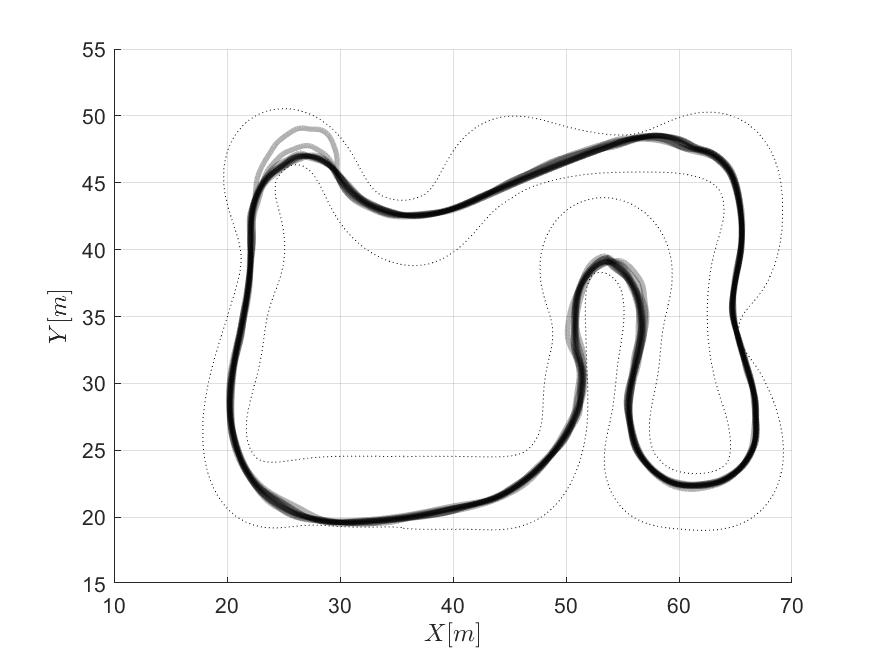
- The LbNMPC controller successfully completed a 180m lap on a real go-kart, demonstrating the feasibility of using a black-box GPR model for complex vehicle control.
- The black-box controller achieved a lap time of 29.3 seconds, which was 3.75% slower than the nominal model-based controller’s 28.2 seconds.
- Despite the performance gap, the trajectories of both controllers were very similar over most of the track, with only minor differences in cornering strategies.
- The black-box controller exhibited slightly higher velocity during the bottom-left turn (160–180m) and managed high sideslip conditions effectively, stabilizing after a 15° oversteer.
- The controller maintained recursive feasibility using soft constraints with slack variables, particularly during the top-left curve where the go-kart approached the track boundary.
- Velocity prediction accuracy was lower in the black-box model (with ~25% higher velocity errors) compared to the nominal model, primarily due to necessary GP approximations for real-time operation.
Read this paper
Open the full text in the Nubint reader and ask about any passage as you read.
Read this paper on NubintThis review was generated by AI from the original paper. Please check the paper before citing it.