
[Paper Review] A Novel Approach to Industrial Defect Generation through Blended Latent Diffusion Model with Online Adaptation
The paper introduces AdaBLDM, a diffusion-model-based defect generator that uses a defect trimap, cross-modal prompts, and online decoder adaptation to synthesize diverse, high-quality industrial defects for improved anomaly detection.
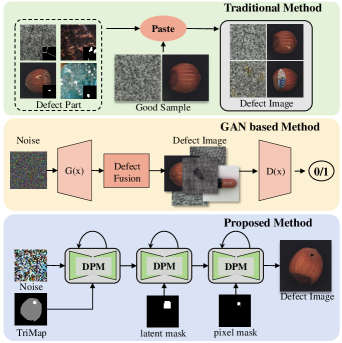
Effectively addressing the challenge of industrial Anomaly Detection (AD) necessitates an ample supply of defective samples, a constraint often hindered by their scarcity in industrial contexts. This paper introduces a novel algorithm designed to augment defective samples, thereby enhancing AD performance. The proposed method tailors the blended latent diffusion model for defect sample generation, employing a diffusion model to generate defective samples in the latent space. A feature editing process, controlled by a ``trimap" mask and text prompts, refines the generated samples. The image generation inference process is structured into three stages: a free diffusion stage, an editing diffusion stage, and an online decoder adaptation stage. This sophisticated inference strategy yields high-quality synthetic defective samples with diverse pattern variations, leading to significantly improved AD accuracies based on the augmented training set. Specifically, on the widely recognized MVTec AD dataset, the proposed method elevates the state-of-the-art (SOTA) performance of AD with augmented data by 1.5%, 1.9%, and 3.1% for AD metrics AP, IAP, and IAP90, respectively. The implementation code of this work can be found at the GitHub repository https://github.com/GrandpaXun242/AdaBLDM.git
Motivation & Objective
- Address the scarcity of defective samples in industrial settings for effective anomaly detection (AD).
- Propose a defect generation framework based on a blended latent diffusion model (BLDM) tailored for defect synthesis.
- Incorporate a defect trimap and cross-modal prompts to control defect location and appearance.
- Introduce a three-stage inference and an online decoder adaptation to enhance sample realism and variability.
- Demonstrate improved AD performance on multiple benchmarks using generated data.
Proposed method
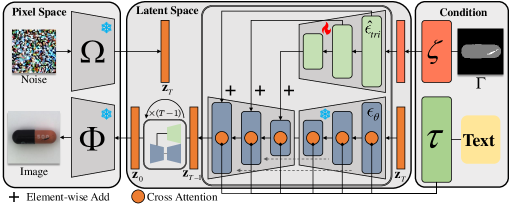
- Utilize a Latent Diffusion Model (LDM) as the backbone and extend it with cross-modal prompts and a defect trimap to control defect regions.
- Employ linguistic prompts derived from CLIP/BLIP to describe object and defect types influencing generation.
- Introduce a defect trimap that confines defects to target regions via embedding and a tailored encoder for trimap features.
- Implement multi-stage denoising with content editing: free diffusion stage, latent/space editing, and pixel-space blending to craft defects.
- Propose online decoder adaptation to fine-tune the decoder for each generated sample, balancing defect realism with preservation of normal regions.
- Train the model with a two-stage scheme: pre-train the denoising model on domain data, then fine-tune trimap encoder and convolutional blocks on real defect data.
Experimental results
Research questions
- RQ1Can diffusion-based defect generation produce diverse, high-quality synthetic defects that improve AD performance beyond existing SOTA methods?
- RQ2How do cross-modal prompts and defect-trimaps affect the realism and localization accuracy of generated defects?
- RQ3Does online decoder adaptation further enhance the quality of synthetic defects and downstream AD metrics?
- RQ4How does AdaBLDM perform across multiple industrial datasets compared with GAN-based and other diffusion-based defect generation methods?
Key findings
- AdaBLDM achieves new SOTA AD performance on MVTec AD with augmented data, surpassing DeSTseg by 1.5% (AP), 1.9% (IAP), and 3.1% (IAP90).
- Compared with SOTA defect generators (DFM, DCDGANc variants), AdaBLDM provides higher-quality, more diverse defective samples as evidenced by AD metrics.
- The three-stage inference plus online decoder adaptation yields higher sample fidelity and better defect pattern variation.
- Across multiple subcategories, SVM-based AD with AdaBLDM-generated data shows strong anomaly detection rates, and DeSTseg-based AD also benefits from AdaBLDM data.
- The method demonstrates robustness across texture and object categories on MVTEC AD, BTAD, and KSDD2.
Read this paper
Open the full text in the Nubint reader and ask about any passage as you read.
Read this paper on NubintThis review was generated by AI from the original paper. Please check the paper before citing it.