
[Paper Review] A parametrisation method for high-order phase reduction in coupled oscillator networks
This paper introduces a novel parametrisation method for high-order phase reduction in weakly coupled oscillator networks, enabling asymptotic expansions of the invariant torus embedding and reduced phase dynamics to arbitrary order. The method solves a conjugacy equation to compute phase dynamics in normal form, successfully predicting remote synchronisation in a Stuart-Landau chain with second-order accuracy.
We present a novel method for high-order phase reduction in networks of weakly coupled oscillators and, more generally, perturbations of reducible normally hyperbolic (quasi-)periodic tori. Our method works by computing an asymptotic expansion for an embedding of the perturbed invariant torus, as well as for the reduced phase dynamics in local coordinates. Both can be determined to arbitrary degrees of accuracy, and we show that the phase dynamics may directly be obtained in normal form. We apply the method to predict remote synchronisation in a chain of coupled Stuart-Landau oscillators.
Motivation & Objective
- To develop a mathematically rigorous method for high-order phase reduction beyond first-order approximations in weakly coupled oscillator networks.
- To overcome the limitations of existing first-order phase reduction techniques, especially in capturing structurally unstable dynamics like remote synchronisation.
- To generalize high-order phase reduction to arbitrary systems of coupled oscillators, not just special cases like Stuart-Landau oscillators.
- To compute asymptotic expansions of the invariant torus embedding and reduced phase dynamics to arbitrary order in the coupling strength $\varepsilon$.
- To derive the reduced phase dynamics directly in normal form, simplifying analysis of collective behaviours such as remote synchronisation.
Proposed method
- The method computes an asymptotic expansion of the embedding $e:(\mathbb{R}/2\pi\mathbb{Z})^m \to \mathbb{R}^M$ of the persisting invariant torus $\mathbb{T}_\varepsilon$ in powers of $\varepsilon$.
- It determines the reduced phase vector field $\mathbf{f}:(\mathbb{R}/2\pi\mathbb{Z})^m \to \mathbb{R}^m$ via solving a conjugacy equation involving the unperturbed vector field $\mathbf{F}_0$ and the perturbation $\mathbf{G}$.
- The approach uses a parametrisation framework inspired by De la Llave et al., adapted to normal hyperbolicity and quasi-periodic dynamics without requiring Diophantine conditions.
- It computes expansions of the torus embedding and phase dynamics order-by-order using homological equations, with resonant terms preserved in normal form.
- The method applies to general coupled systems of the form $\dot{x}_j = F_j(x_j) + \varepsilon G_j(\mathbf{x})$, including networks with non-identical oscillators.
- The reduced dynamics $\mathbf{f}$ is computed directly in normal form, avoiding intermediate non-normalised expressions.
Experimental results
Research questions
- RQ1Can a general, mathematically rigorous method for high-order phase reduction be developed for arbitrary weakly coupled oscillator networks?
- RQ2How can the reduced phase dynamics be computed to arbitrary order in $\varepsilon$ without restricting to special oscillator types like Stuart-Landau?
- RQ3Can the method capture structurally unstable phenomena such as remote synchronisation that first-order methods fail to predict?
- RQ4What is the role of resonant terms in the phase dynamics, and how can they be systematically extracted in normal form?
- RQ5How does the parametrisation of the invariant torus and its dynamics relate to the conjugacy equation framework in geometric singular perturbation theory?
Key findings
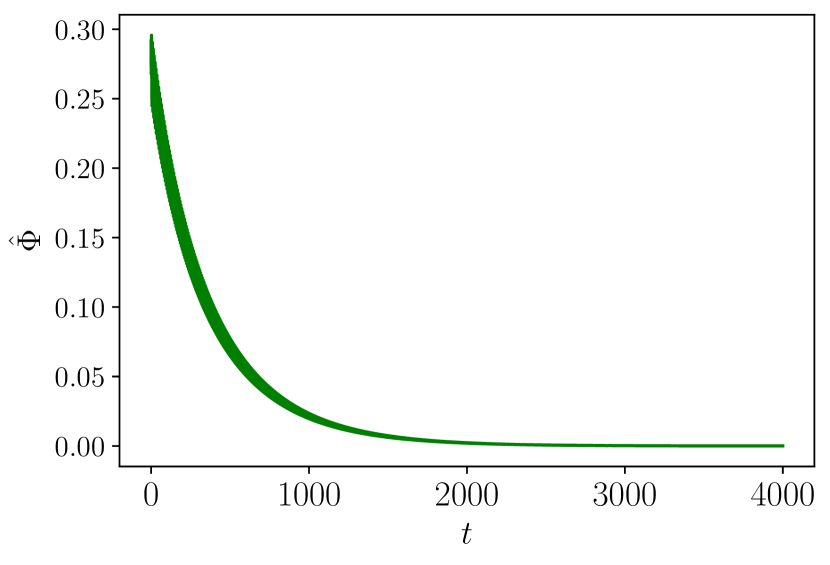
- The method successfully computes the second-order phase dynamics for a chain of three Stuart-Landau oscillators, revealing a non-trivial coupling in the relative phase $\phi_1 - \phi_3$.
- The reduced phase dynamics at order $\varepsilon^2$ is found to be $\frac{d}{dt}(\phi_1 - \phi_3) = \varepsilon^2 \left( -A\sin(\phi_1 - \phi_3) - B\cos(\phi_1 - \phi_3) + B \right) + \mathcal{O}(\varepsilon^3)$, with explicit expressions for $A$ and $B$ provided.
- The constants $A$ and $B$ are derived in terms of oscillator parameters: $A = \frac{1}{4a^2 + (\omega_1 - \omega_2)^2} \left( \frac{\delta}{\gamma}(\omega_2 - \omega_1) + a\left(1 + \frac{d\delta}{c\gamma}\right) + 2a^2\left(\frac{d}{c} + \frac{\delta}{\gamma}\right)\frac{1}{\omega_2 - \omega_1} \right)$.
- Similarly, $B = \frac{1}{4a^2 + (\omega_1 - \omega_2)^2} \left( (\omega_2 - \omega_1) + a\left(\frac{d}{c} - \frac{\delta}{\gamma}\right) + 2a^2\left(1 - \frac{d\delta}{c\gamma}\right)\frac{1}{\omega_2 - \omega_1} \right)$.
- The method confirms that remote synchronisation arises from second-order phase interactions, as the $\varepsilon^2$ term in $\frac{d}{dt}(\phi_1 - \phi_3)$ depends on $\sin(\phi_1 - \phi_3)$ and $\cos(\phi_1 - \phi_3)$, enabling stable phase locking between non-adjacent oscillators.
- The approach enables direct computation of the reduced dynamics in normal form, with resonant terms preserved and non-resonant terms absorbed into the parametrisation, ensuring structural clarity.

Read this paper
Open the full text in the Nubint reader and ask about any passage as you read.
Read this paper on NubintThis review was generated by AI from the original paper. Please check the paper before citing it.