
[Paper Review] A physics-informed deep neural network for surrogate modeling in classical elasto-plasticity
This paper proposes a physics-informed deep neural network, the Elasto-Plastic Neural Network (EPNN), which embeds fundamental principles of classical elasto-plasticity—such as additive strain decomposition and nonlinear incremental elasticity—directly into its architecture. The EPNN achieves superior generalization and data efficiency, outperforming standard ANNs in predicting unseen strain-controlled loading paths for sands using synthetic data from a dilatancy-based constitutive model.
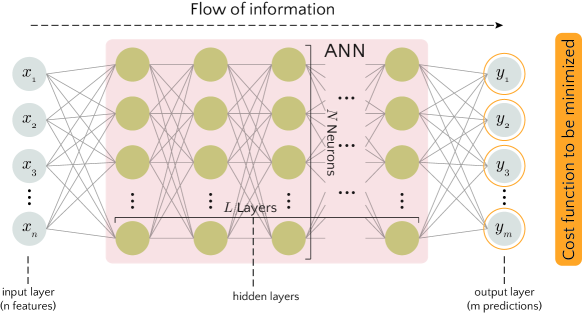
In this work, we present a deep neural network architecture that can efficiently approximate classical elasto-plastic constitutive relations. The network is enriched with crucial physics aspects of classical elasto-plasticity, including additive decomposition of strains into elastic and plastic parts, and nonlinear incremental elasticity. This leads to a Physics-Informed Neural Network (PINN) surrogate model named here as Elasto-Plastic Neural Network (EPNN). Detailed analyses show that embedding these physics into the architecture of the neural network facilitates a more efficient training of the network with less training data, while also enhancing the extrapolation capability for loading regimes outside the training data. The architecture of EPNN is model and material-independent, i.e. it can be adapted to a wide range of elasto-plastic material types, including geomaterials and metals; and experimental data can potentially be directly used in training the network. To demonstrate the robustness of the proposed architecture, we adapt its general framework to the elasto-plastic behavior of sands. We use synthetic data generated from material point simulations based on a relatively advanced dilatancy-based constitutive model for granular materials to train the neural network. The superiority of EPNN over regular neural network architectures is explored through predicting unseen strain-controlled loading paths for sands with different initial densities.
Motivation & Objective
- To develop a surrogate constitutive model for elasto-plastic materials that integrates core physical principles directly into the neural network architecture.
- To improve generalization and extrapolation capability beyond training data, especially for unseen loading paths.
- To create a model- and material-agnostic framework applicable to diverse elasto-plastic materials, including geomaterials and metals.
- To enable direct training on experimental data while maintaining physical consistency and numerical stability.
- To facilitate integration into standard finite element codes through an incremental formulation.
Proposed method
- The EPNN architecture enforces additive decomposition of total strain into elastic and plastic parts as a structural constraint.
- Nonlinear incremental elasticity is embedded in the network’s forward pass via a physics-based stress update rule.
- The network is trained using a loss function that includes both data fidelity and physics-consistency terms, ensuring adherence to constitutive laws.
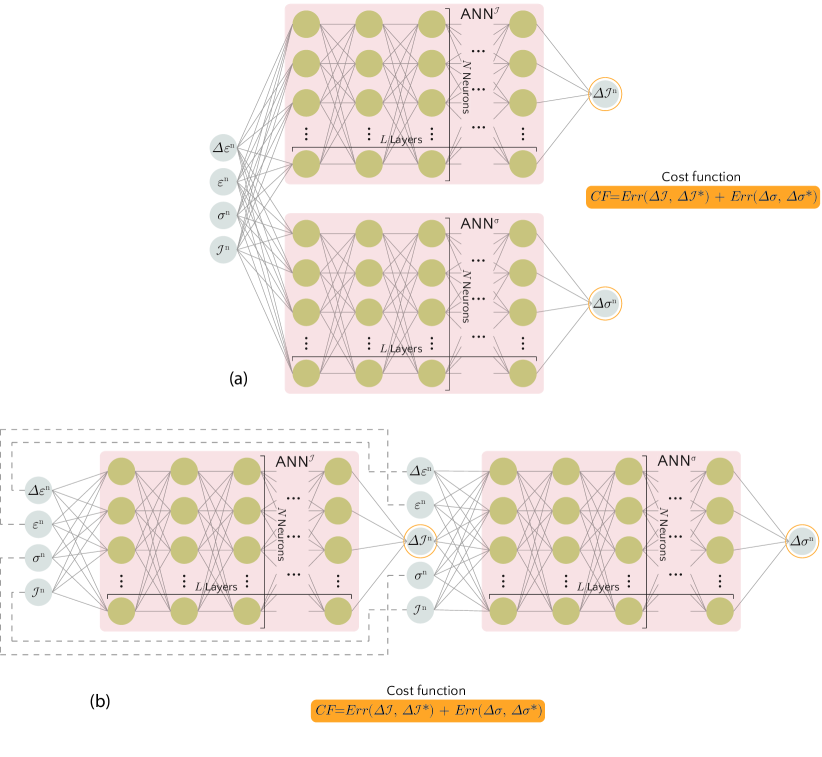
- A two-branch sub-network structure computes elastic and plastic strain contributions, with the plastic strain component trained to satisfy yield and flow rules implicitly.
- Synthetic data from material point simulations based on a dilatancy-based model for sands is used to train the network under various strain-controlled loading paths.
- The framework supports arbitrary monotonic loading paths, including axisymmetric triaxial paths with varying α ratios, enabling generalization beyond training data.
Experimental results
Research questions
- RQ1Can a deep neural network architecture that embeds core physical laws of elasto-plasticity achieve better generalization than standard ANNs with less training data?
- RQ2How does the integration of incremental elasticity and strain decomposition into the network architecture affect prediction accuracy and extrapolation for unseen loading paths?
- RQ3To what extent can the EPNN architecture be generalized across different elasto-plastic materials without retraining or architectural redesign?
- RQ4Can the EPNN be trained directly on experimental data while preserving physical consistency and numerical stability?
- RQ5What impact does data augmentation via incremental probing have on improving the predictive capability of the EPNN?
Key findings
- The EPNN achieves highly accurate stress predictions across diverse strain-controlled loading paths, including axisymmetric triaxial paths with α = -1000, -2.5, and -1.75, matching ground truth from numerical integration.
- The EPNN demonstrates superior extrapolation capability compared to standard parallel and serial ANN architectures, particularly for loading paths not included in the training data.
- The model requires significantly less training data to achieve convergence and maintain stability due to the embedded physics constraints.
- The architecture is fully compatible with standard finite element codes due to its incremental formulation and consistent stress update mechanism.
- The network’s performance improves with higher-quality training data, particularly when augmented with incremental probing data to explore tensorial response zones.
- Future improvements are expected by incorporating additional physics, such as a plastic potential and explicit flow rule, into the plastic strain sub-network.
Read this paper
Open the full text in the Nubint reader and ask about any passage as you read.
Read this paper on NubintThis review was generated by AI from the original paper. Please check the paper before citing it.