
[Paper Review] A Rapid Adapting and Continual Learning Spiking Neural Network Path Planning Algorithm for Mobile Robots
This paper presents a spiking neural network-based path planning system that enables mobile robots to continuously learn and adapt to multiple traversal costs—such as energy, obstacle proximity, and terrain slope—in real time using E-prop learning. The Spiking Wavefront Planner outperforms A* and RRT* in simulated path cost and length minimization, achieving superior efficiency with just 12 hours of online training on a physical robot platform.
Mapping traversal costs in an environment and planning paths based on this map are important for autonomous navigation. We present a neurobotic navigation system that utilizes a Spiking Neural Network Wavefront Planner and E-prop learning to concurrently map and plan paths in a large and complex environment. We incorporate a novel method for mapping which, when combined with the Spiking Wavefront Planner, allows for adaptive planning by selectively considering any combination of costs. The system is tested on a mobile robot platform in an outdoor environment with obstacles and varying terrain. Results indicate that the system is capable of discerning features in the environment using three measures of cost, (1) energy expenditure by the wheels, (2) time spent in the presence of obstacles, and (3) terrain slope. In just twelve hours of online training, E-prop learns and incorporates traversal costs into the path planning maps by updating the delays in the Spiking Wavefront Planner. On simulated paths, the Spiking Wavefront Planner plans significantly shorter and lower cost paths than A* and RRT*. The spiking wavefront planner is compatible with neuromorphic hardware and could be used for applications requiring low size, weight, and power.
Motivation & Objective
- To develop a neurobotic navigation system capable of real-time, continual learning of environmental traversal costs without offline retraining.
- To enable path planning that dynamically adapts to multiple cost metrics—energy, obstacles, and terrain slope—based on online experience.
- To demonstrate the feasibility and efficiency of deploying a spiking neural network planner on physical hardware with low power and size requirements.
- To compare the performance of the Spiking Wavefront Planner against A*, RRT*, and a naive Euclidean planner in both simulated and real-world environments.
Proposed method
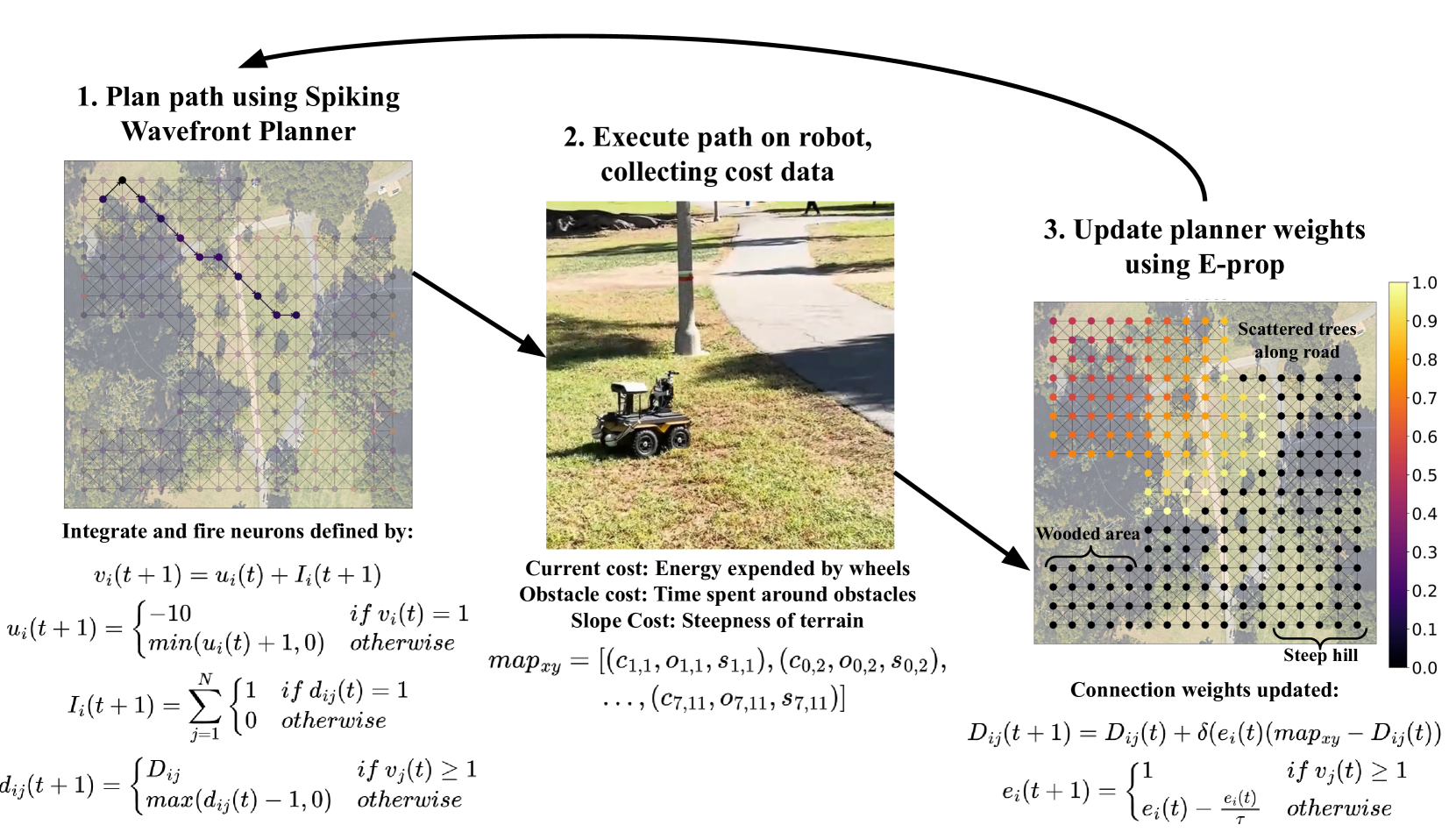
- The system uses a Spiking Wavefront Planner where neurons represent spatial locations, and path planning is achieved via spike propagation from start to goal.
- Environmental costs are mapped using real-time sensor data: wheel current (energy), obstacle proximity, and terrain slope.
- E-prop learning updates synaptic delays in the network based on eligibility traces, enabling continual, online learning of traversal costs.
- The costmap is learned incrementally through robot experience, with delays adjusted to reflect learned cost distributions.
- The system supports dynamic re-planning by re-evaluating paths based on current costmap, allowing adaptation to environmental changes.
- Performance is evaluated via simulation of all paths over the learned costmap and real-world testing on a ground robot in outdoor, complex terrain.
Experimental results
Research questions
- RQ1Can a spiking neural network path planner learn and adapt to multiple, dynamic traversal costs in real time without offline retraining?
- RQ2How does the performance of the Spiking Wavefront Planner compare to A* and RRT* in minimizing path length and cost across diverse cost metrics?
- RQ3To what extent can the system adapt to environmental changes, such as new obstacles, within a few trials without retraining?
- RQ4Can the Spiking Wavefront Planner achieve lower-cost and shorter paths than traditional algorithms when trained on real-world sensor data?
Key findings
- In simulated path evaluations over the learned costmap, the Spiking Wavefront Planner significantly outperformed RRT* and A* in minimizing both path length and normalized cost, with a mean cost of 19.36 compared to 22.07 for RRT* and 19.55 for A*.
- On physical robot trials, the Spiking Wavefront Planner planned significantly shorter paths and lower obstacle costs than RRT*, with a p-value < 0.05 for obstacle cost (2.06 vs. 3.95).
- The system learned a functional costmap in under 12 hours of online training, enabling rapid adaptation to new environmental conditions with minimal retraining.
- The Spiking Wavefront Planner achieved comparable performance to A* in path length and cost metrics, but without requiring a custom heuristic for each cost type.
- The performance gap between the Spiking Wavefront Planner and RRT* widened with increasing path length, with the former consistently outperforming the latter in cost efficiency.
- The system demonstrated compatibility with neuromorphic hardware due to its spiking nature, supporting low-power, embedded deployment.
Read this paper
Open the full text in the Nubint reader and ask about any passage as you read.
Read this paper on NubintThis review was generated by AI from the original paper. Please check the paper before citing it.