
[Paper Review] A room-temperature moiré interlayer exciton laser
This study demonstrates the first room-temperature lasing based on moiré interlayer excitons in a MoS₂/WSe₂ heterobilayer integrated with a silicon topological nanocavity. The moiré potential enhances exciton lifetime, enables wide emission tunability, and enables ultra-low-threshold lasing at the telecommunication O-band with sub-0.1 nm spectral linewidth.
Moiré superlattices in van der Waals heterostructures offer highly tunable quantum systems with emergent electronic and excitonic properties such as superconductivity, topological edge states, and moiré-trapped excitons. Theoretical calculations predicted the existence of the moiré potential at elevated temperatures; however, its impact on the optical properties of interlayer excitons (IXs) at room temperature is lacking, and the benefits of the moiré effects for lasing applications remain unexplored. We report that the moiré potential in a molybdenum disulfide/tungsten diselenide (MoS2/WSe2) heterobilayer system can significantly enhance light emission, elongate the IX lifetime, and modulate the IX emission energy at room temperature. By integrating a moiré superlattice with a silicon topological nanocavity, we achieve ultra-low-threshold lasing at the technologically important telecommunication O-band thanks to the significant moiré modulation. Moreover, the high-quality topological nanocavities facilitate the highest spectral coherence of < 0.1 nm linewidth among all reported two-dimensional material-based laser systems. Our findings not only open a new avenue for studying correlated states at elevated temperatures, but also enable novel architectures for integrated on-chip photonics and optoelectronics.
Motivation & Objective
- To demonstrate room-temperature interlayer exciton lasing in a 2D heterostructure with moiré superlattices.
- To investigate the role of moiré potential in enhancing exciton lifetime and emission tunability at room temperature.
- To integrate moiré interlayer excitons with high-Q topological photonic nanocavities for low-threshold lasing.
- To achieve high spectral coherence and side-mode suppression in a 2D material-based laser system.
- To explore the potential of moiré excitons for on-chip integrated photonics and optoelectronics at ambient conditions.
Proposed method
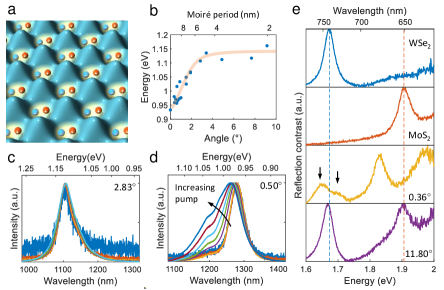
- Employed twist-angle-dependent photoluminescence (PL) and reflection contrast spectroscopy to identify moiré potential effects in MoS₂/WSe₂ heterobilayers at room temperature.
- Conducted power-dependent PL and time-resolved PL measurements to assess exciton recombination dynamics and radiative efficiency.
- Integrated the heterostructure with a silicon-based topological photonic crystal nanocavity to achieve high-quality-factor (Q > 10⁴) optical confinement.
- Used a Czerny-Turner monochromator with high-groove-density gratings (600–1200 grooves/mm) for high-resolution spectral detection of lasing modes.
- Performed polarization-resolved second-harmonic generation (SHG) measurements to determine the twist angle of the heterostructure.
- Simulated the topological nanocavity using finite-difference time-domain (FDTD) method to optimize resonant wavelength and mode profile.
Experimental results
Research questions
- RQ1Can moiré interlayer excitons in MoS₂/WSe₂ sustain strong optical activity and long-lived excitonic states at room temperature?
- RQ2To what extent does the moiré potential enhance exciton lifetime and modulate emission energy in 2D heterostructures at ambient conditions?
- RQ3Can moiré excitons in a 2D heterostructure enable low-threshold lasing when coupled to a high-Q topological nanocavity?
- RQ4What is the spectral coherence and side-mode suppression ratio of lasing in such a system compared to other 2D material-based lasers?
- RQ5Can the combination of moiré potential and topological nanocavities enable lasing in the technologically relevant O-band (1260–1360 nm) at room temperature?
Key findings
- The moiré potential in MoS₂/WSe₂ heterobilayers significantly extends the interlayer exciton (IX) lifetime and enables ultra-wide emission tunability at room temperature.
- Room-temperature interlayer excitons exhibit suppressed non-radiative recombination, leading to enhanced photoluminescence quantum yield.
- Ultra-low-threshold lasing was achieved in the O-band (1260–1360 nm) due to strong moiré modulation and high-Q topological nanocavity confinement.
- The laser exhibited a spectral linewidth of less than 0.1 nm, the narrowest reported to date among 2D material-based lasers.
- A side-mode suppression ratio (SMSR) exceeding 30 dB was achieved, indicating high spectral purity and single-mode operation.
- The coherence time was estimated to be on the order of nanoseconds, consistent with high spectral coherence and stable lasing operation.

Better researchstarts right now
From reading papers to final review, dramatically reduce your research time.
No credit card · Free plan available
This review was created by AI and reviewed by human editors.