
[Paper Review] A Simplified Expression for Quantum Fidelity
This paper presents a simplified, symmetric expression for quantum fidelity between two mixed quantum states: $ F(\rho,\sigma) = \left(\sum_i \sqrt{\lambda_i(\rho\sigma)}\right)^2 $, proven via an elegant spectral mapping argument that avoids matrix geometric means or pseudo-inverses. The reformulation enables a computationally efficient method requiring only one eigendecomposition of $\rho\sigma$, outperforming prior approaches in practice by avoiding full matrix decompositions.
Quantum fidelity is one of the most important measures of similarity between mixed quantum states. However, the usual formulation is cumbersome and hard to understand when encountering the first time. This work shows in a novel, elegant proof that the expression can be rewritten into a form, which is not only more concise but also makes its symmetry property more obvious. Further, the simpler expression gives rise to a formulation that is subsequently shown to be more computationally efficient than the best previous methods by avoiding any full decomposition. Future work might look for ways in which other theorems could be affected or utilize the reformulation where fidelity is the computational bottleneck.
Motivation & Objective
- To provide a more intuitive and symmetric formulation of quantum fidelity for mixed quantum states.
- To eliminate reliance on matrix geometric means or pseudo-inverses in the derivation of the fidelity expression.
- To demonstrate that the simplified form enables a more computationally efficient algorithm for fidelity calculation.
- To empirically validate the computational advantage of the new method against established approaches.
- To enable future applications where fidelity is a computational bottleneck by reducing complexity.
Proposed method
- Prove that the spectrum of $ \sqrt{\sqrt{\rho}\sigma\sqrt{\rho}} $ equals the spectrum of $ \sqrt{\rho\sigma} $ using the cyclic property of matrix spectra and spectral mapping.
- Apply the trace-eigenvalue relation to show $ \Tr\left(\sqrt{\sqrt{\rho}\sigma\sqrt{\rho}}\right) = \Tr\left(\sqrt{\rho\sigma}\right) $.
- Derive the simplified fidelity formula $ F(\rho,\sigma) = \left(\sum_i \sqrt{\lambda_i(\rho\sigma)}\right)^2 $, which is symmetric and concise.
- Implement and benchmark the new method using only one general eigendecomposition of $ \rho\sigma $, avoiding full matrix decompositions.
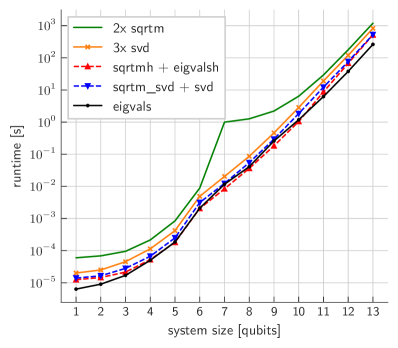
- Compare performance against established methods: 2x sqrtm, 3x svd, sqrtmh + eigvalsh, and sqrtm_svd + svd, using random density matrices on an Apple M1 chip.
- Leverage the fact that $ \rho\sigma $ has non-negative eigenvalues to further optimize the computation.
Experimental results
Research questions
- RQ1Can the standard expression for quantum fidelity between mixed states be simplified into a more symmetric and intuitive form?
- RQ2Is it possible to derive the simplified fidelity expression without relying on matrix geometric means or pseudo-inverses?
- RQ3Does the simplified expression lead to a more efficient computational method that avoids full matrix decompositions?
- RQ4How does the performance of the new method compare to existing state-of-the-art approaches in terms of speed and scalability?
- RQ5Can the new formulation enable faster computation in applications where fidelity is a computational bottleneck?
Key findings
- The simplified fidelity expression $ F(\rho,\sigma) = \left(\sum_i \sqrt{\lambda_i(\rho\sigma)}\right)^2 $ is proven to be equivalent to the standard form using spectral mapping and cyclic spectrum properties.
- The new formulation makes the symmetry of fidelity between $ \rho $ and $ \sigma $ immediately apparent, improving interpretability.
- The method requires only one eigendecomposition of $ \rho\sigma $, avoiding full matrix decompositions and reducing computational overhead.
- Empirical evaluation shows the new method is approximately 2 times faster than the best alternative methods for small and large density matrices.
- The performance gain is consistent across system sizes, with the method remaining competitive even for intermediate dimensions.
- The approach is compatible with existing optimizations, such as leveraging non-negative eigenvalues of $ \rho\sigma $, and could benefit from future advances in eigenvalue computation.
Better researchstarts right now
From reading papers to final review, dramatically reduce your research time.
No credit card · Free plan available
This review was created by AI and reviewed by human editors.