
[Paper Review] A Study of Autoregressive Decoders for Multi-Tasking in Computer Vision
This paper investigates autoregressive decoders for multi-task computer vision using a frozen, pretrained vision encoder (e.g., CLIP) and a lightweight decoder fine-tuned on multiple tasks. It finds that a single, small decoder conditioned on task identity can match or exceed single-task baselines, requires less hyperparameter tuning, and benefits even from unrelated tasks—highlighting the robustness and transferability of frozen-encoder, autoregressive multi-task learning.
There has been a recent explosion of computer vision models which perform many tasks and are composed of an image encoder (usually a ViT) and an autoregressive decoder (usually a Transformer). However, most of this work simply presents one system and its results, leaving many questions regarding design decisions and trade-offs of such systems unanswered. In this work, we aim to provide such answers. We take a close look at autoregressive decoders for multi-task learning in multimodal computer vision, including classification, captioning, visual question answering, and optical character recognition. Through extensive systematic experiments, we study the effects of task and data mixture, training and regularization hyperparameters, conditioning type and specificity, modality combination, and more. Importantly, we compare these to well-tuned single-task baselines to highlight the cost incurred by multi-tasking. A key finding is that a small decoder learned on top of a frozen pretrained encoder works surprisingly well. We call this setup locked-image tuning with decoder (LiT-decoder). It can be seen as teaching a decoder to interact with a pretrained vision model via natural language.
Motivation & Objective
- To understand the design trade-offs and performance of autoregressive decoders in multi-task computer vision.
- To evaluate the effectiveness of a frozen, pretrained vision encoder (e.g., CLIP) combined with a small, multi-task autoregressive decoder.
- To compare multi-task autoregressive decoding against carefully tuned single-task baselines across diverse tasks.
- To investigate how task conditioning, data mixture, and model capacity affect performance.
- To explore the feasibility and limitations of using such models for dense prediction tasks like panoptic segmentation.
Proposed method
- Use a frozen vision encoder (e.g., ViT-Base with CLIP pretraining) to extract image features.
- Train a lightweight autoregressive decoder (e.g., 2-layer Transformer) on multiple tasks using a shared, task-conditioned input.
- Condition the decoder with a task-specific prefix token (e.g., 'classify:', 'caption:', 'answer:') to guide generation.
- Apply standard training techniques: cross-attention to encoder tokens, standard cross-entropy loss, and beam search for decoding.
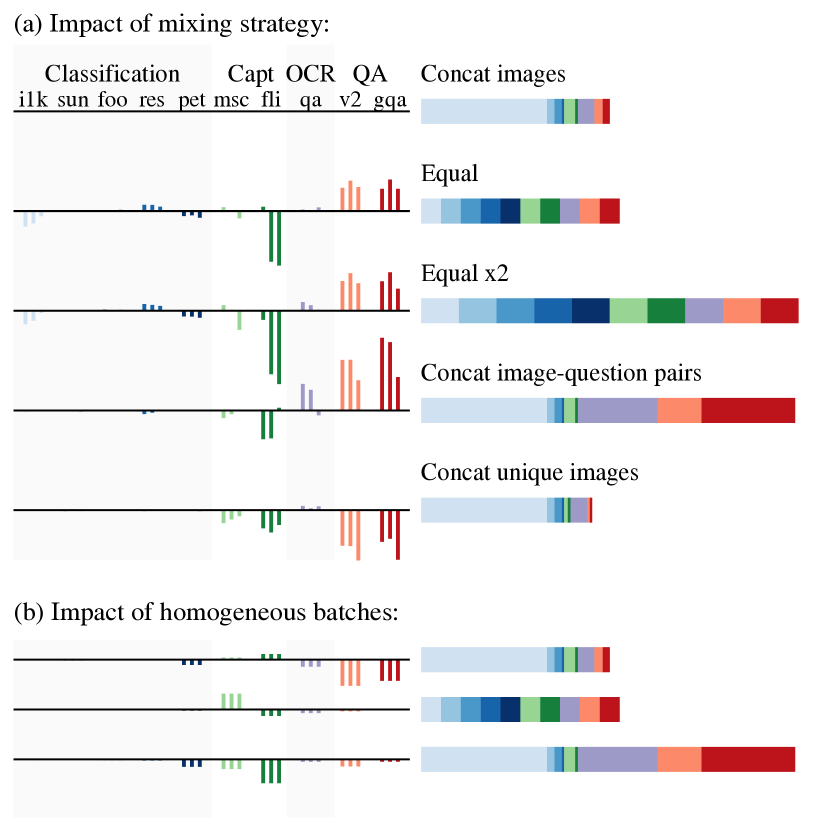
- Use a mixture of datasets (e.g., ImageNet, COCO, VQAv2, TPU, OCR) with balanced sampling to train the multi-task decoder.
- Evaluate performance on held-out test sets using standard metrics: accuracy, BLEU, CIDEr, PQ, etc.
Experimental results
Research questions
- RQ1How does a multi-task autoregressive decoder perform compared to single-task baselines when both are heavily tuned?
- RQ2What is the impact of task conditioning (e.g., prefix tokens) on decoder performance across diverse tasks?
- RQ3How does the number of tasks and decoder capacity affect performance and generalization?
- RQ4Does adding unrelated tasks degrade or improve performance in multi-task learning?
- RQ5Can a frozen encoder support dense output tasks like panoptic segmentation, or is fine-tuning required?
Key findings
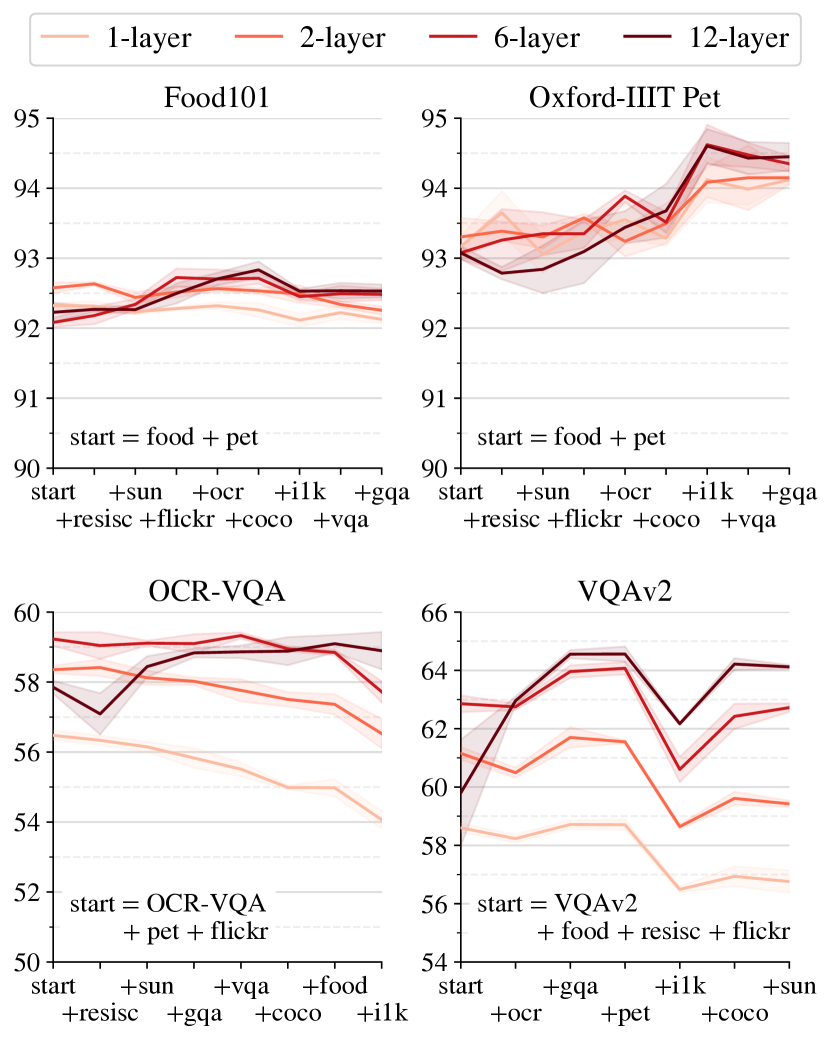
- A small, two-layer autoregressive decoder fine-tuned on top of a frozen, pretrained vision encoder (LiT decoder) achieves performance comparable to or exceeding heavily tuned single-task baselines when prompted with task-specific conditioning.
- Task conditioning is critical: without it, performance degrades significantly across all tasks, indicating the decoder cannot infer the task from context alone.
- Multi-task training is less sensitive to hyperparameter tuning and less prone to overfitting than single-task training, even when adding unrelated tasks.
- The addition of unrelated tasks is beneficial, suggesting that the model learns generalizable representations that help with downstream task generalization.
- For dense prediction tasks like panoptic segmentation, the frozen encoder alone performs poorly (5.0% PQ), but fine-tuning the decoder improves performance to 32.1% PQ, indicating that spatial semantic features may not be sufficient in frozen encoders for such tasks.
- Compressing the encoder’s output tokens (e.g., via mean pooling or bottleneck layers) leads to significant performance drops, especially in captioning and VQA, indicating that full spatial context is essential for the decoder.
Read this paper
Open the full text in the Nubint reader and ask about any passage as you read.
Read this paper on NubintThis review was generated by AI from the original paper. Please check the paper before citing it.