
[Paper Review] A Survey for Graphic Design Intelligence
This survey introduces a systematic taxonomy for Graphic Design Intelligence, organizing existing research into three pillars: representation, understanding, and generation of visual designs. It synthesizes advances in AI-driven design—covering visual elements, layout composition, and user-centered applications—while identifying key challenges and future directions in self-supervised learning, design knowledge encoding, and human-AI collaboration.
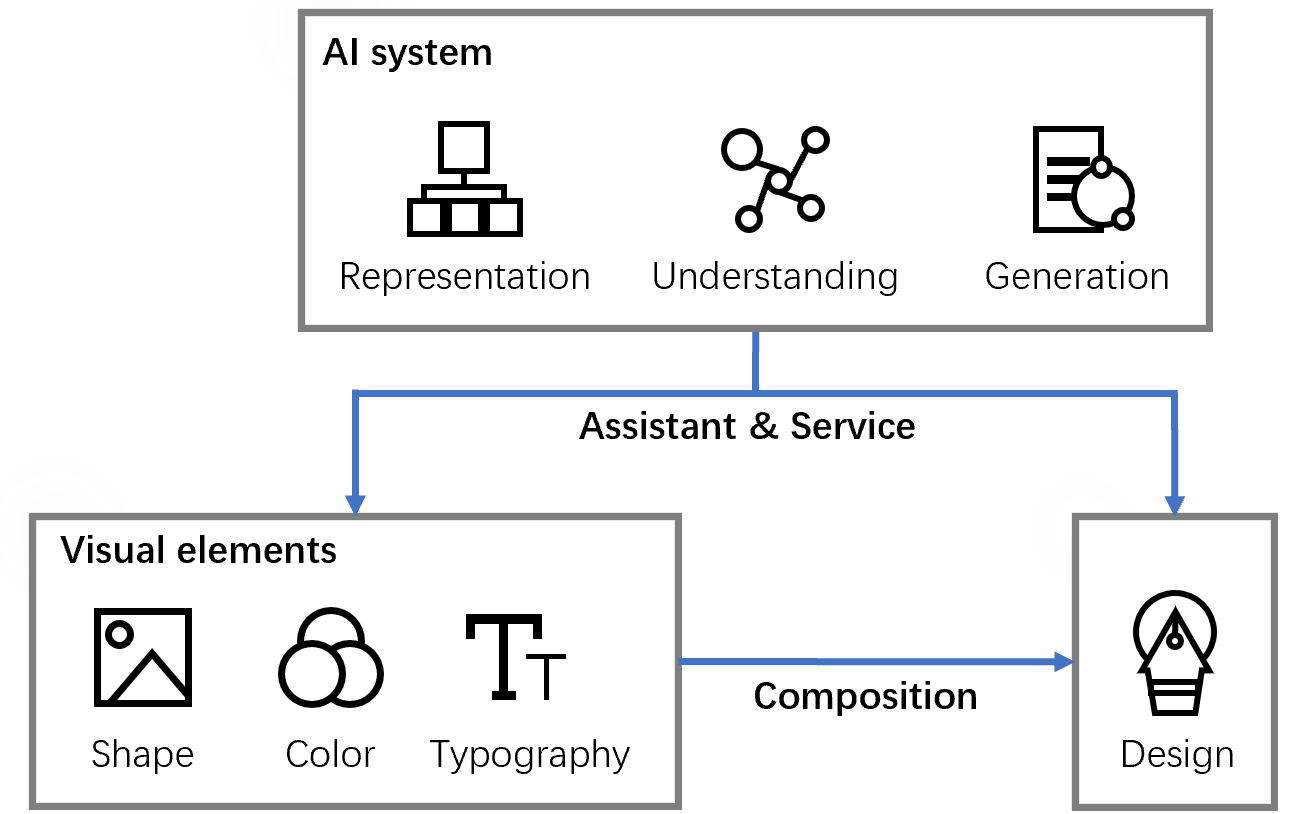
Graphic design is an effective language for visual communication. Using complex composition of visual elements (e.g., shape, color, font) guided by design principles and aesthetics, design helps produce more visually-appealing content. The creation of a harmonious design requires carefully selecting and combining different visual elements, which can be challenging and time-consuming. To expedite the design process, emerging AI techniques have been proposed to automatize tedious tasks and facilitate human creativity. However, most current works only focus on specific tasks targeting at different scenarios without a high-level abstraction. This paper aims to provide a systematic overview of graphic design intelligence and summarize literature in the taxonomy of representation, understanding and generation. Specifically we consider related works for individual visual elements as well as the overall design composition. Furthermore, we highlight some of the potential directions for future explorations.
Motivation & Objective
- To provide a systematic, high-level overview of Graphic Design Intelligence by organizing existing research into a unified taxonomy.
- To address the fragmented nature of current AI-driven design research by unifying work across visual elements and overall design composition.
- To identify critical gaps in representation, understanding, and generation of graphic designs using AI.
- To highlight emerging challenges in self-supervised learning, design knowledge encoding, and human-AI collaboration in design workflows.
- To guide future research by outlining promising directions in scalable learning, structured design modeling, and ethical AI integration.
Proposed method
- Proposes a three-tiered taxonomy: Representation (learning semantic embeddings of designs), Understanding (analyzing structure, relations, and semantics of visual elements), and Generation (automatically producing new designs from constraints).
- Reviews datasets such as PubLayNet, QuickDraw, SVG-Fonts, and SVG icon shapes to evaluate and benchmark design intelligence tasks.
- Examines self-supervised learning approaches using masked modeling and completion tasks on visual and structural design data, focusing on multimodal fusion of pixel and metadata.
- Analyzes efforts to encode design principles (e.g., alignment, contrast) into machine learning models for improved interpretability and quality assessment.
- Explores human-AI collaboration frameworks where AI supports ideation, creation, and refinement while respecting cognitive load and ethical design principles.
- Evaluates model architectures including Transformers and vision Transformers, and discusses the choice of pretext tasks for self-supervised pretraining on design data.
Experimental results
Research questions
- RQ1How can visual designs be effectively represented using low-dimensional, semantic-rich embeddings for downstream tasks?
- RQ2What are the key challenges in understanding the structural and semantic relationships among visual elements in a design?
- RQ3To what extent can AI generate novel, high-quality designs that conform to design principles and user intent?
- RQ4How can self-supervised learning be adapted to large-scale, unlabeled design data to improve representation learning?
- RQ5How can design knowledge (e.g., principles like golden ratio or visual hierarchy) be formally encoded and leveraged in AI models?
Key findings
- The survey identifies a growing body of work in AI-driven graphic design, but highlights a lack of unified taxonomy, with most research focused on isolated tasks rather than holistic design intelligence.
- Large-scale self-supervised learning shows promise for design representation, but challenges remain in reverse-engineering structured metadata from pixel-based designs.
- Current self-supervised methods primarily rely on Transformer backbones and masked language modeling, with limited exploration of alternative architectures or pretext tasks.
- Only a few studies have successfully encoded complex design principles (e.g., visual hierarchy, contrast) into machine models, indicating a major research gap in formalizing design knowledge.
- Human-AI collaboration in design remains underexplored, with few user studies or frameworks that optimize AI’s role across ideation, creation, and refinement stages.
- Benchmark datasets such as QuickDraw (50M sketches), SVG-Fonts (14M fonts), and PubLayNet (330k documents) are critical for advancing research, but their full potential for multi-modal learning is underutilized.
Read this paper
Open the full text in the Nubint reader and ask about any passage as you read.
Read this paper on NubintThis review was generated by AI from the original paper. Please check the paper before citing it.