
[Paper Review] Accurate and efficient structure elucidation from routine one-dimensional NMR spectra using multitask machine learning
This paper presents a multitask machine learning framework that enables accurate, end-to-end structure elucidation of organic molecules from raw 1D 1H and 13C NMR spectra without prior knowledge of molecular formula or fragments. Using a transformer-based architecture pre-trained on substructure-to-structure mapping and integrated with a CNN for spectral encoding, the model achieves 69.6% top-15 accuracy in predicting the correct molecular structure for molecules with up to 19 heavy atoms, reducing the search space by up to 11 orders of magnitude.
Rapid determination of molecular structures can greatly accelerate workflows across many chemical disciplines. However, elucidating structure using only one-dimensional (1D) NMR spectra, the most readily accessible data, remains an extremely challenging problem because of the combinatorial explosion of the number of possible molecules as the number of constituent atoms is increased. Here, we introduce a multitask machine learning framework that predicts the molecular structure (formula and connectivity) of an unknown compound solely based on its 1D 1H and/or 13C NMR spectra. First, we show how a transformer architecture can be constructed to efficiently solve the task, traditionally performed by chemists, of assembling large numbers of molecular fragments into molecular structures. Integrating this capability with a convolutional neural network (CNN), we build an end-to-end model for predicting structure from spectra that is fast and accurate. We demonstrate the effectiveness of this framework on molecules with up to 19 heavy (non-hydrogen) atoms, a size for which there are trillions of possible structures. Without relying on any prior chemical knowledge such as the molecular formula, we show that our approach predicts the exact molecule 69.6% of the time within the first 15 predictions, reducing the search space by up to 11 orders of magnitude.
Motivation & Objective
- To address the challenge of unsupervised, accurate structure elucidation from routine 1D NMR spectra without relying on molecular formula or fragment information.
- To overcome the combinatorial explosion of possible molecular structures as molecular size increases beyond 10–19 heavy atoms.
- To develop an end-to-end deep learning framework that directly maps raw NMR spectra to molecular connectivity and formula.
- To enable fast, scalable, and accessible structure elucidation applicable across chemical research, education, and industrial workflows.
- To lay the foundation for future extension to stereochemistry, larger molecules, and broader elemental diversity.
Proposed method
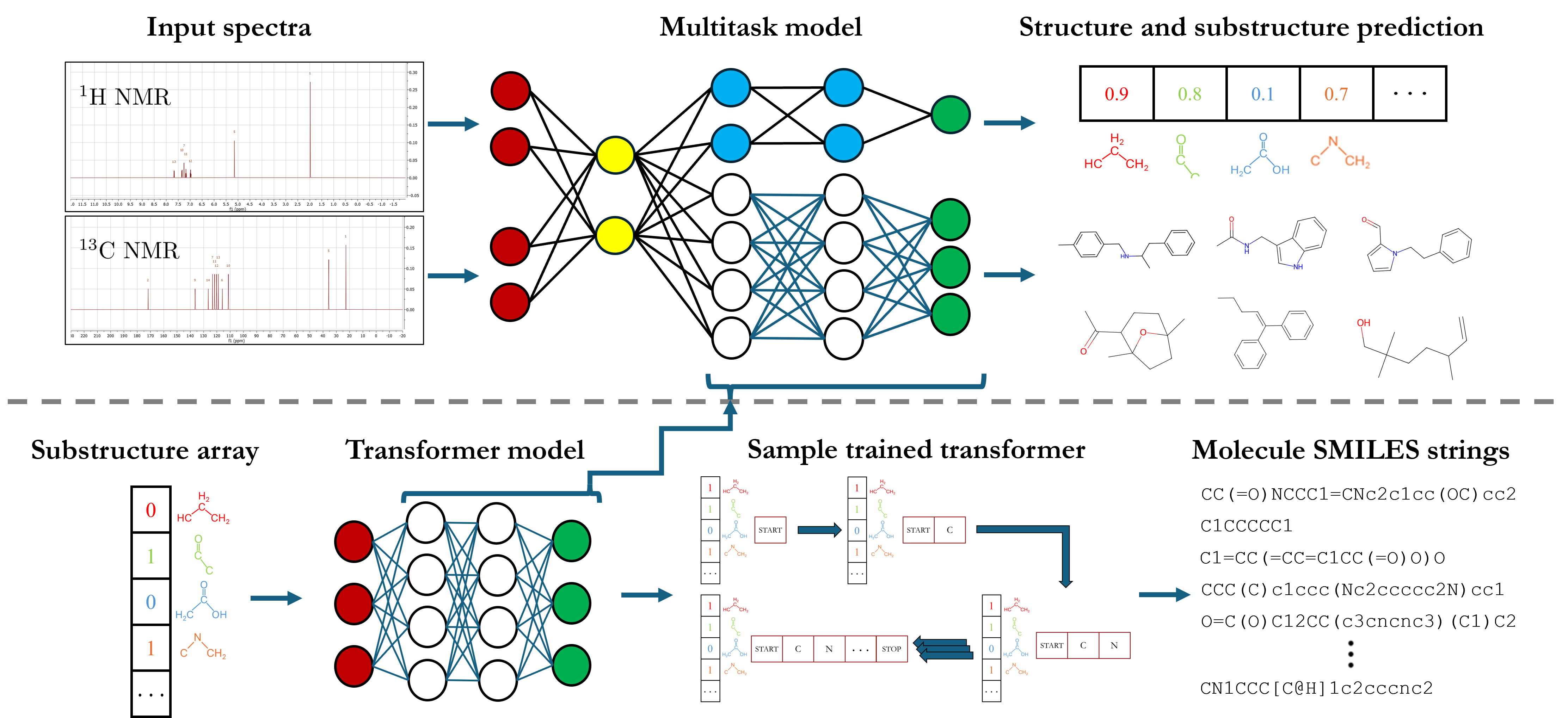
- A transformer model is pre-trained to reconstruct molecular structures from the presence or absence of 957 simple substructures (≤7 atoms), enabling efficient structure assembly.
- A convolutional neural network (CNN) encodes raw 1D 1H and 13C NMR spectra into a latent representation without extensive pre-processing.
- The pre-trained transformer and CNN are integrated into a multitask learning framework that jointly predicts molecular substructures and full molecular structures from spectra.
- The model is trained end-to-end on simulated NMR spectra of molecules with up to 19 heavy atoms, using only spectral data as input.
- The framework employs a beam search strategy to generate and rank candidate structures, with top predictions evaluated for accuracy.
- The model is evaluated on a benchmark of molecules with 10–19 heavy atoms, measuring top-1 and top-15 accuracy.
Experimental results
Research questions
- RQ1Can a multitask deep learning model accurately predict molecular structure from raw 1D NMR spectra without prior knowledge of molecular formula or fragments?
- RQ2How does the model’s performance scale with increasing molecular size, particularly as the number of possible structures grows combinatorially?
- RQ3Can a transformer-based architecture effectively reconstruct molecular connectivity from substructure presence/absence signals?
- RQ4To what extent does the integration of spectral encoding via CNN and structure generation via transformer improve prediction accuracy compared to prior methods?
- RQ5Can the model generalize across diverse molecular scaffolds and maintain high accuracy despite the complexity of spectral interpretation?
Key findings
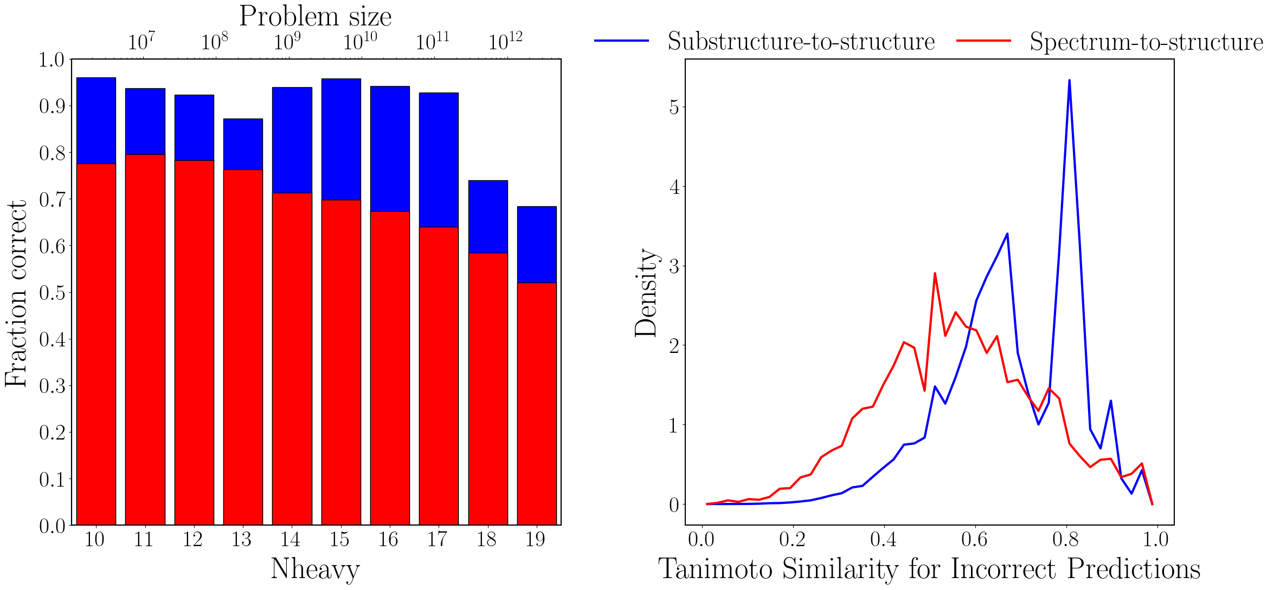
- The model achieves 69.6% top-15 accuracy in predicting the correct molecular structure for molecules with up to 19 heavy atoms using only raw 1H and 13C NMR spectra.
- The framework reduces the effective search space by up to 11 orders of magnitude, enabling efficient exploration of trillions of possible structures.
- The model maintains high performance across molecular sizes, with only a 25.5% drop in accuracy when the number of possible molecules increases by 5 orders of magnitude.
- The pre-trained transformer alone achieves 93.2% top-15 accuracy in structure reconstruction from substructure inputs, demonstrating its robustness for molecular assembly.
- Full structure prediction is completed in under 3 seconds on a standard CPU (AMD Ryzen 7 3700X), making the method highly accessible and practical for real-world use.
- The model is generalizable and can be extended to predict stereochemistry by incorporating stereocenter and double bond configuration data into the training data.
Better researchstarts right now
From reading papers to final review, dramatically reduce your research time.
No credit card · Free plan available
This review was created by AI and reviewed by human editors.