
[Paper Review] Active quantum flocks
This paper introduces active quantum flocks—nonequilibrium quantum many-body systems where hard-core bosons on a 1D lattice exhibit collective, coherent motion through a combination of directed dissipation and quantum spin-flip dynamics. The key finding is long-ranged quantum coherence and spontaneous polar symmetry breaking, indicating the emergence of quantum flocks with ballistic, coherent motion over large distances, realizable in Rydberg atom arrays.
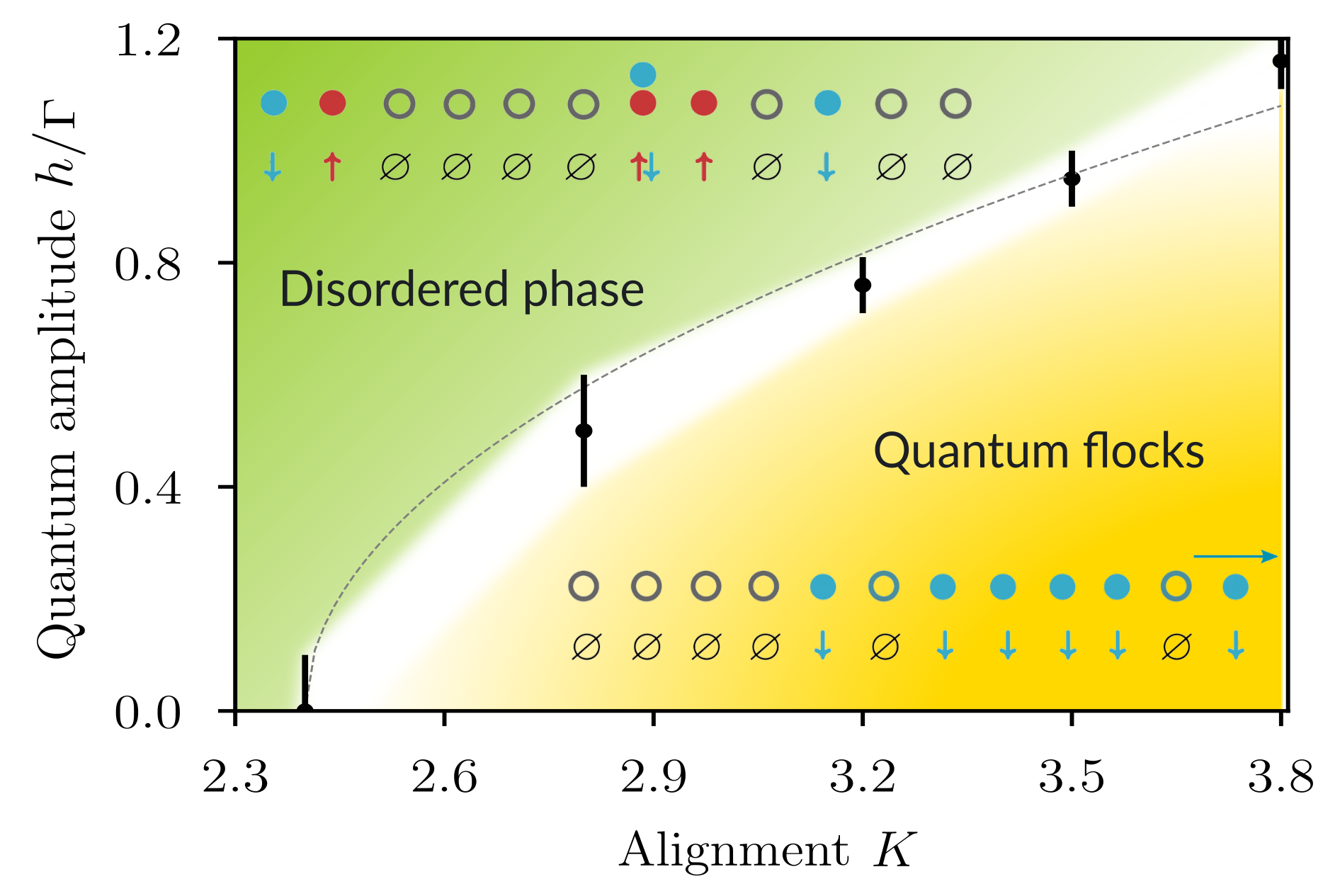
Flocks of animals represent a fascinating archetype of collective behavior in the macroscopic classical world, where the constituents, such as birds, concertedly perform motions and actions as if being one single entity. Here, we address the outstanding question of whether flocks can also form in the microscopic world at the quantum level. For that purpose, we introduce the concept of active quantum matter by formulating a class of models of active quantum particles on a one-dimensional lattice. We provide both analytical and large-scale numerical evidence that these systems can give rise to quantum flocks. A key finding is that these flocks, unlike classical ones, exhibit distinct quantum properties by developing strong quantum coherence over long distances. We propose that quantum flocks could be experimentally observed in Rydberg atom arrays. Our work paves the way towards realizing the intriguing collective behaviors of biological active particles in quantum matter systems. We expect that this opens up a path towards a yet totally unexplored class of nonequilibrium quantum many-body systems with unique properties.
Motivation & Objective
- To explore whether flocking behavior—typical of classical active matter like bird flocks—can emerge in quantum systems.
- To develop a theoretical framework for active quantum matter by defining dynamical processes for quantum particles on a lattice.
- To identify and characterize quantum flocking phases with distinct quantum coherence and symmetry breaking.
- To establish a bridge between classical active matter and quantum many-body physics, opening new avenues in nonequilibrium quantum systems.
Proposed method
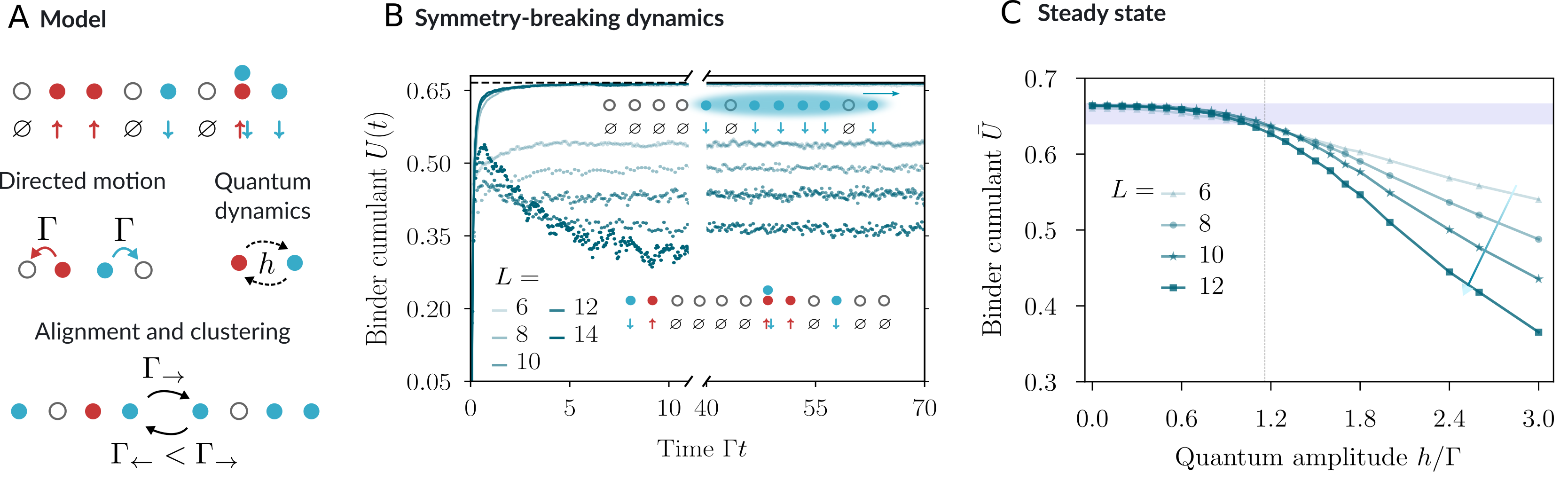
- Formulates a model of two-species hard-core bosons on a 1D lattice with directed dissipation (left-moving ↑, right-moving ↓) at rate Γ.
- Introduces a coherent spin-flip process with amplitude h to enable quantum dynamics and entanglement.
- Incorporates a conditional dissipative spin-flip process whose rate depends on local magnetization, enabling alignment and clustering.
- Uses the Lindblad master equation to describe open quantum dynamics and derives a coarse-grained hydrodynamic description in the thermodynamic limit.
- Applies numerical simulations with 1000 trajectories to compute the Binder cumulant U(t) and analyze symmetry breaking.
- Performs Gaussian fluctuation analysis on density and magnetization to derive stochastic partial differential equations for the coarse-grained dynamics.
Experimental results
Research questions
- RQ1Can collective, coherent motion analogous to classical flocks emerge in quantum many-body systems?
- RQ2What quantum features distinguish such quantum flocks from their classical counterparts?
- RQ3How does quantum coherence manifest in a nonequilibrium quantum system with active dynamics?
- RQ4What is the role of quantum coherence and symmetry breaking in stabilizing long-ranged order in active quantum matter?
Key findings
- For weak quantum amplitude h=0.2, the Binder cumulant U approaches 2/3 at large system sizes, indicating spontaneous polar symmetry breaking and long-range order characteristic of a quantum flocking phase.
- For strong h=3.0, the Binder cumulant tends toward zero with increasing system size, signaling a disordered phase without long-range order.
- The system exhibits stable traveling domain wall solutions in the coarse-grained dynamics, indicating persistent, coherent motion of particle clusters.
- Numerical simulations show that homogeneous initial states with weak noise evolve into traveling wave patterns, confirming the instability of uniform states and emergence of flocking.
- The coarse-grained hydrodynamic equations reveal that Gaussian fluctuations in density and magnetization contribute to the stability and dynamics of traveling domain walls.
- The model predicts that quantum flocks can be realized in Rydberg atom arrays, providing a feasible experimental platform for observation.
Better researchstarts right now
From reading papers to final review, dramatically reduce your research time.
No credit card · Free plan available
This review was created by AI and reviewed by human editors.