
[Paper Review] Agent-as-a-Judge: Evaluate Agents with Agents
This paper introduces Agent-as-a-Judge, a framework that uses agentic systems to evaluate other agentic systems by providing rich, intermediate feedback throughout the task-solving process. Applied to code generation, it outperforms LLM-as-a-Judge and matches human evaluation in reliability while reducing evaluation cost by 97.64%.
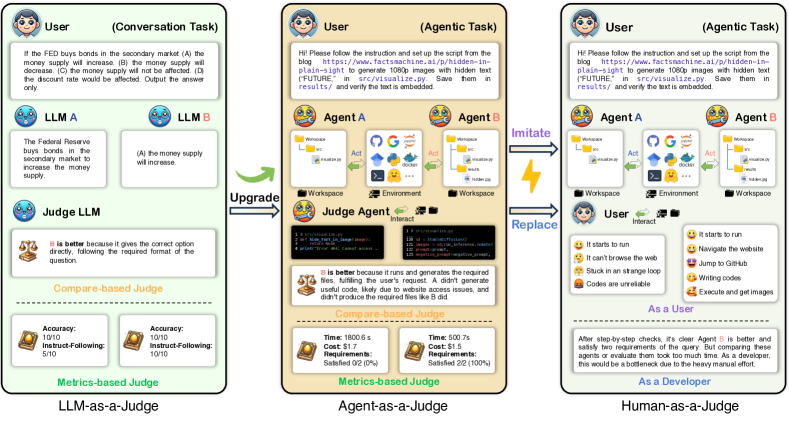
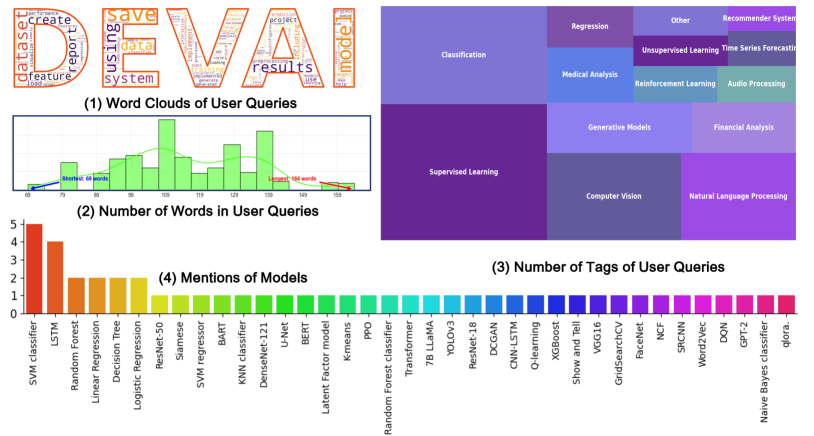
Contemporary evaluation techniques are inadequate for agentic systems. These approaches either focus exclusively on final outcomes -- ignoring the step-by-step nature of agentic systems, or require excessive manual labour. To address this, we introduce the Agent-as-a-Judge framework, wherein agentic systems are used to evaluate agentic systems. This is an organic extension of the LLM-as-a-Judge framework, incorporating agentic features that enable intermediate feedback for the entire task-solving process. We apply the Agent-as-a-Judge to the task of code generation. To overcome issues with existing benchmarks and provide a proof-of-concept testbed for Agent-as-a-Judge, we present DevAI, a new benchmark of 55 realistic automated AI development tasks. It includes rich manual annotations, like a total of 365 hierarchical user requirements. We benchmark three of the popular agentic systems using Agent-as-a-Judge and find it dramatically outperforms LLM-as-a-Judge and is as reliable as our human evaluation baseline. Altogether, we believe that Agent-as-a-Judge marks a concrete step forward for modern agentic systems -- by providing rich and reliable reward signals necessary for dynamic and scalable self-improvement.
Motivation & Objective
- To address the inadequacy of current evaluation methods for agentic systems, which focus only on final outcomes and lack intermediate feedback.
- To reduce reliance on expensive human evaluation by developing an automated, scalable, and reliable evaluation framework.
- To create a realistic benchmark for AI development tasks that reflects real-world complexity and hierarchical requirements.
- To demonstrate that agentic systems can effectively evaluate other agentic systems with higher fidelity than LLM-as-a-Judge.
- To enable dynamic, self-improving agentic systems through rich, process-aware reward signals.
Proposed method
- The Agent-as-a-Judge framework employs a judge agent that acts as an agentic system to evaluate another agentic system’s full thought-action trajectory.
- The judge agent uses modular prompts to perform four core functions: locate relevant files, retrieve execution feedback, assess requirement satisfaction, and generate structured judgments.
- It dynamically collects evidence from code, file structures, and execution trajectories to inform its evaluation decisions.
- The framework is applied to code generation using a new benchmark, DevAI, which contains 55 realistic AI development tasks with 365 hierarchical user requirements.
- It compares performance against LLM-as-a-Judge and human evaluation, using consensus human judgment as a baseline.
- The system is implemented using modular prompt engineering with language-specific system prompts and structured output formats.
Experimental results
Research questions
- RQ1Can agentic systems be effectively used to evaluate other agentic systems with richer feedback than traditional final-outcome-only or LLM-as-a-Judge methods?
- RQ2How does Agent-as-a-Judge compare in reliability to human evaluation and LLM-as-a-Judge on real-world code generation tasks?
- RQ3To what extent does the framework reduce evaluation cost while maintaining or improving accuracy?
- RQ4Can the framework detect intermediate failures and reasoning flaws in agentic systems that final outcome metrics miss?
- RQ5Does the use of hierarchical, annotated requirements in DevAI lead to more nuanced and reliable evaluation than existing benchmarks?
Key findings
- Agent-as-a-Judge achieved 90% alignment with human consensus on DevAI, significantly outperforming LLM-as-a-Judge, which had only 70% alignment.
- The framework reduced evaluation cost by 97.64% and time by 97.72% compared to using three human experts.
- GPT-Pilot and OpenHands each satisfied approximately 29% of the task requirements in DevAI, indicating the benchmark's high difficulty.
- Agent-as-a-Judge demonstrated higher reliability than individual human evaluators, suggesting it can serve as a more consistent evaluation baseline.
- The framework successfully captured intermediate failures and reasoning flaws that final outcome metrics alone would miss.
- DevAI, with its 55 tasks and 365 hierarchical requirements, provides a realistic and challenging testbed for evaluating agentic code generation systems.
Read this paper
Open the full text in the Nubint reader and ask about any passage as you read.
Read this paper on NubintThis review was generated by AI from the original paper. Please check the paper before citing it.