
[Paper Review] Agents: An Open-source Framework for Autonomous Language Agents
Agents is an open-source library that enables building, tuning, and deploying autonomous language agents with planning, memory, tool usage, multi-agent communication, and symbolic control.
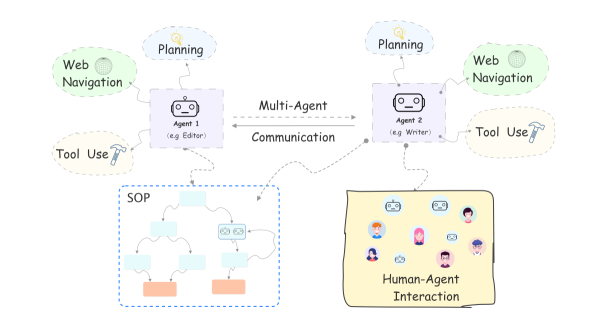
Recent advances on large language models (LLMs) enable researchers and developers to build autonomous language agents that can automatically solve various tasks and interact with environments, humans, and other agents using natural language interfaces. We consider language agents as a promising direction towards artificial general intelligence and release Agents, an open-source library with the goal of opening up these advances to a wider non-specialist audience. Agents is carefully engineered to support important features including planning, memory, tool usage, multi-agent communication, and fine-grained symbolic control. Agents is user-friendly as it enables non-specialists to build, customize, test, tune, and deploy state-of-the-art autonomous language agents without much coding. The library is also research-friendly as its modularized design makes it easily extensible for researchers. Agents is available at https://github.com/aiwaves-cn/agents.
Motivation & Objective
- Motivation to broaden access to autonomous language agents for non-specialists and researchers.
- Provide a modular, extensible framework that combines planning, memory, tools, and multi-agent communication.
- Facilitate easy customization, testing, tuning, and deployment of state-of-the-art agents.
- Offer symbolic control through Standard Operating Procedures (SOPs) to improve stability and tunability.
Proposed method
- Introduce core agent framework consisting of Agent, SOP, and Environment classes instantiated from config files.
- Implement long-short term memory with optional long-term memory stored in a VectorDB and semantic search.
- Support tool usage and web navigation via ToolComponents and OpenAI tool-calling for context-dependent tools.
- Enable multi-agent communication with dynamic scheduling controlled by a moderator/controller agent.
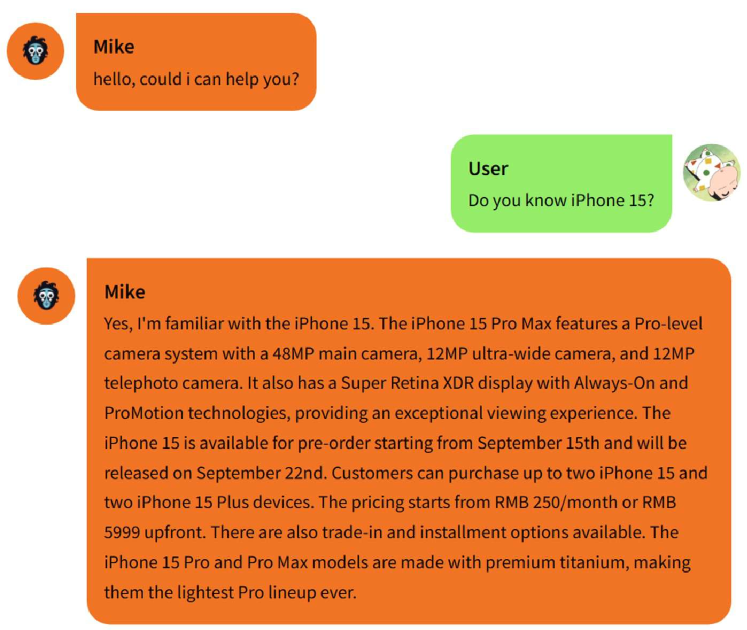
- Provide human-agent interaction by allowing is_human to switch agents to human-operated mode.
- Enable deployment as APIs (FastAPI) and introduce an Agent Hub for sharing fine-tuned agents.
- Automate SOP generation via a retrieval-augmented generation (RAG) pipeline for creating task-specific configurations.
Experimental results
Research questions
- RQ1How can the Agents framework unify planning, memory, tooling, and multi-agent communication in a usable open-source library?
- RQ2What features are essential to make language agents controllable, tunable, and deployable for non-specialists and researchers?
- RQ3Can symbolic plans (SOPs) provide fine-grained control that improves stability and reproducibility of agent behavior?
- RQ4What infrastructure (Agent Hub, API deployment) supports broad adoption and sharing of language agents?
Key findings
- Agents is designed for non-specialists to build, customize, test, tune, and deploy autonomous language agents through modular config-driven components.
- The framework uniquely combines long-short term memory, tool usage, multi-agent communication, human interaction, and symbolic control in a single library.
- It supports web navigation and external API/tool integration via ToolComponents with optional function-calling for context-aware tool use.
- A dynamic scheduling controller enables flexible, non-fixed sequencing of multi-agent actions.
- Agents can be deployed as APIs with FastAPI, and shared through an Agent Hub for easier reuse and collaboration.
- An automatic SOP generation pipeline reduces manual labor by generating config files and prompts from task descriptions.
Read this paper
Open the full text in the Nubint reader and ask about any passage as you read.
Read this paper on NubintThis review was generated by AI from the original paper. Please check the paper before citing it.